
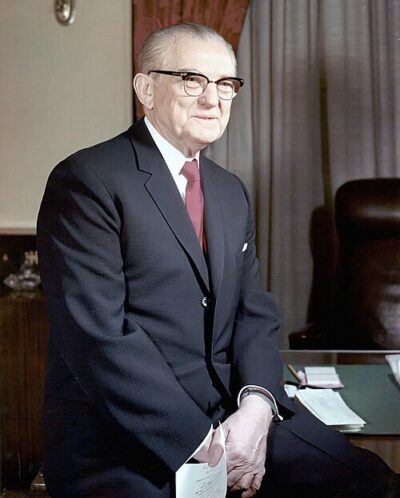
John C. Stennis
John C. Stennis was an American politician. Born August 3, 1901, in Kemper County. Died April 23, 1995, in Jackson. Positions held include member of the Mississippi House of Representatives (1928–1932), President pro tempore of the United States Senate (1987–1989) and district attorney (1932–1937). Educated at Mississippi State University and University of Virginia.
Facts
19 facts · 2 confirmed by two sources · 8 cited · 9 from one source
Where this comes from
Papalocal keeps its own record. It started from these sources; what each one said is kept here as it was copied, so a change on their side never changes this page by itself. Tap one to read its version.
What Wikidata says · copied November 16, 2026 · revision 2566908700
- Described as
- American politician (1901-1995)
- Other names
- John Cornelius Stennis
- Born
- August 3, 1901 · 3 references
- Died
- April 23, 1995 · 3 references
- Born in
- Kemper County
- Died in
- Jackson · 1 reference
- Buried in
- Mississippi
- Citizen of
- United States
- Occupation
- politician · 1 reference; lawyer (1928–) · 1 reference
- Positions held
- member of the Mississippi House of Representatives (1928–1932) · 1 reference; President pro tempore of the United States Senate (1987–1989) · 1 reference; district attorney (1932–1937) · 1 reference; judge (1937–1947) · 1 reference; United States senator (1947–1989) · 1 reference
- Political party
- Democratic Party
- Education
- Mississippi State University (–1923); University of Virginia (–1928)
- Member of
- Phi Beta Kappa Society
- Children
- John Hampton Stennis
- Religion
- Presbyterianism
- Wikipedias with a page
- 23
Wikidata item Q1699509 (wikidata.org/wiki/Q1699509), public domain (CC0). Copied November 16, 2026.
What Wikipedia says · copied November 16, 2026 · revision 1385611137
John Cornelius Stennis (August 3, 1901 – April 23, 1995) was an American politician who served as a U.S. senator from the state of Mississippi. He was a Democrat who served in the Senate for over 41 years, becoming its most senior member for his last eight years. He retired from the Senate in 1989, and was the last Democrat elected to the U.S. Senate from Mississippi until Scott Colom was elected in 2026. At the time of his retirement, Stennis was the last senator to have served during the presidency of Harry S. Truman.
While attending law school, Stennis won a seat in the Mississippi House of Representatives, holding office from 1928 to 1932. In 1934, Stennis was the trial prosecutor in a case where three African-Americans were convicted of murder after having been violently forced by police to confess. The convictions were later overturned in 1936 by the Supreme Court which ruled that forced confessions could not be used as evidence. After serving as a prosecutor and state judge, Stennis won a special election in 1947 to fill the U.S. Senate vacancy following the death of Theodore G. Bilbo. He won election to a full term in 1952 and remained in the Senate until he declined to seek re-election in 1988.
Stennis became the first Chairman of the Senate Ethics Committee and also chaired the Committee on Armed Services and the Committee on Appropriations. He also served as President pro tempore of the Senate from 1987 to 1989. In 1973, President Richard Nixon proposed the Stennis Compromise, whereby the hard-of-hearing Stennis would be allowed to listen to, and summarize, the Watergate tapes, but this idea was rejected by Special Prosecutor Archibald Cox.
Along with fellow Mississippi senator James Eastland, Stennis was a zealous supporter of racial segregation, with Stennis called "one of twentieth century America's most admired white supremacists." He and Eastland supported the Dixiecrat ticket in 1948 headed by Strom Thurmond, and signed the Southern Manifesto, which called for massive resistance to the Supreme Court ruling in Brown v. Board of Education. He also voted against the Civil Rights Act of 1964, the Voting Rights Act of 1965, and the Civil Rights Act of 1968.
He renounced support for segregation in the early 1980s and supported the extension of the Voting Rights Act in 1982, but he voted against the establishment of Martin Luther King Jr. Day as a national holiday, instead favoring a "commemorative day" because, he claimed, he opposed additional federal holidays.
- Born, in its opening lines
- August 3, 1901
- Died, in its opening lines
- April 23, 1995
From the Wikipedia article “John C. Stennis” (en.wikipedia.org/wiki/John_C._Stennis), by its contributors, under CC BY-SA 4.0 (creativecommons.org/licenses/by-sa/4.0/). Copied November 16, 2026; not changed.
Confirmed Two sources agree. Cited One source, and it names where it got it. One source One source, without a reference of its own. Sources disagree The sources disagree. We show the best-supported value and keep theirs below.
