
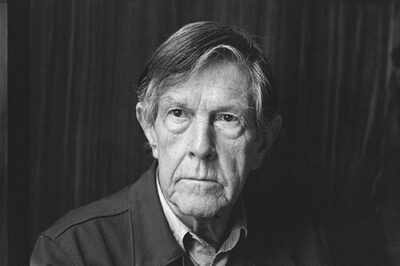
John Cage
John Cage was an American avant-garde composer. Born September 5, 1912, in Good Samaritan Hospital. Died August 12, 1992, in New York City. Known for The Perilous Night, Two² and In the Name of the Holocaust. Educated at University of California, Los Angeles and Los Angeles High School. Awards include Guggenheim Fellowship, Kyoto Prize in Arts and Philosophy and Fellow of the American Academy of Arts and Sciences.
Facts
54 facts · 2 confirmed by two sources · 22 cited · 30 from one source
What’s different
- Born: we show September 5, 1912 (Confirmed). Wikidata also lists October 5, 1912
Where this comes from
Papalocal keeps its own record. It started from these sources; what each one said is kept here as it was copied, so a change on their side never changes this page by itself. Tap one to read its version.
What Wikidata says · copied November 13, 2026 · revision 2565133245
- Described as
- American avant-garde composer (1912-1992)
- Other names
- John Milton Cage, Jr., John Milton Cage Jr., J. C., John Milton, Jr. Cage
- Born
- September 5, 1912 · 18 references; October 5, 1912 · 1 reference
- Died
- August 12, 1992 · 9 references
- Born in
- Good Samaritan Hospital · 2 references
- Died in
- New York City · 2 references
- Cause of death
- stroke · 1 reference
- Citizen of
- United States · 1 reference
- Occupation
- composer · 3 references; writer · 1 reference; poet; university teacher; musicologist; philosopher · 1 reference; painter · 3 references; music theorist
- Worked for
- Wesleyan University; Black Mountain College · 1 reference
- Education
- University of California, Los Angeles; Los Angeles High School (–1928) · 2 references
- Member of
- American Academy of Arts and Sciences (1978–) · 1 reference; American Academy of Arts and Letters (1968–) · 1 reference; The 8th Street Club; New York Mycological Society; North American Mycological Association · 1 reference; International Society for Contemporary Music · 1 reference
- Genre
- aleatoric music; opera; classical music; electronic music; experimental music; musique concrète
- Instrument
- piano
- Record label
- ECM Records
- Known for
- The Perilous Night; Two²; In the Name of the Holocaust; Bacchanale; 4′33″; Sonatas and Interludes; ORGAN²/ASLSP
- Awards
- Guggenheim Fellowship (1949) · 1 reference; Kyoto Prize in Arts and Philosophy (1989) · 1 reference; Fellow of the American Academy of Arts and Sciences; Arts and Letters Award in Music (1949) · 1 reference; Honorary Member of the International Society for Contemporary Music
- Field
- music composition · 1 reference; experimental music · 1 reference; creative and professional writing · 1 reference; philosophy · 1 reference; audiovisual work · 1 reference; mycology
- Spouse
- Xenia Cage (1935–1945) · 1 reference
- Mother
- Crete Cage · 1 reference
- Religion
- Zen
- Website
- https://johncage.org
- Wikipedias with a page
- 76
Wikidata item Q180727 (wikidata.org/wiki/Q180727), public domain (CC0). Copied November 13, 2026.
What Wikipedia says · copied November 13, 2026 · revision 1383242461
John Milton Cage Jr. (September 5, 1912 – August 12, 1992) was an American composer, visual artist and music theorist. A pioneer of indeterminacy in music, electroacoustic music, and non-standard use of musical instruments, Cage was one of the leading figures of the post-war avant-garde. Critics have lauded him as one of the most influential composers of the 20th century. He was also instrumental in the development of modern dance, mostly through his association with choreographer Merce Cunningham, who was also Cage's romantic partner for most of their lives.
Cage's teachers included Henry Cowell (1933) and Arnold Schoenberg (1933–35), both known for their radical innovations in music, but Cage's major influences lay in various East and South Asian cultures. Through his studies of Indian philosophy and Zen Buddhism in the late 1940s, Cage came to the idea of aleatoric or chance-controlled music, which he started composing in 1951. The I Ching, an ancient Chinese classic text and decision-making tool, became Cage's standard composition tool for the rest of his life. In a 1957 lecture, "Experimental Music", he described music as "a purposeless play" which is "an affirmation of life – not an attempt to bring order out of chaos nor to suggest improvements in creation, but simply a way of waking up to the very life we're living".
Cage's best known work is the 1952 composition 4′33″, a piece performed in the absence of deliberate sound; musicians who perform the work do nothing but be present for the duration specified by the title. The content of the composition is intended to be the sounds of the environment heard by the audience during performance. The work's challenge to assumed definitions about musicianship and musical experience made it a popular and controversial topic both in musicology and the broader aesthetics of art and performance. Cage was also a pioneer of the prepared piano (a piano with its sound altered by objects placed between or on its strings or hammers), for which he wrote numerous dance-related works and a few concert pieces. These include Sonatas and Interludes (1946–48).
- Born, in its opening lines
- September 5, 1912
- Died, in its opening lines
- August 12, 1992
From the Wikipedia article “John Cage” (en.wikipedia.org/wiki/John_Cage), by its contributors, under CC BY-SA 4.0 (creativecommons.org/licenses/by-sa/4.0/). Copied November 13, 2026; not changed.
Confirmed Two sources agree. Cited One source, and it names where it got it. One source One source, without a reference of its own. Sources disagree The sources disagree. We show the best-supported value and keep theirs below.
