
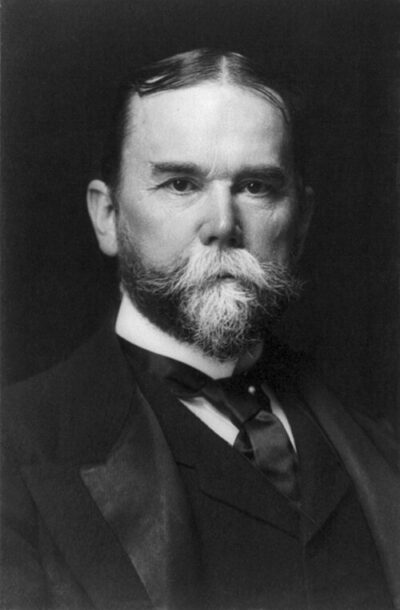
John Hay
John Hay was an American statesman. Born October 8, 1838, in Salem. Died July 1, 1905, in Newbury. Positions held include United States Secretary of State (1898–1905) and United States Ambassador to the United Kingdom. Educated at Brown University and Carthage College.
Facts
33 facts · 2 confirmed by two sources · 11 cited · 20 from one source
Where this comes from
Papalocal keeps its own record. It started from these sources; what each one said is kept here as it was copied, so a change on their side never changes this page by itself. Tap one to read its version.
What Wikidata says · copied November 15, 2026 · revision 2568852180
- Described as
- American statesman (1838–1905)
- Other names
- John Milton Hay
- Born
- October 8, 1838 · 10 references
- Died
- July 1, 1905 · 9 references
- Born in
- Salem · 1 reference
- Died in
- Newbury · 1 reference
- Buried in
- Lake View Cemetery
- Name at birth
- John Milton Hay
- Citizen of
- United States
- Occupation
- writer · 3 references; diplomat; journalist; biographer; politician; secretary; historian · 1 reference; jurist · 1 reference
- Positions held
- United States Secretary of State (1898–1905); United States Ambassador to the United Kingdom
- Political party
- Republican Party
- Education
- Brown University; Carthage College
- Member of
- American Academy of Arts and Letters
- Field
- government office · 1 reference; government · 1 reference; diplomacy · 1 reference; American literature · 1 reference; American poetry · 1 reference
- Spouse
- Clara Louise Hay
- Children
- Alice Wadsworth · 1 reference; Helen Hay Whitney; Adelbert S. Hay; Clarence Leonard Hay
- Mother
- Helen Hay · 1 reference
- Religion
- Congregational churches
- Wikipedias with a page
- 38
Wikidata item Q117101 (wikidata.org/wiki/Q117101), public domain (CC0). Copied November 15, 2026.
What Wikipedia says · copied November 15, 2026 · revision 1384593624
John Milton Hay (October 8, 1838 – July 1, 1905) was an American statesman and official whose career in government lasted almost half a century. Beginning as a private secretary for Abraham Lincoln, he became a diplomat. He served as United States Secretary of State under Presidents William McKinley and Theodore Roosevelt. Hay was also a biographer of Lincoln, and wrote poetry and other literature.
Born in Salem, Indiana, to an anti-slavery family that moved to Warsaw, Illinois, Hay showed great potential from an early age, and his family sent him to Brown University. After graduation in 1858, Hay read law in his uncle's office in Springfield, Illinois, adjacent to that of Lincoln. Hay worked for Lincoln's successful presidential campaign and became one of his private secretaries in the White House. Throughout the American Civil War, Hay was close to Lincoln and stood by his deathbed after the President was shot. In addition to his other literary works, Hay co-authored, with John George Nicolay, Lincoln's other private secretary, a ten-volume biography of Lincoln that helped shape the assassinated president's historical image.
After Lincoln's death, Hay spent several years at diplomatic posts in Europe, then worked for the New-York Tribune under Horace Greeley and Whitelaw Reid. Hay remained active in politics, and from 1879 to 1881 served as Assistant Secretary of State. Afterward, he returned to the private sector, remaining there until President McKinley, of whom he had been a major backer, made him the Ambassador to the United Kingdom in 1897. Hay became the Secretary of State the following year.
Hay served for nearly seven years as Secretary of State under President McKinley and, after McKinley's assassination, under Theodore Roosevelt. Hay was responsible for negotiating the Open Door Policy, which kept China open to trade with all countries on an equal basis, with international powers. By negotiating the Hay–Pauncefote Treaty with the United Kingdom, the (ultimately unratified) Hay–Herrán Treaty with Colombia, and finally the Hay–Bunau-Varilla Treaty with the newly independent Republic of Panama, Hay also cleared the way for the building of the Panama Canal.
- Born, in its opening lines
- October 8, 1838
- Died, in its opening lines
- July 1, 1905
From the Wikipedia article “John Hay” (en.wikipedia.org/wiki/John_Hay), by its contributors, under CC BY-SA 4.0 (creativecommons.org/licenses/by-sa/4.0/). Copied November 15, 2026; not changed.
Confirmed Two sources agree. Cited One source, and it names where it got it. One source One source, without a reference of its own. Sources disagree The sources disagree. We show the best-supported value and keep theirs below.
