
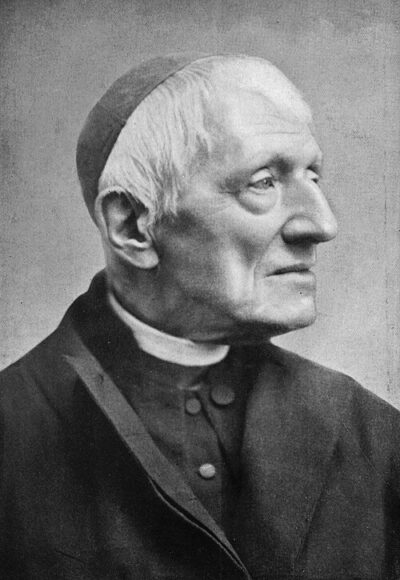
John Henry Newman
John Henry Newman was an English cleric and cardinal. Born February 21, 1801, in London. Died August 11, 1890, in Edgbaston. Positions held include cardinal-deacon (1879–1890) and cardinal. Educated at Trinity College and Great Ealing School.
Facts
28 facts · 2 confirmed by two sources · 9 cited · 17 from one source
Where this comes from
Papalocal keeps its own record. It started from these sources; what each one said is kept here as it was copied, so a change on their side never changes this page by itself. Tap one to read its version.
What Wikidata says · copied November 16, 2026 · revision 2569134622
- Described as
- English cleric and cardinal (1801–1890)
- Other names
- Catholicus, Blessed John Henry Newman, Cardinal Newman, John Henry, Cardinal Newman, Saint John Newman, Cardinal John Henry Newman, John H. Newman
- Born
- February 21, 1801 · 17 references
- Died
- August 11, 1890 · 16 references
- Born in
- London · 2 references
- Died in
- Edgbaston · 1 reference
- Buried in
- West Midlands
- Cause of death
- pneumonia
- Name at birth
- John Henry Newman
- Citizen of
- United Kingdom of Great Britain and Ireland
- Occupation
- theologian · 2 references; poet; Anglican priest; Catholic priest (1847–) · 1 reference; novelist; university teacher; hymnwriter; philosopher · 1 reference
- Positions held
- cardinal-deacon (1879–1890) · 2 references; cardinal · 2 references
- Worked for
- University of Oxford
- Education
- Trinity College; Great Ealing School
- Member of
- Guild of Our Lady of Ransom
- Mother
- Jemima Fourdrinier
- Siblings
- Francis William Newman · 1 reference; Harriet Mozley · 1 reference
- Religion
- Catholic Church (1845–) · 1 reference; Anglicanism (1801–1845)
- Lived in
- Edgbaston (1854–1890)
- Wikipedias with a page
- 69
Wikidata item Q44490 (wikidata.org/wiki/Q44490), public domain (CC0). Copied November 16, 2026.
What Wikipedia says · copied November 16, 2026 · revision 1384275565
John Henry Newman (21 February 1801 – 11 August 1890) was an English Catholic theologian, academic, philosopher, historian, writer, and poet. He was an important figure in the religious history of England in the 19th century.
Originally an evangelical academic at the University of Oxford and clergyman in the Church of England, Newman was drawn to the high church tradition of Anglicanism. He became one of the more notable leaders of the Oxford Movement, an influential group of Anglicans who wished to restore to the Church of England many Catholic beliefs and liturgical rituals practiced before the English Reformation. In this, the movement had some success. After publishing his Tract 90 in 1841, Newman later wrote: "I was on my death-bed, as regards my membership with the Anglican Church."
In 1845, Newman resigned his teaching post at Oxford, left the Church of England and was received into the Catholic Church. He was quickly ordained as a priest and continued as an influential religious leader, based in Birmingham. In 1879, he was created a cardinal by Pope Leo XIII in recognition of his services to the cause of the Catholic Church in England. He was instrumental in the founding of the Catholic University of Ireland in 1854, which later became University College Dublin.
Newman was also a prominent writer: his major writings include the Tracts for the Times (1833–1841), his Essay on the Development of Christian Doctrine (1845), his autobiography Apologia Pro Vita Sua (1864), and the Grammar of Assent (1870). In particular, his theory on the development of doctrine has been highly influential on subsequent Catholic theology.
Newman's canonization was approved by Pope Francis and took place on 13 October 2019. He was proclaimed a Doctor of the Church by Pope Leo XIV in 2025 and was also named co-patron of Catholic education, joining Saint Thomas Aquinas.
- Born, in its opening lines
- February 21, 1801
- Died, in its opening lines
- August 11, 1890
From the Wikipedia article “John Henry Newman” (en.wikipedia.org/wiki/John_Henry_Newman), by its contributors, under CC BY-SA 4.0 (creativecommons.org/licenses/by-sa/4.0/). Copied November 16, 2026; not changed.
Confirmed Two sources agree. Cited One source, and it names where it got it. One source One source, without a reference of its own. Sources disagree The sources disagree. We show the best-supported value and keep theirs below.
