
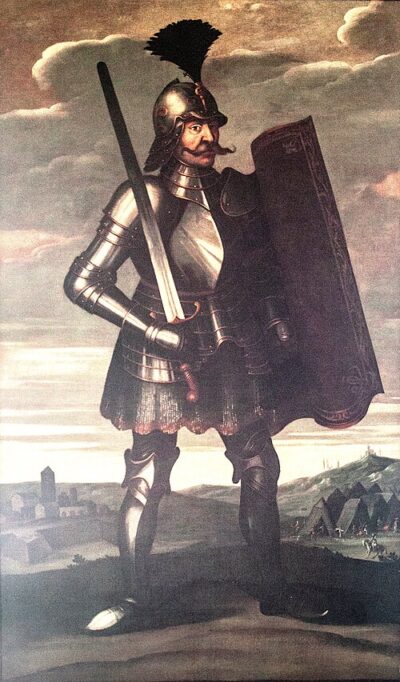
John Hunyadi
John Hunyadi was a Regent-Governor of the Kingdom of Hungary, 1446–1453. Born 1407. Died August 11, 1456, in Zemun. Positions held include Voivode of Transylvania (1441–1446), Regent of Hungary (1446–1453) and ban of Severin (1439–1446). Awards include Golden Chain.
Facts
24 facts · 1 confirmed by two sources · 6 cited · 16 from one source · 1 where the sources disagree
What’s different
- Born: we show 1407 (Sources disagree). Wikipedia says c. 1406
Where this comes from
Papalocal keeps its own record. It started from these sources; what each one said is kept here as it was copied, so a change on their side never changes this page by itself. Tap one to read its version.
What Wikidata says · copied November 16, 2026 · revision 2562349999
- Described as
- Regent-Governor of the Kingdom of Hungary, 1446–1453
- Born
- 1407 · 3 references
- Died
- August 11, 1456 · 2 references
- Died in
- Zemun
- Buried in
- St. Michael's Cathedral
- Cause of death
- plague
- Citizen of
- Hungary
- Occupation
- condottiero; politician
- Positions held
- Voivode of Transylvania (1441–1446) · 1 reference; Regent of Hungary (1446–1453); ban of Severin (1439–1446) · 1 reference; ispán (1441–1456) · 1 reference
- Political party
- politician before the emergence of political parties
- Awards
- Golden Chain (1448) · 1 reference
- Spouse
- Erzsébet Szilágyi (1432–)
- Children
- Matthias Corvinus; Ladislaus Hunyadi; NN · 1 reference
- Father
- Voyk Hunyadi · 1 reference
- Mother
- Elizabeth Morzsinay de Marsina
- Siblings
- N. Hunyadi; John Hunyadi, Ban of Severin
- Religion
- Catholicism
- Military rank
- captain general · 1 reference
- Wikipedias with a page
- 47
Wikidata item Q242688 (wikidata.org/wiki/Q242688), public domain (CC0). Copied November 16, 2026.
What Wikipedia says · copied November 16, 2026 · revision 1385900319
John Hunyadi (Hungarian: Hunyadi János; Romanian: Ioan de Hunedoara; Croatian: Janko Hunjadi; Serbian: Сибињанин Јанко, romanized: Sibinjanin Janko; Ottoman Turkish: حونیادی یانوش, romanized: Hünyadi Yanoş; c. 1406 – 11 August 1456) was a leading Hungarian military and political figure during the 15th century, who served as regent of the Kingdom of Hungary from 1446 to 1453, under the minor Ladislaus V.
According to most contemporary sources, he was the member of a noble family of Wallachian ancestry. Through his struggles against the Ottoman Empire, he earned for himself the nickname "Turk-buster" from his contemporaries. Due to his merits, he quickly received substantial land grants. By the time of his death, he was the owner of immense land areas, totaling approximately four million cadastral acres, which had no precedent before or after in the Kingdom of Hungary. His enormous wealth and his military and political weight were primarily directed towards the purposes of the Ottoman wars.
Hunyadi mastered his military skills on the southern borderlands of the Kingdom of Hungary that were exposed to Ottoman attacks. Appointed Ban of Szörény in 1439, appointed Voivode of Transylvania, Counts of the Székelys, Ispán of Temes County and Captain of Nándorfehérvár (now Belgrade) in 1441, he assumed responsibility for the defense of the frontiers. John Hunyadi immediately advocated for an offensive, anti-Ottoman strategy. He began preparing for an offensive war aimed at gradually shifting military operations into Ottoman territory. His plans signalled a revival of the crusading ideal, as Ottoman expansion had become increasingly intolerable. As Hunyadi wrote to the Pope, his principal goal was, if possible with international assistance, to defeat the Ottomans in a decisive battle, continue the war on Ottoman territory until its final conclusion, and expel the Ottomans from Europe. Well-equipped heavy cavalry and the use of Hussite wagon fort played a crucial role in his victories. He employed professional soldiers, but also mobilized local peasantry against invaders. These innovations contributed to his earliest successes against the Ottoman troops who were plundering the southern marches in the early 1440s.
In 1442, Hunyadi won four victories against the Ottomans, two of which were decisive. In March 1442, Hunyadi defeated Mezid Bey and the raiding Ottoman army at the Battle of the Iron Gate in the south part of the Kingdom of Hungary in Transylvania. In September 1442 at the Battle of the Ialomița, Hunyadi defeated a large Ottoman army of Beylerbey Şehabeddin, the Provincial Governor of Rumelia. This was the first time a European army had defeated such a large Ottoman force, composed not only of raiders but also of provincial cavalry led by their own sanjak beys (governors) and accompanied by the elite, formidable janissaries. These victories brought Hunyadi international fame and undermined the growing belief in Ottoman invincibility, the name of Hunyadi became famous and generally respected in the Christian world and became feared by the entire Ottoman Empire. Hunyadi's victories were a primary motivation for the successful Hungarian anti-Ottoman crusade of the winter of 1443–1444, known as the Long Campaign. Although his crusades ended in defeat at the Battle of Varna in 1444 and at the Second Battle of Kosovo in 1448, Hunyadi established his reputation as a great general through his successful defence during the Siege of Belgrade in 1456 against an Ottoman army led personally by Sultan Mehmed the Conqueror. This victory boosted the morale of European Christian forces and halted Ottoman expansion towards Europe beyond the Balkans for 70 years. The pope ordered that European churches ring their bells at noon to gather the faithful in prayer for those who were fighting. The bells of Christian churches are rung at noon to commemorate the Belgrade victory.
John Hunyadi was also an eminent statesman. He actively took part in the civil war between the partisans of Vladislaus I and the minor Ladislaus V, two claimants to the throne of Hungary in the early 1440s, on behalf of the former. He was popular among the lesser nobility, and in 1445 the Diet of Hungary appointed him as Captains in Chief responsible for the administration of state affairs until Ladislaus V (by that time unanimously accepted as king) came of age. The next Diet went even further, electing Hunyadi as sole regent with the title of Governor. When he resigned from this office in 1452, the sovereign awarded him with the first hereditary title in the Kingdom of Hungary, (perpetual count of Beszterce). He had by this time become one of the wealthiest landowners in the kingdom, and preserved his influence in the Diet up until his death.
This Athleta Christi (Christ's Champion), as Pope Pius II referred to him, died some three weeks after his triumph at Belgrade, falling to an epidemic that had broken out in the crusader camp. However, his victories over the Turks prevented them from invading the Kingdom of Hungary for more than 60 years. His fame was a decisive factor in the election of his son, Matthias Corvinus, as king by the Diet of 1457. Hunyadi is a popular historical figure among Hungarians, Romanians, Serbs, Bulgarians, Croats, and other nations of the region.
- Born, in its opening lines
- c. 1406
- Died, in its opening lines
- August 11, 1456
From the Wikipedia article “John Hunyadi” (en.wikipedia.org/wiki/John_Hunyadi), by its contributors, under CC BY-SA 4.0 (creativecommons.org/licenses/by-sa/4.0/). Copied November 16, 2026; not changed.
Confirmed Two sources agree. Cited One source, and it names where it got it. One source One source, without a reference of its own. Sources disagree The sources disagree. We show the best-supported value and keep theirs below.
