
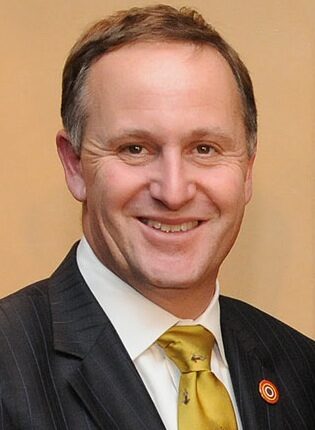
John Key
John Key is a Prime Minister of New Zealand from 2008 to 2016. Born August 9, 1961, in Auckland. Positions held include Prime Minister of New Zealand (2008–2016) and Member of the New Zealand Parliament (2016). Educated at Harvard University and Burnside High School. Awards include Knight Grand Companion of the New Zealand Order of Merit, Honorary Companion of the Order of Australia and honorary doctor of the University of Canterbury.
Facts
22 facts · 1 confirmed by two sources · 7 cited · 14 from one source
Where this comes from
Papalocal keeps its own record. It started from these sources; what each one said is kept here as it was copied, so a change on their side never changes this page by itself. Tap one to read its version.
What Wikidata says · copied November 16, 2026 · revision 2562793074
- Described as
- Prime Minister of New Zealand from 2008 to 2016
- Other names
- Sir John Philip Key, John Philip Key, John P. Key, John Phillip Key, Sir John Phillip Key, Sir John Key
- Born
- August 9, 1961 · 3 references
- Born in
- Auckland · 2 references
- Citizen of
- New Zealand
- Occupation
- politician · 1 reference; economist
- Positions held
- Prime Minister of New Zealand (2008–2016); Member of the New Zealand Parliament (2016) · 1 reference
- Political party
- New Zealand National Party
- Worked for
- Government of New Zealand
- Education
- Harvard University; Burnside High School (1975–1979); Aorangi School; University of Canterbury (–1981); Wairarapa Cobham Intermediate
- Member of
- 51st New Zealand Parliament
- Awards
- Knight Grand Companion of the New Zealand Order of Merit (2017) · 1 reference; Honorary Companion of the Order of Australia (2017) · 1 reference; honorary doctor of the University of Canterbury (2017) · 1 reference
- Field
- politics
- Spouse
- Bronagh Key
- Children
- Max Key · 1 reference
- Website
- http://www.johnkey.co.nz/
- Wikipedias with a page
- 74
Wikidata item Q57783 (wikidata.org/wiki/Q57783), public domain (CC0). Copied November 16, 2026.
What Wikipedia says · copied November 16, 2026 · revision 1385796012
Sir John Phillip Key (born 9 August 1961) is a New Zealand retired politician who served as the 38th prime minister of New Zealand from 2008 to 2016 and as leader of the National Party from 2006 to 2016.
Following his father's death when he was eight, Key was raised by his single mother in a state-house in the Christchurch suburb of Bryndwr. He attended the University of Canterbury and graduated in 1981 with a Bachelor of Commerce. He began a career in the foreign exchange market in New Zealand before moving overseas to work for Merrill Lynch, in which he became head of global foreign exchange in 1995, a position he would hold for six years. In 1999 he was appointed a member of the Foreign Exchange Committee of the Federal Reserve Bank of New York until leaving in 2001.
Key entered the New Zealand Parliament representing the Auckland electorate of Helensville as one of the few new National members of parliament in the election of 2002 following National's significant defeat of that year. In 2004, he was appointed Finance Spokesman for National and eventually succeeded Don Brash as the National Party leader in 2006. After two years as leader of the Opposition, Key led his party to victory at the November 2008 general election. He was subsequently sworn in as prime minister on 19 November 2008. The National government went on to win two more general elections under his leadership: in November 2011 and September 2014. Key was expected to contest for a fourth term of office at the 2017 general election, but on 5 December 2016 he resigned as prime minister and leader of the National Party. He was succeeded by Bill English on 12 December 2016. After resigning from both posts in December 2016 and leaving politics, Key was appointed to the board of directors and role of chairman in several New Zealand corporations.
As prime minister, Key led the Fifth National Government of New Zealand which entered government at the beginning of the late-2000s recession in 2008. He was described as supporting both socially liberal and economically liberal policies. Key was worth an estimated US$35 million in 2016, making him the wealthiest individual ever to assume the premiership. In his first term, Key's government implemented a GST rise and personal tax cuts, while enacting several austerity measures. In February 2011, after a major earthquake in Christchurch, the nation's second largest city, significantly affected the national economy, the government formed the Canterbury Earthquake Recovery Authority. In its second term, Key's government implemented a policy of partial privatisation of five state-owned enterprises, while voters in a citizens-initiated referendum on the issue were 2 to 1 opposed to the policy. He also faced a severe housing crisis, especially in Auckland, and was widely criticised for a perceived lack of action. In foreign policy, Key withdrew New Zealand Defence Force personnel from their deployment in the war in Afghanistan, signed the Wellington Declaration with the United States and pushed for more nations to join the Trans-Pacific Partnership.
- Born, in its opening lines
- August 9, 1961
From the Wikipedia article “John Key” (en.wikipedia.org/wiki/John_Key), by its contributors, under CC BY-SA 4.0 (creativecommons.org/licenses/by-sa/4.0/). Copied November 16, 2026; not changed.
Confirmed Two sources agree. Cited One source, and it names where it got it. One source One source, without a reference of its own. Sources disagree The sources disagree. We show the best-supported value and keep theirs below.
