
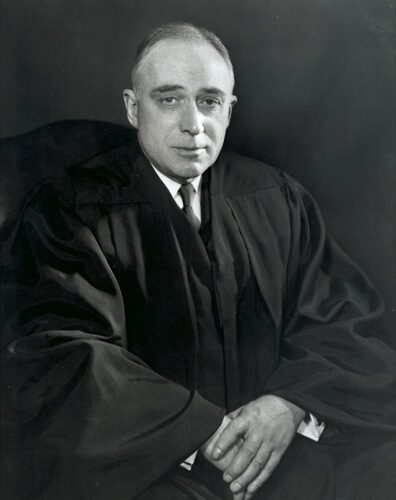
John Marshall Harlan II
John Marshall Harlan II was an US Supreme Court justice from 1955 to 1971. Born May 20, 1899, in Chicago. Died December 29, 1971, in Washington, D.C.. Positions held include Associate Justice of the Supreme Court of the United States (1955–1971) and Judge of the United States Court of Appeals for the Second Circuit. Educated at Balliol College and Princeton University. Awards include Legionnaire of Legion of Merit, Fellow of the American Academy of Arts and Sciences and Rhodes Scholarship.
Facts
25 facts · 2 confirmed by two sources · 3 cited · 20 from one source
Where this comes from
Papalocal keeps its own record. It started from these sources; what each one said is kept here as it was copied, so a change on their side never changes this page by itself. Tap one to read its version.
What Wikidata says · copied November 18, 2026 · revision 2549018930
- Described as
- US Supreme Court justice from 1955 to 1971
- Other names
- John Marshall Harlan, John M. Harlan, John Harlan
- Born
- May 20, 1899 · 4 references
- Died
- December 29, 1971 · 4 references
- Born in
- Chicago
- Died in
- Washington, D.C.
- Buried in
- Lyons Plain Cemetery · 1 reference
- Cause of death
- spinal cord neoplasm
- Citizen of
- United States
- Occupation
- judge; lawyer
- Positions held
- Associate Justice of the Supreme Court of the United States (1955–1971); Judge of the United States Court of Appeals for the Second Circuit
- Political party
- Republican Party
- Education
- Balliol College · 1 reference; Princeton University; Upper Canada College; New York Law School; Latin School of Chicago · 1 reference; Appleby College
- Member of
- American Academy of Arts and Sciences
- Awards
- Legionnaire of Legion of Merit; Fellow of the American Academy of Arts and Sciences; Rhodes Scholarship (1920) · 1 reference
- Father
- John Maynard Harlan
- Mother
- Elizabeth Palmer Flagg
- Religion
- Episcopal Church
- Wikipedias with a page
- 18
Wikidata item Q957749 (wikidata.org/wiki/Q957749), public domain (CC0). Copied November 18, 2026.
What Wikipedia says · copied November 18, 2026 · revision 1384364507
John Marshall Harlan (May 20, 1899 – December 29, 1971) was an American lawyer and jurist who served as an associate justice of the U.S. Supreme Court from 1955 to 1971. Harlan is usually called John Marshall Harlan II to distinguish him from his grandfather, John Marshall Harlan, who served on the U.S. Supreme Court from 1877 to 1911.
Harlan was a student at Upper Canada College and Appleby College and then at Princeton University. Awarded a Rhodes Scholarship, he studied law at Balliol College, Oxford. Upon his return to the U.S. in 1923 Harlan worked in the law firm of Root, Clark, Buckner & Howland while studying at New York Law School. Later he served as Assistant U.S. Attorney for the Southern District of New York and as Special Assistant Attorney General of New York. In 1954 Harlan was appointed to the United States Court of Appeals for the Second Circuit, and a year later President Dwight D. Eisenhower nominated Harlan to the U.S. Supreme Court following the death of Justice Robert H. Jackson.
Harlan is often characterized as a member of the conservative wing of the Warren Court. He advocated a limited role for the judiciary, remarking that the Supreme Court should not be considered "a general haven for reform movements". In general, Harlan adhered more closely to precedent, and was more reluctant to overturn legislation than many of his colleagues on the Court. He strongly disagreed with the doctrine of incorporation, which held that the provisions of the federal Bill of Rights applied to the state governments, not merely the federal government. At the same time, he advocated a broad interpretation of the Fourteenth Amendment's Due Process Clause, arguing that it protected a wide range of rights not expressly mentioned in the United States Constitution. Justice Harlan was gravely ill when he retired from the Supreme Court on September 23, 1971. He died from spinal cancer three months later on December 29, 1971. After Harlan's retirement, President Richard Nixon appointed William Rehnquist to replace him.
- Born, in its opening lines
- May 20, 1899
- Died, in its opening lines
- December 29, 1971
From the Wikipedia article “John Marshall Harlan II” (en.wikipedia.org/wiki/John_Marshall_Harlan_II), by its contributors, under CC BY-SA 4.0 (creativecommons.org/licenses/by-sa/4.0/). Copied November 18, 2026; not changed.
Confirmed Two sources agree. Cited One source, and it names where it got it. One source One source, without a reference of its own. Sources disagree The sources disagree. We show the best-supported value and keep theirs below.
