
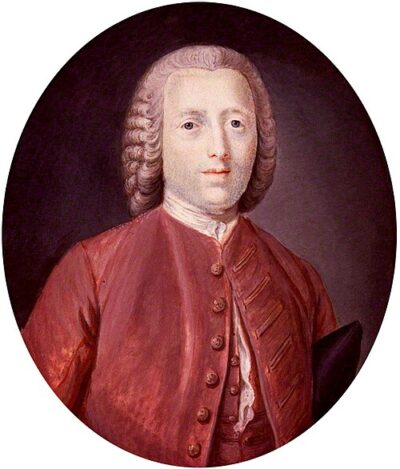
John Needham
John Needham was an English biologist and Roman Catholic priest. Born September 10, 1713, in London. Died December 30, 1781, in Brussels. Awards include Fellow of the Royal Society.
Facts
16 facts · 2 confirmed by two sources · 9 cited · 5 from one source
Where this comes from
Papalocal keeps its own record. It started from these sources; what each one said is kept here as it was copied, so a change on their side never changes this page by itself. Tap one to read its version.
What Wikidata says · copied November 18, 2026 · revision 2567448868
- Described as
- English biologist and Roman Catholic priest (1713-1781)
- Other names
- John Turberville Needham
- Born
- September 10, 1713 · 3 references
- Died
- December 30, 1781 · 4 references
- Born in
- London · 1 reference
- Died in
- Brussels · 1 reference
- Citizen of
- United Kingdom
- Occupation
- educator; naturalist · 2 references; physiologist · 1 reference; philosopher · 1 reference; Catholic priest · 1 reference
- Member of
- Royal Society of London (1747–) · 1 reference
- Awards
- Fellow of the Royal Society (1)
- Field
- biology; natural science · 1 reference; Catholicism · 1 reference
- Religion
- Catholic Church · 1 reference
- Wikipedias with a page
- 20
Wikidata item Q729674 (wikidata.org/wiki/Q729674), public domain (CC0). Copied November 18, 2026.
What Wikipedia says · copied November 18, 2026 · revision 1377992924
John Turberville Needham FRS (10 September 1713 – 30 December 1781) was an English biologist and Roman Catholic priest.
He was first exposed to natural philosophy while in seminary school and later published a paper which, while the subject was mostly about geology, described the mechanics of pollen and won recognition in the botany community.
He did experiments with gravy and later, tainted wheat, in containers. This was in order to experiment with spontaneous generation. Needham was curious on how this term was relevant. The experiments consisted of briefly boiling a broth mixture and then cooling the mixture in an open container to room temperature. Later, the flasks would be sealed, and microbes would grow a few days later. Those experiments seemed to show that there was a life force that produced spontaneous generation. Today, it is known that the boiling time was insufficient to kill any endospores of microbes and the cooling of flasks left open to the air could cause microbial contamination. It could also be ascertained that Needham did not use proper sterile technique. His experiments were later challenged and repeated by Lazzaro Spallanzani, an Italian scientist. Using a slightly different protocol (with a longer boiling time), Spallanzani did not have any microbes grow in his sealed flasks, contradicting Needham's findings.
He is frequently believed to be an Irish Jesuit, a myth which was created by Voltaire during a feud regarding spontaneous generation in which Voltaire was against Needham and his theories.
He became a member of the Royal Society in 1747 and was the first Catholic priest to do so.
Needham's experiments with the spontaneous generation of life were cited by French Enlightenment philosopher Baron d'Holbach in his atheist work, the System of Nature.
- Born, in its opening lines
- September 10, 1713
- Died, in its opening lines
- December 30, 1781
From the Wikipedia article “John Needham” (en.wikipedia.org/wiki/John_Needham), by its contributors, under CC BY-SA 4.0 (creativecommons.org/licenses/by-sa/4.0/). Copied November 18, 2026; not changed.
Confirmed Two sources agree. Cited One source, and it names where it got it. One source One source, without a reference of its own. Sources disagree The sources disagree. We show the best-supported value and keep theirs below.
