
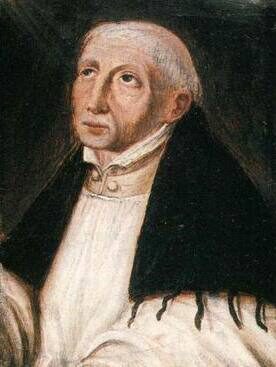
John of Ruysbroeck
John of Ruysbroeck was a Brabantian mystic and writer. Born 1293, in Ruisbroek. Died December 2, 1381, in Groenendaal. Known for Dat rijcke der ghelieven, Die gheestelike brulocht and Vanden blinckenden steen.
Facts
21 facts · 0 confirmed by two sources · 4 cited · 17 from one source
Where this comes from
Papalocal keeps its own record. It started from these sources; what each one said is kept here as it was copied, so a change on their side never changes this page by itself. Tap one to read its version.
What Wikidata says · copied November 16, 2026 · revision 2564773080
- Described as
- Brabantian mystic and writer (1293–1381)
- Other names
- John Ruysbroeck, Divine Doctor, Jean Ruysbroek, Ecstatic Doctor, John of Ruusbroec
- Born
- 1293 · 31 references
- Died
- December 2, 1381 · 1 reference
- Born in
- Ruisbroek
- Died in
- Groenendaal
- Citizen of
- Duchy of Brabant
- Occupation
- writer; chaplain; mystic · 1 reference; Catholic priest; theologian · 1 reference
- Known for
- Dat rijcke der ghelieven; Die gheestelike brulocht; Vanden blinckenden steen; Vanden vier becoringhen; Vanden gheesteliken tabernakel; Vanden kersten ghelove; Vanden seven sloten; Spieghel der eeuwigher salicheit; Vanden seven trappen; Boecsken der verclaringhe
- Religion
- Catholic Church
- Wikipedias with a page
- 30
Wikidata item Q920312 (wikidata.org/wiki/Q920312), public domain (CC0). Copied November 16, 2026.
What Wikipedia says · copied November 16, 2026 · revision 1378734546
John of Ruusbroec or Jan van Ruusbroec (pronounced [ˈjɑɱ vɑn ˈryzbruk]; 1293/1294 – 2 December 1381), sometimes modernized Ruysbroeck, was an Augustinian canon and one of the most important of the medieval mystics of the Low Countries. Some of his main literary works include The Kingdom of the Divine Lovers, The Twelve Beguines, The Spiritual Espousals, A Mirror of Eternal Blessedness, The Little Book of Enlightenment, and The Sparkling Stone. Some of his letters also survive, as well as several short sayings (recorded by some of his disciples, such as Jan van Leeuwen). He wrote in the Middle Dutch vernacular, the language of the common people of the Low Countries, rather than in Latin, the language of the Catholic Church liturgy and official texts, in order to reach a wider audience.
From the Wikipedia article “John of Ruusbroec” (en.wikipedia.org/wiki/John_of_Ruusbroec), by its contributors, under CC BY-SA 4.0 (creativecommons.org/licenses/by-sa/4.0/). Copied November 16, 2026; not changed.
Confirmed Two sources agree. Cited One source, and it names where it got it. One source One source, without a reference of its own. Sources disagree The sources disagree. We show the best-supported value and keep theirs below.
