
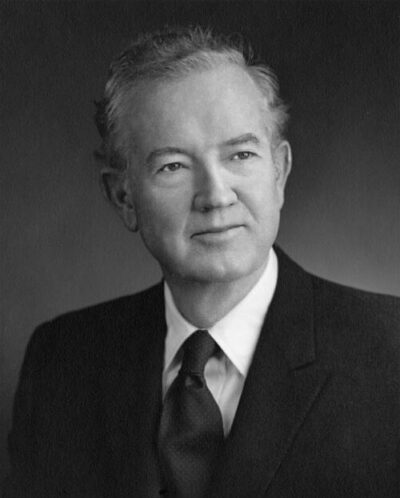
John Sparkman
John Sparkman was an American jurist and politician. Born December 20, 1899, in Hartselle. Died November 16, 1985, in Huntsville. Positions held include United States representative (1937–1946) and United States senator (1946–1979). Educated at University of Alabama (2 times) and University of Alabama School of Law.
Facts
23 facts · 2 confirmed by two sources · 9 cited · 12 from one source
Where this comes from
Papalocal keeps its own record. It started from these sources; what each one said is kept here as it was copied, so a change on their side never changes this page by itself. Tap one to read its version.
What Wikidata says · copied November 16, 2026 · revision 2567017297
- Described as
- American jurist and politician (1899–1985)
- Other names
- John J. Sparkman, John Jackson Sparkman
- Born
- December 20, 1899 · 4 references
- Died
- November 16, 1985 · 4 references
- Born in
- Hartselle
- Died in
- Huntsville · 2 references
- Buried in
- Maple Hill Cemetery
- Cause of death
- myocardial infarction · 1 reference
- Name at birth
- John Jackson Sparkman
- Citizen of
- United States
- Occupation
- politician · 1 reference; farmer · 1 reference; lawyer · 1 reference; professor · 1 reference
- Positions held
- United States representative (1937–1946); United States senator (1946–1979) · 1 reference
- Political party
- Democratic Party
- Worked for
- University of Alabama in Huntsville (1925–1928)
- Education
- University of Alabama (2 times) (1917–1924); University of Alabama School of Law (–1923)
- Member of
- Pi Kappa Alpha (1921–); Scottish Rite
- Field
- agriculture · 1 reference
- Religion
- Methodism
- Military branch
- United States Army · 1 reference
- Wikipedias with a page
- 20
Wikidata item Q388215 (wikidata.org/wiki/Q388215), public domain (CC0). Copied November 16, 2026.
What Wikipedia says · copied November 16, 2026 · revision 1368899103
John Jackson Sparkman (December 20, 1899 – November 16, 1985) was an American jurist and politician from the state of Alabama. A Southern Democrat, Sparkman served in the United States House of Representatives from 1937 to 1946 and the United States Senate from 1946 until 1979. He was the Democratic Party's nominee for vice president in the 1952 presidential election.
Born in Morgan County, Alabama, Sparkman established a legal practice in Huntsville, Alabama, after graduating from the University of Alabama School of Law. He won election to the House in 1936 and served as house majority whip in 1946. He left the House in 1946 after winning a special election to succeed Senator John H. Bankhead II. While in the Senate, he helped establish Marshall Space Flight Center and served as the chairman of several committees. Sparkman served as Adlai Stevenson's running mate in the 1952 presidential election, but they were defeated by the Republican ticket of Dwight D. Eisenhower and Richard Nixon.
Although supportive of progressive social and economic legislation during the course of his political career, Sparkman was also known as a defender of segregation during the Civil Rights era; voting regularly against civil rights legislation and condemned the "judicial usurpation" of the U.S. Supreme Court decision of Brown v. Board of Education, Sparkman signed the 1956 Southern Manifesto, which pledged opposition to racial integration and promised to use "all lawful means" to fight the ruling that put court power behind the integration of public institutions. He became the longest-serving senator from Alabama in 1977, a record that was surpassed by Richard Shelby in 2019. Sparkman chose not to seek re-election in 1978 and retired from public office the following year.
- Born, in its opening lines
- December 20, 1899
- Died, in its opening lines
- November 16, 1985
From the Wikipedia article “John Sparkman” (en.wikipedia.org/wiki/John_Sparkman), by its contributors, under CC BY-SA 4.0 (creativecommons.org/licenses/by-sa/4.0/). Copied November 16, 2026; not changed.
Confirmed Two sources agree. Cited One source, and it names where it got it. One source One source, without a reference of its own. Sources disagree The sources disagree. We show the best-supported value and keep theirs below.
