
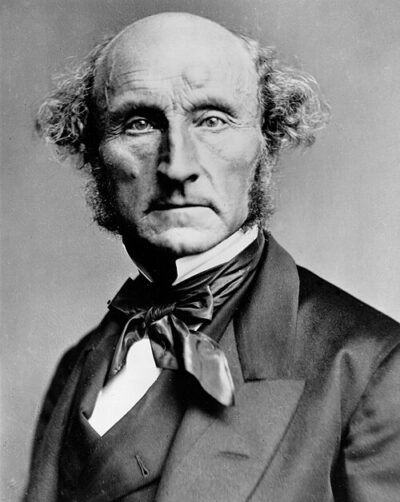
John Stuart Mill
John Stuart Mill was a British philosopher and political economist. Born May 20, 1806, in Pentonville. Died May 8, 1873, in Avignon. Positions held include member of the 19th Parliament of the United Kingdom (1865–1868). Known for On Liberty, Autobiography and Considerations on Representative Government. Educated at University College London. Awards include honorary doctor of the University of Vienna, Honorary Fellow of the Royal Society of Edinburgh and Fellow of the American Academy of Arts and Sciences.
Facts
30 facts · 1 confirmed by two sources · 10 cited · 18 from one source · 1 where the sources disagree
What’s different
- Died: we show May 8, 1873 (Sources disagree). Wikipedia says May 7, 1873
Where this comes from
Papalocal keeps its own record. It started from these sources; what each one said is kept here as it was copied, so a change on their side never changes this page by itself. Tap one to read its version.
What Wikidata says · copied November 16, 2026 · revision 2568299884
- Described as
- British philosopher and political economist (1806–1873)
- Other names
- J. S. Mill, Pepo
- Born
- May 20, 1806 · 10 references
- Died
- May 8, 1873 · 8 references
- Born in
- Pentonville · 1 reference
- Died in
- Avignon · 3 references
- Buried in
- Saint-Véran Cemetery
- Cause of death
- erysipelas · 1 reference
- Citizen of
- United Kingdom of Great Britain and Ireland
- Occupation
- philosopher · 1 reference; economist; politician · 2 references; autobiographer · 1 reference; writer · 2 references; egalitarianism; clerk; suffragist · 1 reference
- Positions held
- member of the 19th Parliament of the United Kingdom (1865–1868) · 1 reference
- Political party
- Liberal Party
- Worked for
- East India Company · 1 reference
- Education
- University College London
- Member of
- Hungarian Academy of Sciences; American Academy of Arts and Sciences
- Known for
- On Liberty; Autobiography; Considerations on Representative Government
- Awards
- honorary doctor of the University of Vienna · 1 reference; Honorary Fellow of the Royal Society of Edinburgh; Fellow of the American Academy of Arts and Sciences
- Spouse
- Harriet Taylor Mill · 1 reference
- Father
- James Mill · 1 reference
- Religion
- atheism
- Wikipedias with a page
- 152
Wikidata item Q50020 (wikidata.org/wiki/Q50020), public domain (CC0). Copied November 16, 2026.
What Wikipedia says · copied November 16, 2026 · revision 1383835772
John Stuart Mill (20 May 1806 – 7 May 1873) was an English philosopher, political economist, and politician. He was a paradigmatic philosopher of liberalism and has been described as "the most influential English-speaking philosopher of the nineteenth century" by the Stanford Encyclopedia of Philosophy. He conceived of liberty as justifying the freedom of the individual in opposition to unlimited state and social control, and formulated the Harm principle. He also advocated proportional representation, the emancipation of women, and the development of labour organisations and farm cooperatives, and has been classified as both a classical liberal and social liberal. Mill's philosophy has also been described as early market socialism.
The Columbia Encyclopedia describes Mill as occasionally coming "close to socialism, a theory repugnant to his predecessors". He was a proponent of the utilitarianism of his predecessor Jeremy Bentham, and contributed to the investigation of scientific methodology.
A member of the Liberal Party and co-author of the early feminist work The Subjection of Women (1869), Mill was also the second Member of Parliament to call for women's suffrage after Henry Hunt in 1832. The contentions of his essay On Liberty (1859) remain highly influential: and a copy of the work is passed to the president of the Liberal Democrats (the successor party to Mill's own) as a symbol of office.
- Born, in its opening lines
- May 20, 1806
- Died, in its opening lines
- May 7, 1873
From the Wikipedia article “John Stuart Mill” (en.wikipedia.org/wiki/John_Stuart_Mill), by its contributors, under CC BY-SA 4.0 (creativecommons.org/licenses/by-sa/4.0/). Copied November 16, 2026; not changed.
Confirmed Two sources agree. Cited One source, and it names where it got it. One source One source, without a reference of its own. Sources disagree The sources disagree. We show the best-supported value and keep theirs below.
