
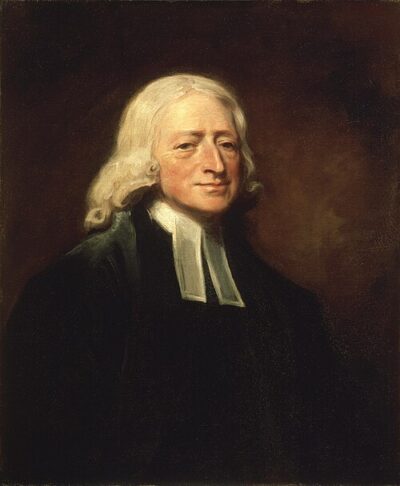
John Wesley
John Wesley was a British cleric and founder of the Methodist movement. Born June 17, 1703, in Epworth. Died March 2, 1791, in St Luke's. Educated at Christ Church and Charterhouse School.
Facts
24 facts · 1 confirmed by two sources · 6 cited · 16 from one source · 1 where the sources disagree
What’s different
- Born: we show June 17, 1703 (Sources disagree). Wikipedia says June 28, 1703
Where this comes from
Papalocal keeps its own record. It started from these sources; what each one said is kept here as it was copied, so a change on their side never changes this page by itself. Tap one to read its version.
What Wikidata says · copied November 16, 2026 · revision 2565536955
- Described as
- British cleric and founder of the Methodist movement (1703-1791)
- Born
- June 17, 1703 · 5 references
- Died
- March 2, 1791 · 10 references
- Born in
- Epworth · 1 reference
- Died in
- St Luke's
- Buried in
- Wesley's Chapel
- Citizen of
- Kingdom of Great Britain
- Occupation
- Methodist pastor · 1 reference; diarist; philosopher; translator; hymnwriter; missionary · 1 reference; priest · 1 reference; writer · 1 reference
- Education
- Christ Church; Charterhouse School
- Spouse
- Mary Vazeille (1751–) · 1 reference
- Father
- Samuel Wesley · 1 reference
- Mother
- Susanna Wesley · 1 reference
- Siblings
- Mehetabel Wright; Charles Wesley · 1 reference; Samuel Wesley
- Religion
- Methodism; Anglicanism
- Wikipedias with a page
- 77
Wikidata item Q213393 (wikidata.org/wiki/Q213393), public domain (CC0). Copied November 16, 2026.
What Wikipedia says · copied November 16, 2026 · revision 1384061951
John Wesley (; 28 June [O.S. 17 June] 1703 – 2 March 1791) was an English cleric, theologian, and evangelist who was a principal leader of a revival movement within the Church of England known as Methodism. The societies he founded became the dominant form of the ongoing independent Methodist movement.
Educated at Charterhouse and Christ Church, Oxford, Wesley was elected a fellow of Lincoln College, Oxford, in 1726 and ordained as an Anglican priest two years later. At Oxford, he led the "Holy Club", a society formed for the purpose of the study and the pursuit of a devout Christian life. After an unsuccessful two-year ministry in Savannah, Georgia, he returned to London and joined a religious society led by Moravian Christians. On 24 May 1738, he experienced what has come to be called his evangelical conversion. He left the Moravians and began his own ministry.
A key step in the development of Wesley's ministry was to travel widely and preach outdoors, embracing Arminian doctrines. Moving across Great Britain and Ireland, he helped form and organise small Christian groups that developed intensive and personal accountability, discipleship, and religious instruction. He appointed itinerant, unordained evangelists—both women and men—to care for these groups of people. Under Wesley's direction, Methodists became leaders in many social issues of the day, including the abolition of slavery and support for women preachers.
Although he was not a systematic theologian, Wesley argued against Calvinism and for the notion of Christian perfection, which he cited as the reason that he felt God "raised up" Methodists into existence. His evangelicalism, firmly grounded in sacramental theology, maintained that means of grace played a role in sanctification of the believer; however, he taught that it was by faith a believer was transformed into the likeness of Christ. He held that, in this life, Christians could achieve a state where the love of God "reigned supreme in their hearts", giving them not only outward but inward holiness. Wesley's teachings, collectively known as Wesleyan theology, continue to inform the doctrine of Methodist churches. In his early ministry years, Wesley was barred from preaching in many parish churches and the Methodists were persecuted; he later became widely respected, and by the end of his life, was described as "the best-loved man in England".
- Born, in its opening lines
- June 28, 1703
- Died, in its opening lines
- March 2, 1791
From the Wikipedia article “John Wesley” (en.wikipedia.org/wiki/John_Wesley), by its contributors, under CC BY-SA 4.0 (creativecommons.org/licenses/by-sa/4.0/). Copied November 16, 2026; not changed.
Confirmed Two sources agree. Cited One source, and it names where it got it. One source One source, without a reference of its own. Sources disagree The sources disagree. We show the best-supported value and keep theirs below.
