
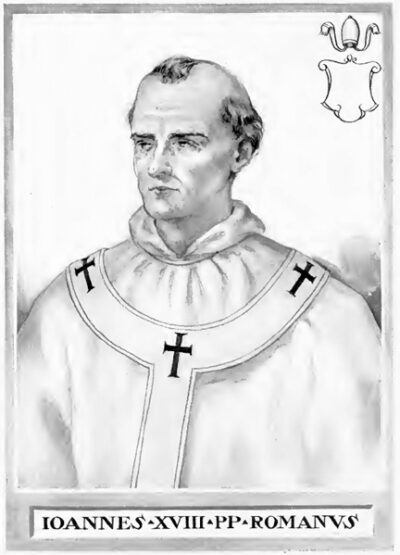
John XVII, born John Sicco, served as Pope from approximately May 1003 until his death in December of that year. His pontificate, lasting about seven months, occurred during a period of significant influence by the Roman patrician John II Crescentius, who played a role in the selection and removal of several popes. John XVII's time as bishop of Rome and nominal ruler of the Papal States was relatively brief and marked by the political dynamics of the era.
Facts
8 facts · 0 confirmed by two sources · 1 cited · 6 from one source · 1 where the sources disagree
What’s different
- Died: we show December 12, 1003 (Sources disagree). Wikipedia says November 6, 1003
Where this comes from
Papalocal keeps its own record. It started from these sources; what each one said is kept here as it was copied, so a change on their side never changes this page by itself. Tap one to read its version.
What Wikidata says · copied November 13, 2026 · revision 2557975539
- Described as
- pope
- Other names
- John Sicco, Pope John XVII, Ioannes XVII
- Died
- December 12, 1003
- Born in
- Rapagnano
- Died in
- Rome
- Buried in
- Archbasilica of St. John Lateran
- Citizen of
- Papal States · 1 reference
- Occupation
- Catholic priest
- Positions held
- Pope (1003)
- Religion
- Catholic Church · 1 reference
- Wikipedias with a page
- 71
Wikidata item Q227963 (wikidata.org/wiki/Q227963), public domain (CC0). Copied November 13, 2026.
What Wikipedia says · copied November 14, 2026 · revision 1377060281
Pope John XVII (Latin: Ioannes XVII; died 6 November 1003), born John Sicco, was the bishop of Rome and nominal ruler of the Papal States for about seven months in 1003. He was one of the popes chosen and eclipsed by the patrician John II Crescentius.
- Died, in its opening lines
- November 6, 1003
From the Wikipedia article “Pope John XVII” (en.wikipedia.org/wiki/Pope_John_XVII), by its contributors, under CC BY-SA 4.0 (creativecommons.org/licenses/by-sa/4.0/). Copied November 14, 2026; not changed.
Confirmed Two sources agree. Cited One source, and it names where it got it. One source One source, without a reference of its own. Sources disagree The sources disagree. We show the best-supported value and keep theirs below.
