
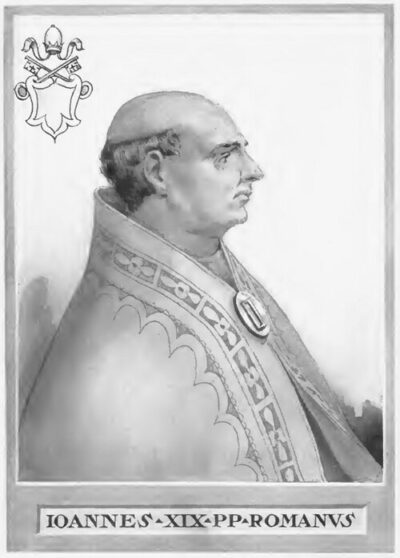
John XVIII was a pope of the Catholic Church. Died July 18, 1009, in Rome. Positions held include Pope (1003–1009).
Facts
9 facts · 1 confirmed by two sources · 4 cited · 4 from one source
Where this comes from
Papalocal keeps its own record. It started from these sources; what each one said is kept here as it was copied, so a change on their side never changes this page by itself. Tap one to read its version.
What Wikidata says · copied November 16, 2026 · revision 2557975542
- Described as
- pope of the Catholic Church
- Other names
- Fasanius of Rapagnano, Fasano, Giovanni Fasano, Ioannes XVIII, Iohannes PP. XVIII, Joannes Fasanus, Johannes XVIII. Papa, John XIX, Pope John XVIII, papa Giovanni XVIII
- Died
- July 18, 1009
- Born in
- Rome · 2 references
- Died in
- Rome · 1 reference
- Buried in
- St. Peter's Basilica
- Citizen of
- Papal States · 1 reference
- Occupation
- Catholic priest; writer · 1 reference
- Positions held
- Pope (1003–1009)
- Religion
- Catholic Church · 1 reference
- Wikipedias with a page
- 71
Wikidata item Q179702 (wikidata.org/wiki/Q179702), public domain (CC0). Copied November 16, 2026.
What Wikipedia says · copied November 16, 2026 · revision 1377060503
Pope John XVIII (Latin: Ioannes XVIII; died June or July 1009) was the bishop of Rome and nominal ruler of the Papal States from 25 December 1003 to his abdication in July 1009. He wielded little temporal power, ruling during the struggle between John II Crescentius and Emperor Henry II for the control of Rome. He was the last pope to use his baptismal name for centuries. Every pope after him (with the exceptions of Adrian VI and Marcellus II) has taken on a new papal name.
- Died, in its opening lines
- July 1009
From the Wikipedia article “Pope John XVIII” (en.wikipedia.org/wiki/Pope_John_XVIII), by its contributors, under CC BY-SA 4.0 (creativecommons.org/licenses/by-sa/4.0/). Copied November 16, 2026; not changed.
Confirmed Two sources agree. Cited One source, and it names where it got it. One source One source, without a reference of its own. Sources disagree The sources disagree. We show the best-supported value and keep theirs below.
