
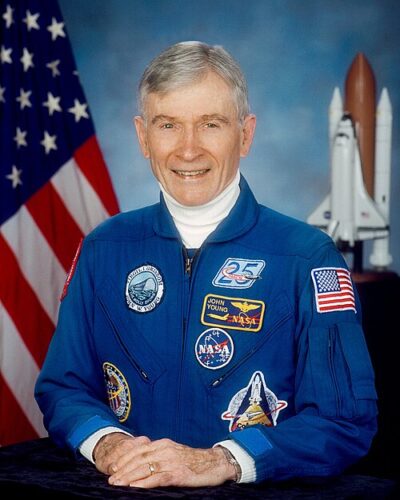
John Young
John Young was an American astronaut, naval officer, test pilot and aeronautical engineer. Born September 24, 1930, in San Francisco. Died January 5, 2018, in Houston. Positions held include Chief of the Astronaut Office (1974–1987). Educated at Georgia Tech and United States Naval Test Pilot School. Awards include Distinguished Flying Cross, Congressional Space Medal of Honor and NASA Exceptional Service Medal.
Facts
37 facts · 2 confirmed by two sources · 10 cited · 25 from one source
Where this comes from
Papalocal keeps its own record. It started from these sources; what each one said is kept here as it was copied, so a change on their side never changes this page by itself. Tap one to read its version.
What Wikipedia says · copied November 13, 2026 · revision 1384856033
John Watts Young (September 24, 1930 – January 5, 2018) was an American astronaut, naval officer and aviator, test pilot, and aeronautical engineer. He became the ninth person to walk on the Moon as commander of the Apollo 16 mission in 1972.
Before becoming an astronaut, Young received his Bachelor of Science degree in aeronautical engineering from the Georgia Institute of Technology and joined the U.S. Navy. After serving at sea during the Korean War he became a naval aviator and graduated from the U.S. Naval Test Pilot School. As a test pilot, he set several world time-to-climb records. Young retired from the Navy in 1976 with the rank of captain.
In 1962, Young was selected as a member of NASA Astronaut Group 2. He flew on the first crewed Gemini mission (Gemini 3) in 1965, and then commanded the 1966 Gemini 10 mission. In 1969, he flew as command module pilot on Apollo 10, and became the first person to orbit the Moon alone. In 1972, he commanded Apollo 16 and spent three days on the lunar surface exploring the Descartes Highlands with Charles Duke. Young also commanded STS-1 in 1981, the Space Shuttle program's first launch, and STS-9 in 1983, both of which were on Columbia.
Young is the only astronaut to have flown in four different classes of NASA spacecraft: Gemini, the Apollo command module, the Apollo Lunar Module, and the Space Shuttle.
He was one of only two astronauts, along with Ken Mattingly, his command module pilot during the Apollo 16 mission, to fly on both an Apollo mission and a Space Shuttle mission, and the only astronaut to walk on the Moon and fly on the Space Shuttle. Young served as Chief of the Astronaut Office from 1974 to 1987, and retired from NASA in 2004, after 42 years of service.
- Born, in its opening lines
- September 24, 1930
- Died, in its opening lines
- January 5, 2018
From the Wikipedia article “John Young (astronaut)” (en.wikipedia.org/wiki/John_Young_(astronaut)), by its contributors, under CC BY-SA 4.0 (creativecommons.org/licenses/by-sa/4.0/). Copied November 13, 2026; not changed.
What Wikidata says · copied November 14, 2026 · revision 2569128869
- Described as
- American astronaut, naval officer, test pilot and aeronautical engineer (1930–2018)
- Other names
- John Watts Young, Captain John Watts Young
- Born
- September 24, 1930 · 5 references
- Died
- January 5, 2018 · 6 references
- Born in
- San Francisco · 2 references
- Died in
- Houston · 1 reference
- Buried in
- Arlington National Cemetery
- Cause of death
- pneumonia
- Name at birth
- John Watts Young
- Citizen of
- United States
- Occupation
- naval officer; test pilot; astronaut (1962–2004) · 1 reference; autobiographer; air force pilot; military flight engineer
- Positions held
- Chief of the Astronaut Office (1974–1987)
- Worked for
- National Aeronautics and Space Administration
- Education
- Georgia Tech; United States Naval Test Pilot School
- Member of
- International Astronomical Union · 1 reference; NASA Astronaut Group 2 · 1 reference
- Awards
- Distinguished Flying Cross; Congressional Space Medal of Honor (1981) · 1 reference; NASA Exceptional Service Medal (1965); Patron’s Medal (1983) · 1 reference; National Aviation Hall of Fame (1988) · 1 reference; United States Astronaut Hall of Fame; NASA Outstanding Leadership Medal (1992); NASA Exceptional Achievement Medal (1994); Navy Distinguished Service Medal (1969); NASA Distinguished Service Medal (1969) · 1 reference; Hubbard Medal (1981); International Space Hall of Fame (1982) · 2 references; Yuri A. Gagarin Gold Medal (1972)
- Father
- William Hugh Young · 1 reference
- Military branch
- United States Navy
- Military rank
- captain
- Lived in
- Florida
- Wikipedias with a page
- 56
Wikidata item Q107667 (wikidata.org/wiki/Q107667), public domain (CC0). Copied November 14, 2026.
Confirmed Two sources agree. Cited One source, and it names where it got it. One source One source, without a reference of its own. Sources disagree The sources disagree. We show the best-supported value and keep theirs below.
