
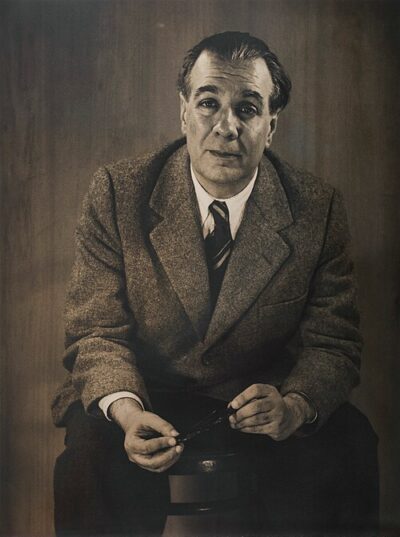
Jorge Luis Borges
Jorge Luis Borges was an Argentine writer, essayist, poet and translator. Born August 24, 1899, in Buenos Aires. Died June 14, 1986, in Geneva. Known for The Library of Babel. Educated at Collège Calvin. Awards include Gran Premio de Honor de la SADE, Prix Formentor and Commandeur des Arts et des Lettres.
Facts
46 facts · 2 confirmed by two sources · 20 cited · 23 from one source · 1 where the sources disagree
What’s different
- Cause of death: we show liver cancer (Sources disagree). Wikidata also lists pulmonary emphysema
Where this comes from
Papalocal keeps its own record. It started from these sources; what each one said is kept here as it was copied, so a change on their side never changes this page by itself. Tap one to read its version.
What Wikidata says · copied November 16, 2026 · revision 2567933903
- Described as
- Argentine writer, essayist, poet and translator (1899–1986)
- Other names
- J. L. Borges, Chorche Louis Borches, Horhe Luis Borhes, Jorge Luis Borges Acevedo, Khorkhe Luyis Borkhes, Jorge Francisco Isidoro Luis Borges Acevedo, Borges, Jorge Francisco Isidoro Luis Borges
- Born
- August 24, 1899 · 14 references
- Died
- June 14, 1986 · 11 references
- Born in
- Buenos Aires · 5 references
- Died in
- Geneva · 3 references
- Buried in
- Cemetery of Kings
- Cause of death
- liver cancer · 1 reference; pulmonary emphysema · 1 reference
- Name at birth
- Jorge Francisco Isidoro Luis Borges Acevedo
- Citizen of
- Argentina · 2 references
- Occupation
- translator · 1 reference; librarian · 2 references; literary critic; screenwriter; writer · 6 references; poet · 2 references; opinion journalist · 1 reference; essayist · 2 references
- Worked for
- University of Buenos Aires; National University of La Plata; Mariano Moreno National Library; Miguel Cané Municipal Public Library (1937–1946) · 1 reference
- Education
- Collège Calvin (–1918)
- Member of
- American Academy of Arts and Sciences; Bavarian Academy of Fine Arts; American Academy of Arts and Letters
- Genre
- essay
- Known for
- The Library of Babel
- Awards
- Gran Premio de Honor de la SADE (1944) · 1 reference; Prix Formentor (1961); Commandeur des Arts et des Lettres (1962); Knight Commander of the Order of the British Empire (1965); Commander of the Order of the Sun of Peru (1965); Grand Officer of the Order of Merit of the Italian Republic (1967) · 1 reference; Jerusalem Prize (1971) · 1 reference; Alfonso Reyes International Prize (1973) · 3 references; commander of the Order of Bernardo O'Higgins (1976); Edgar Awards (1976); doctor honoris causa from the Paris-Sorbonne University (1978) · 3 references; Commander's Cross of the Order of Merit of the Federal Republic of Germany (1979); World Fantasy Award for Life Achievement (1979) · 1 reference; Miguel de Cervantes Prize (1979) · 1 reference; Grand Officer of the Order of the Falcon (1979)
- Spouse
- Elsa Astete Millán (1967–1970) · 1 reference; María Kodama (1986) · 1 reference
- Father
- Jorge Guillermo Borges Haslam · 2 references
- Mother
- Leonor Acevedo Suárez · 2 references
- Siblings
- Norah Borges
- Wikipedias with a page
- 194
Wikidata item Q909 (wikidata.org/wiki/Q909), public domain (CC0). Copied November 16, 2026.
What Wikipedia says · copied November 16, 2026 · revision 1385300528
Jorge Francisco Isidoro Luis Borges ( BOR-hess; Spanish: [ˈxoɾxe ˈlwis ˈboɾxes] ; 24 August 1899 – 14 June 1986) was an Argentine short-story writer, essayist, poet and translator regarded as a key figure in Spanish-language and international literature. His best-known works, Ficciones (transl. Fictions) and El Aleph (transl. The Aleph), published in the 1940s, are collections of short stories exploring motifs such as dreams, labyrinths, chance, infinity, archives, mirrors, fictional writers, and mythology. Borges's works have contributed to philosophical literature and the fantasy genre, and have had a major influence on the magical realist movement in 20th century Latin American literature.
Born in Buenos Aires, Borges moved with his family to Switzerland in 1914, where he studied at the Collège de Genève. The family travelled widely in Europe, including Spain. On his return to Argentina in 1921, Borges began publishing his poems and essays in surrealist literary journals. He also worked as a librarian and public lecturer. In 1955, he was appointed director of the National Public Library and professor of English literature at the University of Buenos Aires. He was completely blind by the age of 55. Scholars have proposed that his progressive loss of sight influenced his development of innovative literary symbols through imaginative techniques. By the 1960s, his work was translated and published widely in the United States and Europe. Borges himself was fluent in several languages.
In 1961, Borges came to international attention when he received the first International Formentor Prize, which he shared with Samuel Beckett. His international reputation was consolidated in the 1960s, aided by the growing number of English translations, the Latin American Boom, and the success of García Márquez's One Hundred Years of Solitude. He dedicated his final work, The Conspirators, to the city of Geneva, Switzerland. Writer and essayist J. M. Coetzee said of him: "He, more than anyone, renovated the language of fiction and thus opened the way to a remarkable generation of Spanish-American novelists." David Foster Wallace wrote: "The truth, briefly stated, is that Borges is arguably the great bridge between modernism and postmodernism in world literature ... His stories are inbent and hermetic, with the oblique terror of a game whose rules are unknown and its stakes everything."
- Born, in its opening lines
- August 24, 1899
- Died, in its opening lines
- June 14, 1986
From the Wikipedia article “Jorge Luis Borges” (en.wikipedia.org/wiki/Jorge_Luis_Borges), by its contributors, under CC BY-SA 4.0 (creativecommons.org/licenses/by-sa/4.0/). Copied November 16, 2026; not changed.
Confirmed Two sources agree. Cited One source, and it names where it got it. One source One source, without a reference of its own. Sources disagree The sources disagree. We show the best-supported value and keep theirs below.
