
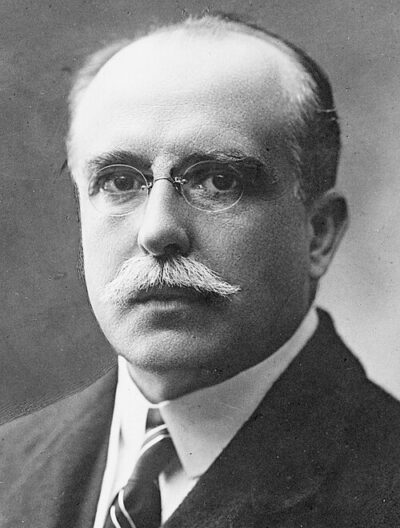
José Pardo y Barreda
José Pardo y Barreda was a Peruvian politician. Born February 24, 1864, in Lima. Died August 3, 1947, in Lima. Positions held include President of Peru (2 times) (1904–1919), President of the Council of Ministers of Peru (1903–1904) and Minister of Foreign Affairs of Peru (1903–1904). Educated at National University of San Marcos.
Facts
21 facts · 2 confirmed by two sources · 8 cited · 11 from one source
Where this comes from
Papalocal keeps its own record. It started from these sources; what each one said is kept here as it was copied, so a change on their side never changes this page by itself. Tap one to read its version.
What Wikidata says · copied November 18, 2026 · revision 2568930048
- Described as
- Peruvian politician (1864-1947)
- Other names
- Jose Pardo y Barreda, José Simón Pardo y Barreda
- Born
- February 24, 1864 · 1 reference
- Died
- August 3, 1947 · 1 reference
- Born in
- Lima · 1 reference
- Died in
- Lima
- Buried in
- Presbítero Matias Maestro
- Citizen of
- Peru
- Occupation
- politician · 1 reference; diplomat · 1 reference; lawyer · 1 reference
- Positions held
- President of Peru (2 times) (1904–1919); President of the Council of Ministers of Peru (1903–1904); Minister of Foreign Affairs of Peru (1903–1904); rector of the National University of San Marcos (1914–1915)
- Political party
- Civil Party
- Education
- National University of San Marcos
- Children
- Juan Pardo Heeren; Carmen Pardo Heeren · 1 reference
- Father
- Manuel Pardo · 1 reference
- Mother
- Mariana Barreda y Osma · 1 reference
- Siblings
- Felipe Pardo y Barreda · 1 reference; Juan Pardo y Barreda
- Wikipedias with a page
- 24
Wikidata item Q136632 (wikidata.org/wiki/Q136632), public domain (CC0). Copied November 18, 2026.
What Wikipedia says · copied November 18, 2026 · revision 1375905716
José Simón Pardo y Barreda (February 24, 1864 – August 3, 1947) was a Peruvian politician who served twice as President of Peru, in 1904–1908 and 1915–1919.
Born in Lima, Peru, he was the son of Manuel Justo Pardo y Lavalle, who had been the first civilian president of Peru (1872–1876) and the founder of the Civilista Party; he is one of two second-generation Peruvian presidents. (Manuel Prado, son of former dictator Mariano Ignacio Prado, is the other.) His grandfather, Felipe Pardo y Aliaga (1806–1868), was a distinguished diplomat, writer and politician who was also a Foreign Minister and Vice President of the Peruvian Council of State before, during and after the presidencies of Vivanco and Castilla.
José Pardo headed the Civilista Party and was Foreign Minister under Eduardo López de Romaña and then Prime Minister (1903–1904) under Manuel Candamo. After Candamo's death, Serapio Calderón became the interim president and called for new elections. The Civilista Party named José Pardo as its candidate, while the Democratic Party presented the candidacy of Nicolás de Piérola, who retired early before the elections mentioning a "lack of guarantees." This fact led Pardo to become elected. Both his presidential terms were marked by liberal politics.
His government was marked by pushing for better education for all Peruvians. Elementary education in Peru, according to the Law of 1876 proposed by his father, Manuel Pardo, was under the responsibility of the municipalities throughout the country. José Pardo, under his Secretary of Justice and Instruction, decided to confront the problem.
The law promulgated in 1905 reformed the education system to depend on the central government. It also called for primary education to be free and compulsory in far-away places such as villages and mines, and that at least a small school for all children be located in any place with more than two hundred inhabitants. The Escuela Normal de Varones ("Normal school for males") was founded for the formation of male teachers, as well as the Escuela Normal de Mujeres ("Normal school for females").
Pardo created a General Branch of Instruction on which inspectors in charge of the work of surveillance in the whole Republic depended. In the cultural field the following were established: The National Academy of History, the School of Fine Arts (Bellas Artes), the National Academy of Music, and the National Museum of History. The superior combat school was also founded to form major state officers.
During his second government José Pardo confronted the consequences of the First World War, as well as the labor agitation for the obtainment of the "8 working hours" a day. It was finally granted on January 15, 1919.
An Act of October 1916 prescribed (as noted by one study) “minimum wages for native workers and the payment of wages in current coin.” An Act of November 1918 prohibited (with exceptions) the employment of children under the age of 14, together with underground work for those under the age of 18 and night work for those under the age of 21. An Act of December 1918 prohibited work on Sundays and civic holidays in various workplaces. Also in 1918, a law was passed safeguarding pregnant workers.
With barely a month before the end of his second term, he was ousted in a coup by Augusto B. Leguía. He spent the next eleven years in exile in the South of France, until his return to Lima. He died there in 1947.
In 1900, Pardo married his first cousin, Carmen Heeren Barreda. The marriage produced seven children: Manuel, José (the Marquis of Fuente Hermosa de Miranda, until his death in 1999), Enrique, Carmen, Juan, Oscar and Felipe. The current Marquis, José Pardo Paredes (born 1947), is one of President Jose Pardo's grandchildren.
- Born, in its opening lines
- February 24, 1864
- Died, in its opening lines
- August 3, 1947
From the Wikipedia article “José Pardo y Barreda” (en.wikipedia.org/wiki/José_Pardo_y_Barreda), by its contributors, under CC BY-SA 4.0 (creativecommons.org/licenses/by-sa/4.0/). Copied November 18, 2026; not changed.
Confirmed Two sources agree. Cited One source, and it names where it got it. One source One source, without a reference of its own. Sources disagree The sources disagree. We show the best-supported value and keep theirs below.
