
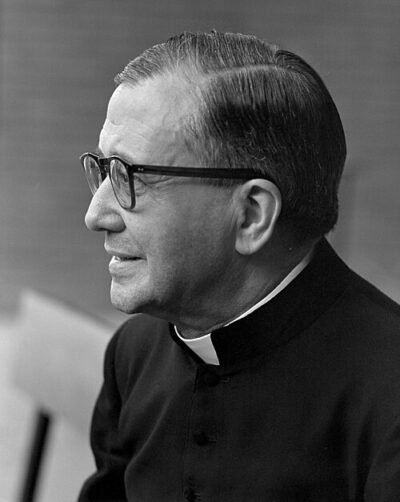
Josemaría Escrivá
Josemaría Escrivá was a Spanish priest, writer and Catholic saint. Born January 9, 1902, in Barbastro city. Died June 26, 1975, in Rome. Positions held include chaplain and president of the priestly society of the Holy Cross (1943–1975). Known for Prelature of the Holy Cross and Opus Dei. Educated at Piarists of Barbastro and Seminary of San Francisco de Paula. Awards include Grand Cross of the Order of Charles III, Grand Cross of the Order of Isabella the Catholic and Grand Cross of the Order of St. Raymond of Peñafort.
Facts
47 facts · 2 confirmed by two sources · 9 cited · 36 from one source
Where this comes from
Papalocal keeps its own record. It started from these sources; what each one said is kept here as it was copied, so a change on their side never changes this page by itself. Tap one to read its version.
What Wikidata says · copied November 16, 2026 · revision 2563913307
- Described as
- Spanish priest, writer and Catholic saint
- Other names
- Josemaria Escriva de Balaguer, Josemaria Escriva, Josepmaria Escrivà, Josemaría Escrivá de Balaguer
- Born
- January 9, 1902 · 7 references
- Died
- June 26, 1975 · 7 references
- Born in
- Barbastro city · 1 reference
- Died in
- Rome · 2 references
- Buried in
- prelatic church of Our Lady of Peace
- Cause of death
- disease
- Name at birth
- José María Julián Mariano Escrivá Albás
- Citizen of
- Spain · 1 reference
- Occupation
- Latin Catholic priest (1925–) · 1 reference; writer; lawyer; theologian · 1 reference; jurist · 1 reference; Catholic priest · 1 reference
- Positions held
- chaplain; president of the priestly society of the Holy Cross (1943–1975)
- Education
- Piarists of Barbastro; Seminary of San Francisco de Paula (1918–1925) · 2 references; Pontifical University of Zaragoza · 1 reference; Faculty of Law of the University of Zaragoza; Universidad Central; Pontifical Lateran University
- Member of
- Prelature of the Holy Cross and Opus Dei; Priestly Society of the Holy Cross
- Known for
- Prelature of the Holy Cross and Opus Dei
- Awards
- Grand Cross of the Order of Charles III (1960); Grand Cross of the Order of Isabella the Catholic (1956) · 1 reference; Grand Cross of the Order of St. Raymond of Peñafort (1954) · 1 reference; Grand Cross of the Civil Order of Beneficence (1964) · 1 reference; Hijo Predilecto de Barbastro (1947); Hijo Adoptivo de Barcelona (1966); Hijo Adoptivo de Pamplona (1960); honorary doctor of the University of Zaragoza (1960); Grand Cross of the Civil Order of Alfonso X the Wise (1951) · 1 reference
- Father
- José Escriba y Corzán
- Mother
- María de los Dolores Albás y Blanc
- Siblings
- Santiago Escrivá de Balaguer y Albás; Carmen Escrivá de Balaguer y Albás; María Asunción Escrivá Albás; María de los Dolores Escrivá Albás; María del Rosario Escrivá Albás
- Religion
- Catholic Church
- Lived in
- Barbastro (1902–1914); Logroño (1914–1920); Zaragoza (1920–1927); Madrid (1927–1946); Villa Tevere (1946–1975)
- Wikipedias with a page
- 64
Wikidata item Q186807 (wikidata.org/wiki/Q186807), public domain (CC0). Copied November 16, 2026.
What Wikipedia says · copied November 16, 2026 · revision 1382296128
Josemaría Escrivá de Balaguer y Albás (9 January 1902 – 26 June 1975) was a Spanish Catholic priest who founded Opus Dei, an organization of laypeople and priests dedicated to the principle of everyday holiness. He was canonized by Pope John Paul II in 2002.
Escrivá studied for the priesthood in Logroño and Zaragoza and in 1925 was ordained in the latter. He then moved to Madrid, where he pursued doctoral studies in civil law at the Central University. After the start of the Spanish Civil War in 1936, Escrivá fled from Madrid, via Andorra and France, to the city of Burgos, which at the time served as the headquarters of the rebel Nationalist forces under General Francisco Franco. After the military triumph of the Nationalists, Escrivá returned to Madrid and completed his doctorate in 1939. His principal work was the initiation, government and expansion of Opus Dei. His best-known publication is The Way, which has been translated into 43 languages and has sold several million copies. Escrivá settled in Rome in 1946. In 1955, he received a doctorate in theology from the Lateran University.
Escrivá and Opus Dei have attracted attention and controversy within the Catholic Church and in the worldwide press, including allegations of secrecy, elitism, cult-like practices, collaboration with the dictatorship of General Franco in Spain (1936–1975) and other right-wing political causes, as well as financial malfeasance. After his death, Escrivá's beatification and canonization in 2002 also generated considerable comment and contention. Several former members of Opus Dei and associates of Escrivá have publicly questioned his personal character and holiness.
Sources close to Opus Dei, and some independent journalists such as the Vatican analyst John L. Allen Jr., have argued that many of those accusations are unproven and originate with Escrivá's personal enemies. John Paul II and other Catholic leaders have endorsed Escrivá's teachings on the universal call to holiness, the role of the laity, and the sanctifying effect of ordinary work. According to Allen, among Catholics, Escrivá is "reviled by some and venerated by millions more".
- Born, in its opening lines
- January 9, 1902
- Died, in its opening lines
- June 26, 1975
From the Wikipedia article “Josemaría Escrivá” (en.wikipedia.org/wiki/Josemaría_Escrivá), by its contributors, under CC BY-SA 4.0 (creativecommons.org/licenses/by-sa/4.0/). Copied November 16, 2026; not changed.
Confirmed Two sources agree. Cited One source, and it names where it got it. One source One source, without a reference of its own. Sources disagree The sources disagree. We show the best-supported value and keep theirs below.
