
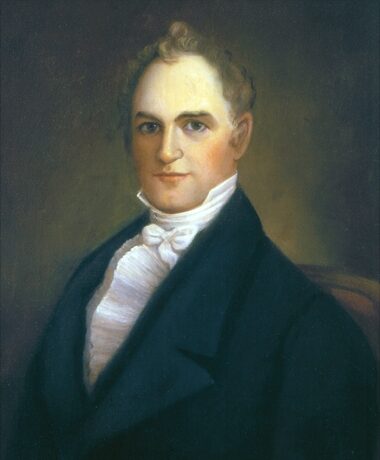
Joseph Desha
Joseph Desha was an American politician. Born December 9, 1768, in Monroe County. Died October 11, 1842, in Georgetown. Positions held include United States representative (1807–1819), Governor of Kentucky (1824–1828) and member of the State Senate of Kentucky (1802–1807).
Facts
19 facts · 2 confirmed by two sources · 4 cited · 13 from one source
Where this comes from
Papalocal keeps its own record. It started from these sources; what each one said is kept here as it was copied, so a change on their side never changes this page by itself. Tap one to read its version.
What Wikidata says · copied November 18, 2026 · revision 2512794987
- Described as
- American politician (1768-1842)
- Born
- December 9, 1768 · 3 references
- Died
- October 11, 1842 · 3 references
- Born in
- Monroe County
- Died in
- Georgetown
- Buried in
- Georgetown Cemetery
- Citizen of
- United States
- Occupation
- politician · 1 reference
- Positions held
- United States representative (1807–1819); Governor of Kentucky (1824–1828); member of the State Senate of Kentucky (1802–1807); member of the Kentucky House of Representatives (1797–1802)
- Political party
- Democratic-Republican Party
- Children
- Isaac B. Desha; John Desha · 1 reference; John Rollin Langhern Desha · 1 reference
- Father
- Robert Desha
- Mother
- Eleanor Holmes Desha · 1 reference
- Siblings
- Robert Desha
- Military rank
- major general
- Wikipedias with a page
- 15
Wikidata item Q359460 (wikidata.org/wiki/Q359460), public domain (CC0). Copied November 18, 2026.
What Wikipedia says · copied November 18, 2026 · revision 1384127091
Joseph Desha (December 9, 1768 – October 11, 1842) was an American politician who was a U.S. representative from Kentucky from 1807 to 1819 and the ninth governor of Kentucky from 1824 to 1828. First known as an Indian fighter from Middle Tennessee, Desha settled in Mason County, Kentucky, where he parlayed his military record into several terms in the state legislature.
In 1807, Desha was elected to the first of six consecutive terms in the U.S. House of Representatives. A Democratic-Republican, he was considered a war hawk, supporting the War of 1812. In 1813, he volunteered to serve in the war and commanded a division at the Battle of the Thames. Returning to Congress after the war, he was the only member of the Kentucky congressional delegation to oppose the unpopular Compensation Act of 1816. Nearly every other member of the delegation was defeated for reelection after the vote, but Desha's opposition to the act helped him retain his seat. He did not seek reelection in 1818, and made an unsuccessful run for governor in 1820, losing to John Adair. By 1824, the Panic of 1819 had ruined Kentucky's economy, and Desha made a second campaign for the governorship almost exclusively on promises of relief for the state's large debtor class. He was elected by a large majority, and debt relief partisans captured both houses of the General Assembly. After the Kentucky Court of Appeals overturned debt relief laws favored by Desha and the majority of the legislature, the legislators abolished the court and created a replacement court, to which Desha appointed several debt relief partisans. The existing court refused to acknowledge the legitimacy of the move, and during a period known as the Old Court – New Court controversy, two courts of last resort existed in the state.
Although popular when elected, Desha's reputation was damaged by two controversies during his term. The first was his role in the ouster of Horace Holley as president of Transylvania University. While the religious conservatives on the university's board opposed Holley because they considered him too liberal, Desha's opposition was primarily based on Holley's friendship with Henry Clay, one of Desha's political enemies. After Desha bitterly denounced Holley in an address to the legislature in late 1825, Holley resigned. Desha's reputation took a further hit after his son, Isaac B. Desha, was charged with murder. Partially because of Desha's influence as governor, two guilty verdicts were overturned. After the younger Desha unsuccessfully attempted suicide while awaiting a third trial, Governor Desha issued a pardon for his son. These controversies, along with an improving economy, propelled Desha's political foes to victory in the legislative elections of 1825 and 1826. They abolished the so-called "Desha court" over Desha's veto, ending the court controversy. In a final act of defiance, Desha threatened to refuse to vacate the governor's mansion, although he ultimately acquiesced without incident, ceding the governorship to his successor, National Republican Thomas Metcalfe. At the expiration of his term, he retired from public life and ultimately died at his son's home in Georgetown, Kentucky, on October 11, 1842.
- Born, in its opening lines
- December 9, 1768
- Died, in its opening lines
- October 11, 1842
From the Wikipedia article “Joseph Desha” (en.wikipedia.org/wiki/Joseph_Desha), by its contributors, under CC BY-SA 4.0 (creativecommons.org/licenses/by-sa/4.0/). Copied November 18, 2026; not changed.
Confirmed Two sources agree. Cited One source, and it names where it got it. One source One source, without a reference of its own. Sources disagree The sources disagree. We show the best-supported value and keep theirs below.
