
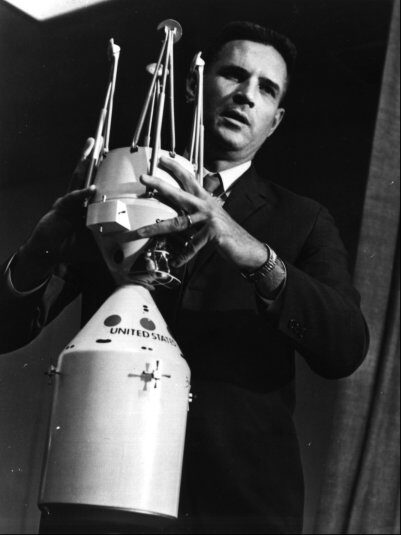
Joseph Francis Shea
Joseph Francis Shea was an aerospace engineer. Born September 5, 1926, in The Bronx. Died February 14, 1999, in Weston. Educated at University of Michigan.
Facts
13 facts · 1 confirmed by two sources · 1 cited · 10 from one source · 1 where the sources disagree
What’s different
- Born: we show September 5, 1926 (Sources disagree). Wikipedia says September 5, 1925
Where this comes from
Papalocal keeps its own record. It started from these sources; what each one said is kept here as it was copied, so a change on their side never changes this page by itself. Tap one to read its version.
What Wikidata says · copied November 18, 2026 · revision 2549437445
- Described as
- aerospace engineer (1926-1999)
- Born
- September 5, 1926 · 1 reference
- Died
- February 14, 1999
- Born in
- The Bronx
- Died in
- Weston
- Citizen of
- United States
- Occupation
- military officer; military flight engineer; engineer
- Worked for
- Massachusetts Institute of Technology; National Aeronautics and Space Administration
- Education
- University of Michigan
- Member of
- National Academy of Engineering · 1 reference
- Military branch
- United States Navy
- Wikipedias with a page
- 15
Wikidata item Q2988651 (wikidata.org/wiki/Q2988651), public domain (CC0). Copied November 18, 2026.
What Wikipedia says · copied November 18, 2026 · revision 1368232535
Joseph Francis Shea (September 5, 1925 – February 14, 1999) was an American aerospace engineer and NASA manager. Born in the Bronx borough of New York City, he was educated at the University of Michigan, receiving a Ph.D. in Engineering Mechanics in 1955. After working for Bell Labs on the guidance systems of the Titan I and Titan II intercontinental ballistic missiles, he was hired by NASA in 1961. As deputy director of NASA's Office of Manned Space Flight, and later as head of the Apollo Spacecraft Program Office, Shea played a key role in shaping the course of the Apollo program, helping to lead NASA to the decision in favor of lunar orbit rendezvous and supporting "all up" testing of the Saturn V rocket. While sometimes causing controversy within the agency, Shea was remembered by his former colleague George Mueller as "one of the greatest systems engineers of our time".
Deeply involved in the investigation of the 1967 Apollo 1 fire, Shea suffered from stress. He was moved to an alternative position in Washington and left NASA shortly afterwards. From 1968 until 1990, he worked as a senior manager at Raytheon in Lexington, Massachusetts, and thereafter became an adjunct professor of aeronautics and astronautics at MIT. While Shea served as a consultant for NASA on the redesign of the International Space Station in 1993, he was forced to resign from the position due to health issues. He died in 1999.
- Born, in its opening lines
- September 5, 1925
- Died, in its opening lines
- February 14, 1999
From the Wikipedia article “Joseph Francis Shea” (en.wikipedia.org/wiki/Joseph_Francis_Shea), by its contributors, under CC BY-SA 4.0 (creativecommons.org/licenses/by-sa/4.0/). Copied November 18, 2026; not changed.
Confirmed Two sources agree. Cited One source, and it names where it got it. One source One source, without a reference of its own. Sources disagree The sources disagree. We show the best-supported value and keep theirs below.
