
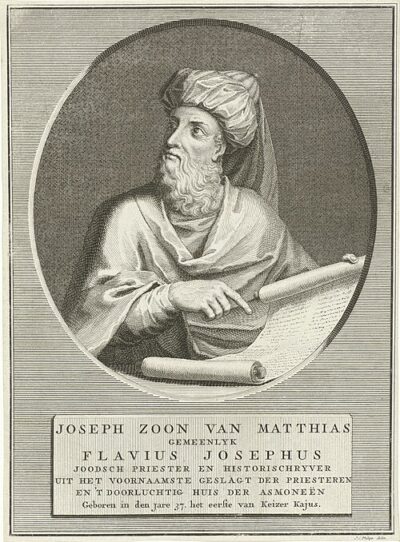
Josephus
Josephus was a Roman–Jewish historian and military leader (c. 37–c. 100). Born 37, in Jerusalem. Died 100, in Rome. Known for The Jewish War, Antiquities of the Jews and The Life of Flavius Josephus.
Facts
19 facts · 0 confirmed by two sources · 10 cited · 9 from one source
Where this comes from
Papalocal keeps its own record. It started from these sources; what each one said is kept here as it was copied, so a change on their side never changes this page by itself. Tap one to read its version.
What Wikidata says · copied November 16, 2026 · revision 2569024944
- Described as
- Roman–Jewish historian and military leader (c. 37–c. 100)
- Other names
- Joseph ben Matityahu, Flavius Iosephus, Titus Flavius Josephus, Flavius Josephus
- Born
- 37 · 3 references
- Died
- 100 · 1 reference
- Born in
- Jerusalem · 3 references
- Died in
- Rome · 1 reference
- Name at birth
- יוסף בן מתתיהו
- Citizen of
- Ancient Rome
- Occupation
- writer · 5 references; historian · 4 references
- Known for
- The Jewish War · 1 reference; Antiquities of the Jews · 1 reference; The Life of Flavius Josephus; Against Apion
- Field
- history · 1 reference; historiography · 1 reference
- Children
- Flavius Hyrcanus; Flavius Simonides Agrippa; Flavius Justus
- Father
- Matthias
- Siblings
- Matthias
- Wikipedias with a page
- 94
Wikidata item Q134461 (wikidata.org/wiki/Q134461), public domain (CC0). Copied November 16, 2026.
What Wikipedia says · copied November 16, 2026 · revision 1384251431
Flavius Josephus (born Yosef ben Mattityahu; c. AD 36 – c. 100) was a Roman–Jewish historian and military leader. Best known for writing The Jewish War, he was born in Jerusalem—then part of the Roman province of Judea—to a father of priestly descent and a mother who claimed Hasmonean royal ancestry.
He initially fought against the Roman Empire during the First Jewish–Roman War as general of the Jewish forces in Galilee, until surrendering in AD 67 to the Roman army led by Vespasian after the six-week siege of Yodfat. Josephus claimed the Jewish messianic prophecies that initiated the First Jewish–Roman War made reference to Vespasian becoming Roman emperor. In response, Vespasian decided to keep him as a slave and presumably interpreter. After Vespasian became emperor in AD 69, he granted Josephus his freedom, at which time Josephus assumed the Emperor's family name of Flavius.
Flavius Josephus fully defected to the Roman side and was granted Roman citizenship. He became an advisor and close associate of Vespasian's son Titus, serving as his translator during Titus's protracted siege of Jerusalem in AD 70, which resulted in the near-total razing of the city and the destruction of the Second Temple.
Josephus recorded the Great Jewish Revolt (AD 66–70), including the siege of Masada. Some notable works were The Jewish War (c. 75), Antiquities of the Jews (c. 94), and his autobiography The Life of Flavius Josephus (c. 94-99). The Jewish War recounts the Jewish revolt against Roman occupation. Antiquities of the Jews recounts the history of the world from a Jewish perspective for an ostensibly Greek and Roman audience. His autobiography recounts details of his whole life and most on his tenure as commander of Galilee during the revolt against Rome. These works provide insight into first-century Judaism and the background of Early Christianity. Josephus' works are the chief source next to the Bible for the history and antiquity of ancient Israel and Judea during the Second Temple period. They also provide extra-biblical accounts of figures such as Pontius Pilate, Herod the Great, John the Baptist, James, brother of Jesus, and Jesus of Nazareth.
From the Wikipedia article “Josephus” (en.wikipedia.org/wiki/Josephus), by its contributors, under CC BY-SA 4.0 (creativecommons.org/licenses/by-sa/4.0/). Copied November 16, 2026; not changed.
Confirmed Two sources agree. Cited One source, and it names where it got it. One source One source, without a reference of its own. Sources disagree The sources disagree. We show the best-supported value and keep theirs below.
