
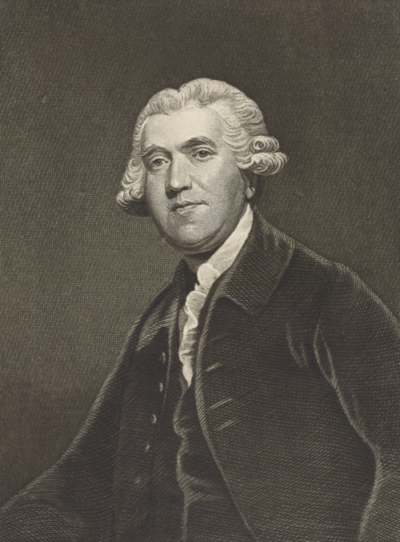
Josiah Wedgwood
Josiah Wedgwood was an English potter and founder of the Wedgwood company. Born July 12, 1730, in Burslem. Died January 3, 1795, in Etruria. Awards include Fellow of the Royal Society.
Facts
31 facts · 2 confirmed by two sources · 21 cited · 8 from one source
Where this comes from
Papalocal keeps its own record. It started from these sources; what each one said is kept here as it was copied, so a change on their side never changes this page by itself. Tap one to read its version.
What Wikidata says · copied November 16, 2026 · revision 2568063469
- Described as
- English potter and founder of the Wedgwood company (1730–1795)
- Other names
- J. Wedgwood I
- Born
- July 12, 1730 · 6 references
- Died
- January 3, 1795 · 8 references
- Born in
- Burslem
- Died in
- Etruria · 2 references
- Buried in
- Staffordshire
- Citizen of
- Kingdom of Great Britain
- Occupation
- potter; entrepreneur · 1 reference; abolitionist; designer · 1 reference; ceramics designer · 1 reference
- Member of
- Royal Society of London; Lunar Society of Birmingham · 1 reference; Wedgwood and Bentley
- Awards
- Fellow of the Royal Society
- Spouse
- Sarah Wedgwood (1764–) · 2 references
- Children
- Josiah Wedgwood · 1 reference; Thomas Wedgwood · 1 reference; John Wedgwood · 1 reference; Susannah Wedgwood · 1 reference; Sarah Wedgwood · 2 references; Richard Wedgwood · 1 reference; Catherine Wedgwood · 1 reference; Mary Ann Wedgwood · 3 references; Paul Foley · 2 references
- Father
- Thomas Wedgwood III · 1 reference
- Mother
- Mary Stringer · 2 references
- Siblings
- John Wedgwood · 1 reference; Thomas Wedgwood IV · 1 reference; Margaret Wedgwood · 1 reference; Catherine Wedgwood · 1 reference
- Wikipedias with a page
- 39
Wikidata item Q319331 (wikidata.org/wiki/Q319331), public domain (CC0). Copied November 16, 2026.
What Wikipedia says · copied November 16, 2026 · revision 1383299088
Josiah Wedgwood (12 July 1730 – 3 January 1795) was an English potter, entrepreneur and abolitionist. Founding the Wedgwood company in 1759, he developed improved pottery bodies by systematic experimentation, and was the leader in the industrialisation of the manufacture of European pottery.
The renewed classical enthusiasms of the late 1760s and early 1770s were of major importance to his sales promotion. His expensive goods were in much demand from the upper classes, while he used emulation effects to market cheaper sets to the rest of society. Every new invention that Wedgwood produced – green glaze, creamware, black basalt, and jasperware – was quickly copied. Having once achieved efficiency in production, he obtained efficiencies in sales and distribution. His showrooms in London gave the public the chance to see his complete range of tableware.
Wedgwood's company never made porcelain during his lifetime, but specialised in fine earthenwares and stonewares that had many of the same qualities, but were considerably cheaper. He made great efforts to keep the designs of his wares in tune with current fashion. He was an early adopter of transfer printing which gave similar effects to hand-painting for a far lower cost. Meeting the demands of the consumer revolution that helped drive the Industrial Revolution in Britain, Wedgwood is credited as a pioneer of modern marketing. He pioneered direct mail, money-back guarantees, self-service, free delivery, buy one get one free, and illustrated catalogues.
A prominent abolitionist fighting slavery, Wedgwood is remembered too for his Am I Not a Man and a Brother? anti-slavery medallion, which had been commissioned by Joseph Hooper, a founder of the Society for Effecting the Abolition of the Slave Trade. The medallion used the design from that society.
Wedgwood was a member of the Darwin–Wedgwood family, and he was the grandfather of Charles and Emma Darwin.
- Born, in its opening lines
- July 12, 1730
- Died, in its opening lines
- January 3, 1795
From the Wikipedia article “Josiah Wedgwood” (en.wikipedia.org/wiki/Josiah_Wedgwood), by its contributors, under CC BY-SA 4.0 (creativecommons.org/licenses/by-sa/4.0/). Copied November 16, 2026; not changed.
Confirmed Two sources agree. Cited One source, and it names where it got it. One source One source, without a reference of its own. Sources disagree The sources disagree. We show the best-supported value and keep theirs below.
