
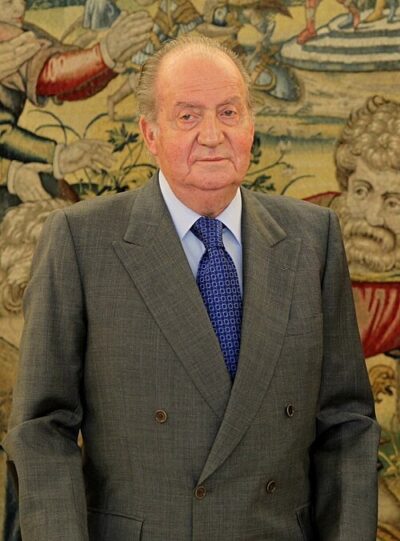
Juan Carlos I of Spain is a King of Spain from 1975 to 2014. Born January 5, 1938, in Rome. Positions held include Prince of Spain (1969–1975), king emeritus of Spain (2014–) and Monarch of Spain (1975–2014). Educated at Instituto San Isidro and Villa St. Jean International School. Awards include Grand Cross of the Legion of Honour, Knight Grand Cross with Collar of the Order of Merit of the Italian Republic and Order of the White Eagle.
Facts
53 facts · 1 confirmed by two sources · 15 cited · 37 from one source
Where this comes from
Papalocal keeps its own record. It started from these sources; what each one said is kept here as it was copied, so a change on their side never changes this page by itself. Tap one to read its version.
What Wikidata says · copied November 16, 2026 · revision 2565151619
- Described as
- King of Spain from 1975 to 2014
- Other names
- Juan Carlos I, Juan Carlos Alfonso Víctor María de Borbón y Borbón-Dos Sicilias, Juan Carlos Alfonso Víctor María de Todos los Santos
- Born
- January 5, 1938 · 8 references
- Born in
- Rome · 3 references
- Citizen of
- Spain · 1 reference
- Occupation
- monarch; aristocrat; royalty; military officer
- Positions held
- Prince of Spain (1969–1975); king emeritus of Spain (2014–); Monarch of Spain (1975–2014); Head of State of Spain (1975–2014); Grand Master of the Order of Alcántara (1975–2014) · 1 reference
- Education
- Instituto San Isidro · 1 reference; Villa St. Jean International School; General Military Academy (1955–1957) · 1 reference; Military Naval Academy (1957–1958) · 1 reference; Academia General del Aire (1958–1959) · 1 reference; University of Madrid (1961–) · 1 reference
- Member of
- Académie des Sciences Morales et Politiques; Club of Rome; Spanish Royal Family; Juan Carlos I of Spain and Queen Sofía
- Sport
- sailing · 1 reference
- Awards
- Grand Cross of the Legion of Honour; Knight Grand Cross with Collar of the Order of Merit of the Italian Republic (1980); Order of the White Eagle; Collar of the Order of the White Lion; Knight of the Order of the Golden Fleece; Charlemagne Prize (1982) · 1 reference; Félix Houphouët-Boigny Peace Prize (1994); Four Freedoms Award – Freedom Medal (1996); Nansen Refugee Award (1987); Grand Cross with Collar of the Order of the Three Stars; Grand Cross with Chain of the Order of Merit of the Republic of Hungary (civil); Collar of the Order of the Star of Romania; Order of Francisco Morazán; Royal Victorian Chain (1986); International Simón Bolívar Prize (1983)
- Spouse
- Queen Sofía of Spain (1962–) · 1 reference
- Children
- Infanta Elena, Duchess of Lugo · 1 reference; Infanta Cristina of Spain · 1 reference; Felipe VI of Spain · 1 reference
- Father
- Infante Juan, Count of Barcelona · 1 reference
- Mother
- Infanta María de las Mercedes, Countess of Barcelona · 1 reference
- Siblings
- Infanta Margarita, Duchess of Soria; Infanta Pilar, Duchess of Badajoz; Infante Alfonso of Spain
- Religion
- Catholic Church
- Military rank
- Captain general of the Army (1975–) · 1 reference; Air captain general · 1 reference; Capitán General de la Real Armada Española · 1 reference
- Lived in
- Palace of Zarzuela
- Height
- 1.82 m (6 ft 0 in) · 1 reference
- Wikipedias with a page
- 126
Wikidata item Q19943 (wikidata.org/wiki/Q19943), public domain (CC0). Copied November 16, 2026.
What Wikipedia says · copied November 16, 2026 · revision 1382489517
Juan Carlos I (Spanish: [xwaŋˈ kaɾlos]; Juan Carlos Alfonso Víctor María de Borbón y Borbón-Dos Sicilias; born 5 January 1938) is a member of the Spanish royal family who reigned as King of Spain from 1975 until his abdication in 2014. Although chosen by Francisco Franco as his successor, Juan Carlos helped dismantle the Francoist system and oversee the Spanish transition to democracy.
Juan Carlos is the son of Infante Juan, Count of Barcelona, and grandson of Alfonso XIII, the last king of Spain before the abolition of the monarchy in 1931 and the subsequent declaration of the Second Spanish Republic. Juan Carlos was born in Rome, Italy, during his family's exile. General Francisco Franco took over the government of Spain after his victory in the Spanish Civil War in 1939, yet in 1947 Spain's status as a monarchy was affirmed and a law was passed allowing Franco to choose his successor. Juan Carlos's father assumed his claims to the throne after former king Alfonso XIII died in February 1941. However, Franco saw Juan Carlos's father to be too liberal and in 1969 declared Juan Carlos to be Prince of Spain, his successor as head of state.
Juan Carlos spent his early years in Italy and came to Spain in 1947 to continue his studies. After completing his secondary education in 1955, he began his military training and entered the General Military Academy at Zaragoza. Later, he attended the Naval Military Academy and the General Academy of the Air, and finished his tertiary education at the University of Madrid. In 1962, Juan Carlos married Princess Sophia of Greece and Denmark in Athens. The couple have three children: Elena, Cristina, and Felipe. Due to Franco's advanced age and declining health amid his struggle with Parkinson's disease, Juan Carlos first began periodically acting as Spain's head of state in the summer of 1974. In November the following year, Franco died and Juan Carlos became king.
Juan Carlos was expected to continue Franco's legacy, but instead introduced reforms to dismantle the Francoist regime and to begin Spain's transition to democracy soon after his accession. This led to the 1977 general election, the first free election in Spain since 1936, followed by the approval of the Spanish Constitution of 1978 in a referendum which re-established a constitutional monarchy. In 1981, Juan Carlos played a major role in preventing a coup that attempted to revert to Francoist government in the King's name. In 2008, he was considered the most popular leader across all Ibero-America. Hailed for his role in Spain's transition to democracy, the King and the monarchy's reputation began to suffer after controversies surrounding his family arose, exacerbated by the public controversy centering on an elephant-hunting trip he undertook during a time of financial crisis in Spain.
In June 2014, Juan Carlos abdicated in favour of his son, who acceded to the throne as Felipe VI. Since August 2020, Juan Carlos has lived in self-imposed exile from Spain over allegedly improper ties to business deals in Saudi Arabia. The New York Times estimated in 2014 that Juan Carlos's fortune was around €1.8 billion ($2.3 billion). Juan Carlos is the second-oldest-living member of the Spanish royal family after Teresa de Borbón-Dos Sicilias.
- Born, in its opening lines
- January 5, 1938
From the Wikipedia article “Juan Carlos I” (en.wikipedia.org/wiki/Juan_Carlos_I), by its contributors, under CC BY-SA 4.0 (creativecommons.org/licenses/by-sa/4.0/). Copied November 16, 2026; not changed.
Confirmed Two sources agree. Cited One source, and it names where it got it. One source One source, without a reference of its own. Sources disagree The sources disagree. We show the best-supported value and keep theirs below.
