
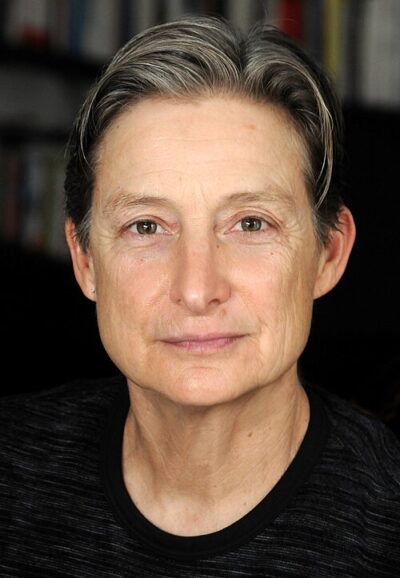
Judith Butler
Judith Butler is an American feminist gender studies philosopher. Born February 24, 1956, in Cleveland. Known for Vulnerability in Resistance, Torture and the Ethics of Photography and Gender Trouble. Educated at Bennington College and Yale University. Awards include Brudner Prize, honorary doctorate of the Bordeaux Montaigne University and honorary doctorate from the University of Paris-VII.
Facts
43 facts · 1 confirmed by two sources · 22 cited · 20 from one source
Where this comes from
Papalocal keeps its own record. It started from these sources; what each one said is kept here as it was copied, so a change on their side never changes this page by itself. Tap one to read its version.
What Wikidata says · copied November 13, 2026 · revision 2567928530
- Described as
- American feminist gender studies philosopher (born 1956)
- Other names
- Judith Pamela Butler, Judith P. Butler, Butler
- Born
- February 24, 1956 · 9 references
- Born in
- Cleveland · 3 references
- Citizen of
- United States
- Occupation
- philosopher · 3 references; writer; university teacher · 2 references; sociologist; literary critic; women's rights activist · 1 reference; journalist; art theorist · 1 reference
- Worked for
- Wesleyan University; University of California, Berkeley (1993–) · 1 reference; European Graduate School · 1 reference
- Education
- Bennington College · 2 references; Yale University (1978) · 2 references; Heidelberg University · 1 reference
- Member of
- American Academy of Arts and Sciences; British Academy (2015–) · 1 reference
- Known for
- Vulnerability in Resistance · 1 reference; Torture and the Ethics of Photography; Gender Trouble · 1 reference; Bodies That Matter · 1 reference
- Awards
- Brudner Prize (2004); honorary doctorate of the Bordeaux Montaigne University (2011) · 1 reference; honorary doctorate from the University of Paris-VII (2011) · 2 references; Theodor W. Adorno Award (2012) · 2 references; honorary doctorate from the McGill University (2013); honorary doctor of the University of St Andrews (2013); Honorary doctor of the University of Fribourg (2014); Honorary doctor of the University of Liège (2015); Albertus-Magnus professorate (2016) · 1 reference; Catalonia International Prize (2021) · 1 reference; Chevalier des Arts et des Lettres; Guggenheim Fellowship · 1 reference; Fellow of the British Academy (2015) · 1 reference; honorary doctor of the Autonomous University of Barcelona (2026) · 1 reference
- Field
- feminist theory; queer theory; literary theory; gender studies; transsexualism; sociology · 1 reference
- Wikipedias with a page
- 91
Wikidata item Q219368 (wikidata.org/wiki/Q219368), public domain (CC0). Copied November 13, 2026.
What Wikipedia says · copied November 13, 2026 · revision 1385285092
Judith Butler (born February 24, 1956) is an American feminist, queer philosopher, and gender studies scholar whose work has influenced political philosophy, ethics, psychoanalysis, and the fields of feminist and queer theory, academic freedom, and literary theory.
Butler has held academic appointments at Wesleyan University, George Washington University, and Johns Hopkins University where they received tenure in 1992 before joining the faculty in the Department of Rhetoric at the University of California, Berkeley in 1993. There they became the Maxine Elliot Professor in 1998, holding faculty appointments in the Departments of Rhetoric and Comparative Literature and the program in critical theory which they cofounded in 2007. They founded the International Consortium of Critical Theory, funded by the Mellon Foundation, in 2015. They also hold the Hannah Arendt Chair at the European Graduate School (EGS).
Butler is best known for the books Gender Trouble: Feminism and the Subversion of Identity (1990) and Bodies That Matter: On the Discursive Limits of Sex (1993), in which they challenge conventional, heteronormative notions of gender and develop their theory of gender performativity. This theory has had a major influence on feminist and queer scholarship.
Butler has also spoken and written on war, non-violence, ethics, public mourning, democratic theory and other contemporary political questions, including the Palestinian struggles and the limits of Zionism. They have also spoken internationally in support of LGBTQIA rights and against anti-gender ideology.
- Born, in its opening lines
- February 24, 1956
From the Wikipedia article “Judith Butler” (en.wikipedia.org/wiki/Judith_Butler), by its contributors, under CC BY-SA 4.0 (creativecommons.org/licenses/by-sa/4.0/). Copied November 13, 2026; not changed.
Confirmed Two sources agree. Cited One source, and it names where it got it. One source One source, without a reference of its own. Sources disagree The sources disagree. We show the best-supported value and keep theirs below.
