
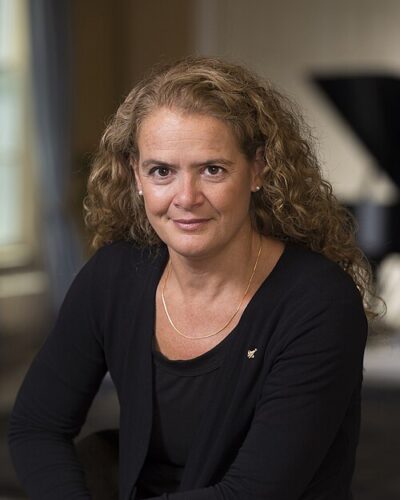
Julie Payette
Julie Payette is the 29th governor general of Canada, former CSA Astronaut. Born October 20, 1963, in Montreal. Positions held include Governor General of Canada (2017–2021). Educated at McGill University and University of Toronto. Awards include Officer of the Order of Canada, Knight of the National Order of Quebec and NASA Exceptional Service Medal.
Facts
28 facts · 1 confirmed by two sources · 7 cited · 20 from one source
Where this comes from
Papalocal keeps its own record. It started from these sources; what each one said is kept here as it was copied, so a change on their side never changes this page by itself. Tap one to read its version.
What Wikidata says · copied November 13, 2026 · revision 2542577153
- Described as
- 29th governor general of Canada, former CSA Astronaut (born 1963)
- Born
- October 20, 1963 · 1 reference
- Born in
- Montreal · 1 reference
- Citizen of
- Canada
- Occupation
- astronaut · 1 reference; engineer; politician (2017–2021) · 1 reference
- Positions held
- Governor General of Canada (2017–2021)
- Worked for
- IBM; Bell-Northern Research; Canadian Space Agency; Government of Canada
- Education
- McGill University (–1986); University of Toronto (–1990); UWC Atlantic College; Collège Regina Assumpta
- Awards
- Officer of the Order of Canada (–2017); Knight of the National Order of Quebec (2000) · 1 reference; NASA Exceptional Service Medal (2010); NASA Space Flight Medal; honorary doctorate at the Laval University · 1 reference; Honorary doctor of the University of Ottawa; Fellow of the Royal Society of Canada (2019) · 1 reference; honorary doctorate of Concordia University; honorary doctorate from the University of Alberta; honorary doctorate from the University of British Columbia; Companion of the Order of Canada (2017–); Women of Distinction Awards (2000) · 1 reference
- Lived in
- Rideau Hall (2017–2021) · 1 reference
- Wikipedias with a page
- 55
Wikidata item Q240769 (wikidata.org/wiki/Q240769), public domain (CC0). Copied November 13, 2026.
What Wikipedia says · copied November 13, 2026 · revision 1383489755
Julie Payette (French pronunciation: [ʒyli pajɛt]; born October 20, 1963) is a Canadian engineer, scientist and former astronaut who served as the 29th governor general of Canada from 2017 to 2021.
Payette holds engineering degrees from McGill University and the University of Toronto. She worked as a research scientist before joining the Canadian Space Agency (CSA) in 1992 as a member of the Canadian Astronaut Corps. She completed two spaceflights, STS-96 and STS-127, and has logged more than 25 days in space. She also served as capsule communicator at NASA Mission Control Center in Houston and from 2000 to 2007 as CSA's chief astronaut.
In July 2013, Payette was named chief operating officer for the Montreal Science Centre. She also held a number of board appointments, including the National Bank of Canada. On July 13, 2017, Prime Minister Justin Trudeau announced that Queen Elizabeth II had approved the appointment of Payette as the next governor general of Canada. She was invested on October 2, 2017.
Payette resigned on January 21, 2021, following the conclusion of a workplace review that found she had "belittled, berated and publicly humiliated Rideau Hall staff" and "created a toxic, verbally abusive workplace". The review was initiated by the Privy Council Office to investigate accusations of harassment of civil servants in the Office of the Governor General. The report's official goal was not to validate nor make findings of fact, as it only relied on what interview participants reported.
She is the second governor general to have resigned the office (the first being Roméo LeBlanc, who resigned due to health issues); the first to resign due to scandal; and the first to have left a vacancy upon resignation.
- Born, in its opening lines
- October 20, 1963
From the Wikipedia article “Julie Payette” (en.wikipedia.org/wiki/Julie_Payette), by its contributors, under CC BY-SA 4.0 (creativecommons.org/licenses/by-sa/4.0/). Copied November 13, 2026; not changed.
Confirmed Two sources agree. Cited One source, and it names where it got it. One source One source, without a reference of its own. Sources disagree The sources disagree. We show the best-supported value and keep theirs below.
