
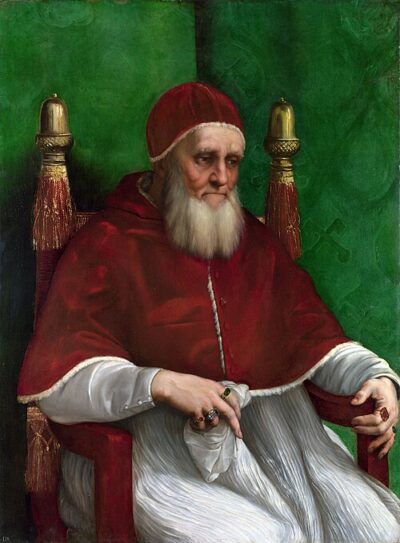
Julius II
Julius II was a pope of the Catholic Church from 1503 to 1513. Born December 5, 1443, in Albisola Superiore. Died February 21, 1513, in Rome. Positions held include Pope (1503–1513), cardinal-bishop of Ostia (1483–1503) and Camerlengo of the Sacred College of Cardinals (1479–1480). Educated at University of Perugia.
Facts
36 facts · 2 confirmed by two sources · 10 cited · 24 from one source
Where this comes from
Papalocal keeps its own record. It started from these sources; what each one said is kept here as it was copied, so a change on their side never changes this page by itself. Tap one to read its version.
What Wikidata says · copied November 16, 2026 · revision 2569098960
- Described as
- pope of the Catholic Church from 1503 to 1513 (1443–1513)
- Other names
- Pope Julius II, Iulius II, The Fearsome Pope, The Warrior Pope, Papa Julio II, Giuliano Della Rovere, Julien de La Rovère, Julien de, Cardinal La Rovère, Julius II. Papst, pape Jules II, Julien de La Rovere, Giuliano della Rovere
- Born
- December 5, 1443 · 2 references
- Died
- February 21, 1513 · 2 references
- Born in
- Albisola Superiore
- Died in
- Rome · 2 references
- Buried in
- St. Peter's Basilica
- Cause of death
- syphilis
- Name at birth
- Giuliano della Rovere
- Citizen of
- Republic of Genoa
- Occupation
- Catholic priest
- Positions held
- Pope (1503–1513) · 2 references; cardinal-bishop of Ostia (1483–1503); Camerlengo of the Sacred College of Cardinals (1479–1480); cardinal-nephew; Roman Catholic Bishop of Carpentras (1471–1472) · 1 reference; Roman Catholic Bishop of Avignon (1474–1475) · 1 reference; bishop of Lausanne (1472–1476) · 3 references; bishop of Viviers (1477–1478) · 2 references; Roman Catholic Bishop of Mende (1478–1483) · 2 references; Roman Caholic Bishop of Bologna (1483–1502) · 2 references; Roman Catholic Bishop of Coutances (1476–1477) · 2 references; bishop of Catania (1473–1474) · 2 references; Archbishop of Avignon (1475–1503) · 2 references; apostolic administrator (2 times) (1473–1503) · 1 reference; cardinal priest of Saint-Pierre-aux-Liens (1471–1503)
- Education
- University of Perugia · 1 reference
- Field
- abbot; politics · 1 reference; Christianity · 1 reference; Catholicism · 1 reference; Renaissance · 1 reference
- Children
- Felice della Rovere
- Father
- Raffaello della Rovere · 1 reference
- Mother
- Teodora Marinola · 1 reference
- Siblings
- Giovanni della Rovere; Luchina della Rovere
- Religion
- Catholic Church · 2 references
- Wikipedias with a page
- 97
Wikidata item Q80516 (wikidata.org/wiki/Q80516), public domain (CC0). Copied November 16, 2026.
What Wikipedia says · copied November 16, 2026 · revision 1377751984
Pope Julius II (Latin: Iulius II; Italian: Giulio II; born Giuliano della Rovere; 5 December 1443 – 21 February 1513) was head of the Catholic Church and leader of the Papal States from 1503 to his death, in February 1513.
Nicknamed the Warrior Pope, the Battle Pope or the Fearsome Pope, it is often speculated that he had chosen his papal name not in honour of Pope Julius I but in emulation of Julius Caesar. One of the most powerful and influential popes, Julius II was a central figure of the High Renaissance and left a significant cultural and political legacy. As a result of his policies during the Italian Wars, the Papal States increased their power and centralization, and the office of the papacy continued to be crucial, diplomatically and politically, during the entirety of the 16th century in Italy and Europe.
In 1506, Julius II established the Vatican Museums and initiated the rebuilding of the St. Peter's Basilica. The same year he organized the famous Swiss Guard for his personal protection and commanded a successful campaign in Romagna against local lords. The interests of Julius II lay also in the New World, as he ratified the Treaty of Tordesillas, establishing the first bishoprics in the Americas and beginning the Catholicization of Latin America. In 1508, he commissioned the Raphael Rooms and Michelangelo's paintings in the Sistine Chapel.
Pope Julius II allowed people seeking indulgences to donate money to the Church, which would be used for the construction of Saint Peter's Basilica. He was fiercely satirized after his death by Erasmus of Rotterdam in Julius Excluded from Heaven, in which the drunken pope, denied entry to heaven by St. Peter, justifies his worldly life and plots to create a rival abode from which to conquer heaven.
- Born, in its opening lines
- December 5, 1443
- Died, in its opening lines
- February 21, 1513
From the Wikipedia article “Pope Julius II” (en.wikipedia.org/wiki/Pope_Julius_II), by its contributors, under CC BY-SA 4.0 (creativecommons.org/licenses/by-sa/4.0/). Copied November 16, 2026; not changed.
Confirmed Two sources agree. Cited One source, and it names where it got it. One source One source, without a reference of its own. Sources disagree The sources disagree. We show the best-supported value and keep theirs below.
