
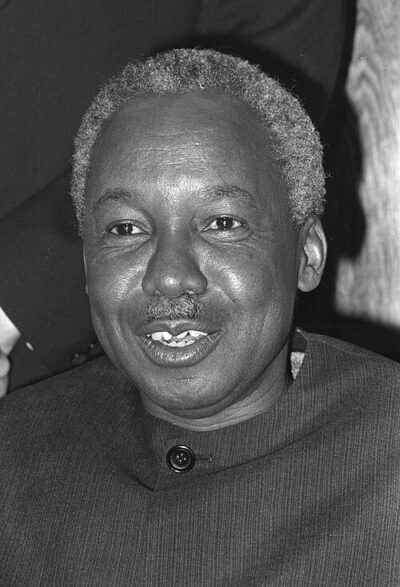
Julius Nyerere
Julius Nyerere was a Tanzanian politician and writer, first Prime Minister and President of Tanzania. Born April 13, 1922, in Butiama. Died October 14, 1999, in London. Positions held include President of Tanzania (1964–1985), chairperson of the Organisation of African Unity (1984–1985) and Prime Minister of Tanganyika (1960–1962). Known for Arusha Declaration. Educated at Makerere University and University of Edinburgh. Awards include Jawaharlal Nehru Award for International Understanding, Order of José Martí and Nansen Refugee Award.
Facts
43 facts · 2 confirmed by two sources · 7 cited · 33 from one source · 1 where the sources disagree
What’s different
- Buried in: we show Butiama (Sources disagree). Wikidata also lists Mara Region
Where this comes from
Papalocal keeps its own record. It started from these sources; what each one said is kept here as it was copied, so a change on their side never changes this page by itself. Tap one to read its version.
What Wikidata says · copied November 16, 2026 · revision 2565420895
- Described as
- Tanzanian politician and writer, first Prime Minister and President of Tanzania (1922–1999)
- Other names
- Julius Kambarage Nyerere, Julius K. Nyerere
- Born
- April 13, 1922 · 4 references
- Died
- October 14, 1999 · 8 references
- Born in
- Butiama · 1 reference
- Died in
- London · 2 references
- Buried in
- Butiama · 1 reference; Mara Region · 1 reference
- Cause of death
- leukemia
- Citizen of
- Tanzania
- Occupation
- linguist; politician · 2 references; translator; writer; educator; teacher
- Positions held
- President of Tanzania (1964–1985); chairperson of the Organisation of African Unity (1984–1985); Prime Minister of Tanganyika (1960–1962); President of Tanganyika (1962–1964); president · 1 reference
- Political party
- Tanganyika African National Union (1954–1977); Party of the Revolution (1977–1999)
- Education
- Makerere University (–1947); University of Edinburgh (–1952); University of Fort Hare
- Known for
- Arusha Declaration
- Awards
- Jawaharlal Nehru Award for International Understanding (1973) · 1 reference; Order of José Martí (1974) · 2 references; Nansen Refugee Award (1983); Lenin Peace Prize; Gandhi Peace Prize (1995); International Simón Bolívar Prize (1992); Royal Order of the Seraphim; Order of the Elephant; Order of Jamaica · 1 reference; Order of the Welwitschia (2010) · 1 reference; Order of Agostinho Neto (1985) · 1 reference; Order of the Companions of O. R. Tambo; Grand Cross of the Order of the Aztec Eagle; Grand Cross with Collar of the Order of the White Rose of Finland (1963) · 1 reference; Honorary doctor of the University of Ottawa
- Spouse
- Maria Nyerere (1953–1999)
- Children
- Rosemary Nyerere
- Father
- Mfumu Burrito Nyerere
- Religion
- Catholicism
- Wikipedias with a page
- 90
Wikidata item Q186525 (wikidata.org/wiki/Q186525), public domain (CC0). Copied November 16, 2026.
What Wikipedia says · copied November 16, 2026 · revision 1384641792
Julius Kambarage Nyerere (Swahili: [ˈdʒulius kɑᵐbɑˈɾɑɠɛ ɲɛˈɾɛɾɛ]; 13 April 1922 – 14 October 1999) was a Tanzanian politician, anti-colonial activist, revolutionary and political theorist. He governed Tanganyika as prime minister from 1961 to 1962 and then as president from 1962 to 1964, after which he led its successor state, Tanzania, as president from 1964 to 1985. He was a founding member and chair of the Tanganyika African National Union (TANU) party and of its successor, Chama Cha Mapinduzi, from 1954 to 1990. Ideologically an African nationalist and African socialist, he promoted a political philosophy known as Ujamaa.
Born in Butiama, then in the British colony of Tanganyika, Nyerere was the son of a Zanaki chief. He studied at Makerere College in Uganda and then Edinburgh University in Scotland. In 1952 he returned to Tanganyika, married, and worked as a school teacher. In 1954, he helped form TANU, through which he campaigned for Tanganyikan independence. Influenced by the Indian independence leader Mahatma Gandhi, Nyerere preached non-violent protest. Elected to the Legislative Council in the 1958–1959 elections, Nyerere then led TANU to victory at the 1960 general election, becoming prime minister. Negotiations with the British authorities resulted in independence in 1961. In 1962, Tanganyika became a republic, with Nyerere elected as its first president. His administration pursued decolonisation and the "Africanisation" of the civil service while promoting unity between indigenous Africans and the country's Asian and European minorities. He encouraged the formation of a one-party state and unsuccessfully pursued the Pan-Africanist formation of an East African Federation with Uganda and Kenya. A 1963 mutiny within the army was suppressed with British assistance.
Following the Zanzibar Revolution of 1964, Zanzibar was unified with Tanganyika to form Tanzania. Nyerere placed a growing emphasis on national self-reliance and socialism, developing close links with Mao Zedong's China. In 1967, Nyerere issued the Arusha Declaration which outlined his vision of Ujamaa. Banks and other major industries and companies were nationalized; education and healthcare were significantly expanded. Renewed emphasis was placed on agricultural development through the formation of communal farms, although these reforms hampered food production and left areas dependent on food aid. His government provided training and aid to anti-colonialist groups fighting white-minority rule throughout southern Africa and oversaw Tanzania's 1978–1979 war with Uganda which resulted in the overthrow of Ugandan President Idi Amin. In 1985, Nyerere stood down and was succeeded by Ali Hassan Mwinyi, who reversed many of Nyerere's policies. He remained chair of Chama Cha Mapinduzi until 1990, supporting a transition to a multi-party system, and later served as mediator in attempts to end the Burundian Civil War.
Nyerere was a controversial figure. Across Africa he gained widespread respect as an anti-colonialist and in power received praise for ensuring that, unlike many of its neighbours, Tanzania remained stable and unified in the decades following independence. His construction of the one-party state and use of detention without trial led to accusations of dictatorial governance, while he has also been blamed for economic mismanagement. He is held in deep respect within Tanzania, where he is described as the "Father of the Nation".
- Born, in its opening lines
- April 13, 1922
- Died, in its opening lines
- October 14, 1999
From the Wikipedia article “Julius Nyerere” (en.wikipedia.org/wiki/Julius_Nyerere), by its contributors, under CC BY-SA 4.0 (creativecommons.org/licenses/by-sa/4.0/). Copied November 16, 2026; not changed.
Confirmed Two sources agree. Cited One source, and it names where it got it. One source One source, without a reference of its own. Sources disagree The sources disagree. We show the best-supported value and keep theirs below.
