
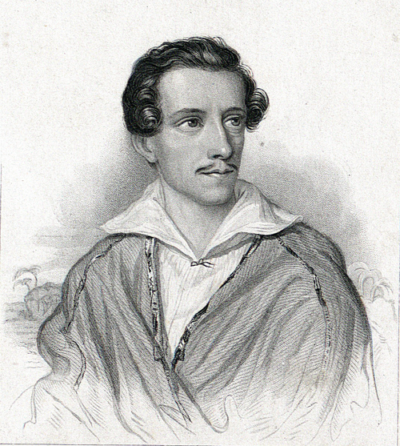
Juliusz Słowacki
Juliusz Słowacki was a Polish Romantic poet. Born September 4, 1809, in Kremenets. Died April 3, 1849, in Paris. Known for Kordian and Balladyna. Educated at Vilnius University.
Facts
24 facts · 2 confirmed by two sources · 7 cited · 15 from one source
Where this comes from
Papalocal keeps its own record. It started from these sources; what each one said is kept here as it was copied, so a change on their side never changes this page by itself. Tap one to read its version.
What Wikidata says · copied November 16, 2026 · revision 2565542730
- Described as
- Polish Romantic poet (1809–1849)
- Born
- September 4, 1809 · 11 references
- Died
- April 3, 1849 · 9 references
- Born in
- Kremenets · 3 references
- Died in
- Paris · 4 references
- Buried in
- Wawel Cathedral
- Cause of death
- tuberculosis
- Citizen of
- Russia; France; Poland
- Occupation
- poet · 2 references; diplomat; translator; playwright · 1 reference; writer · 2 references; philosopher · 1 reference; dramaturge · 1 reference
- Worked for
- Vilnius University
- Education
- Vilnius University
- Member of
- Circle of God's Cause
- Known for
- Kordian; Balladyna
- Field
- fiction · 1 reference
- Father
- Euzebiusz Słowacki · 1 reference
- Mother
- Salomea Slowacka
- Wikipedias with a page
- 66
Wikidata item Q243267 (wikidata.org/wiki/Q243267), public domain (CC0). Copied November 16, 2026.
What Wikipedia says · copied November 16, 2026 · revision 1379200118
Juliusz Słowacki (; Polish: [ˈjuljuʂ swɔˈvat͡skʲi]; French: Jules Slowacki; 4 September 1809 – 3 April 1849) was a Polish Romantic poet. He is considered one of the "Three Bards" of Polish literature — a major figure in the Polish Romantic period, and the father of modern Polish drama. His works often feature elements of Slavic paganism, Polish history, mysticism and orientalism. His style includes the employment of neologisms and irony. His primary genre was the drama, but he also wrote lyric poetry. His most popular works include the dramas Kordian and Balladyna and the poems Beniowski, Testament mój and Anhelli.
Słowacki spent his youth in the so-called "Stolen Lands" within the Russian Empire, in Kremenets (Polish: Krzemieniec, now in Ukraine) and in Vilnius (now Lithuania). He briefly worked for the government of the Kingdom of Poland. During the November 1830 Uprising, he was a courier for the Polish revolutionary government. When the uprising ended in defeat, he found himself abroad and thereafter, like many compatriots, lived the life of an émigré. He settled briefly in Paris, France, and later in Geneva, Switzerland. He also traveled through Italy, Greece and the Middle East. Eventually he returned to Paris, where he spent the last decade of his life. He briefly returned to Poland when another uprising broke out during the Spring of Nations (1848).
- Born, in its opening lines
- September 4, 1809
- Died, in its opening lines
- April 3, 1849
From the Wikipedia article “Juliusz Słowacki” (en.wikipedia.org/wiki/Juliusz_Słowacki), by its contributors, under CC BY-SA 4.0 (creativecommons.org/licenses/by-sa/4.0/). Copied November 16, 2026; not changed.
Confirmed Two sources agree. Cited One source, and it names where it got it. One source One source, without a reference of its own. Sources disagree The sources disagree. We show the best-supported value and keep theirs below.
