
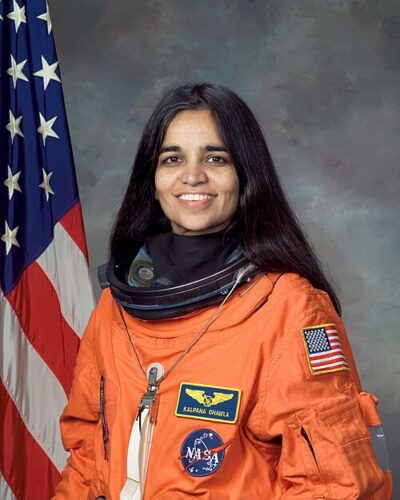
Kalpana Chawla
Kalpana Chawla was an American astronaut. Born March 17, 1962, in Karnal. Died February 1, 2003, in Texas. Educated at Punjab Engineering College and University of Colorado Boulder (2 times). Awards include Congressional Space Medal of Honor, Order of Merit (Ukraine), 3rd class and NASA Space Flight Medal.
Facts
34 facts · 2 confirmed by two sources · 29 cited · 3 from one source
Where this comes from
Papalocal keeps its own record. It started from these sources; what each one said is kept here as it was copied, so a change on their side never changes this page by itself. Tap one to read its version.
What Wikidata says · copied November 13, 2026 · revision 2565867238
- Described as
- American astronaut
- Born
- March 17, 1962 · 3 references
- Died
- February 1, 2003 · 4 references
- Born in
- Karnal · 3 references
- Died in
- Texas
- Buried in
- Zion National Park · 1 reference
- Cause of death
- Space Shuttle Columbia disaster · 2 references
- Citizen of
- India; United States (1991–) · 2 references
- Occupation
- astronaut · 4 references; amateur radio operator · 1 reference; aerospace engineer · 1 reference; flight instructor · 1 reference; aircraft pilot · 1 reference; researcher · 1 reference
- Worked for
- National Aeronautics and Space Administration (1995–) · 2 references; Ames Research Center (1988–1993) · 3 references; Overset Methods, Inc. (1993–) · 3 references
- Education
- Punjab Engineering College (1978–1982) · 2 references; University of Colorado Boulder (2 times) (1986–1988); Tagore Baal Niketan Sr. Sec. School, Karnal (–1976) · 3 references; University of Texas at Arlington (1982–1984) · 2 references
- Awards
- Congressional Space Medal of Honor (2004) · 4 references; Order of Merit (Ukraine), 3rd class (1998) · 1 reference; NASA Space Flight Medal · 2 references; NASA Distinguished Service Medal (2003) · 3 references; Pravasi Bharatiya Samman (2004) · 1 reference; CQ Amateur Radio Hall of Fame (2018) · 1 reference; Doctor of Science (honorary) (2003) · 1 reference
- Field
- computational fluid dynamics · 2 references; aerospace engineering · 1 reference; aerodynamics · 1 reference
- Religion
- Hinduism · 1 reference
- Lived in
- Houston · 1 reference
- Nickname
- K.C. · 1 reference
- Wikipedias with a page
- 72
Wikidata item Q237879 (wikidata.org/wiki/Q237879), public domain (CC0). Copied November 13, 2026.
What Wikipedia says · copied November 13, 2026 · revision 1381545459
Kalpana Chawla (; March 17, 1962 – February 1, 2003) was an Indian-born American astronaut, aerospace engineer, and pilot who was the first woman of Indian heritage to fly into space. Chawla participated in two spaceflights, STS-87 and STS-107, in 1997 and 2003, respectively. On both of these flights, she conducted scientific experiments researching the effects of microgravity on various physical processes. When the crew members in STS-107 descended back to Earth, the Space Shuttle Columbia disintegrated due to damage it sustained at liftoff. This killed all seven astronauts on board, including Chawla.
Chawla was born in Karnal, Haryana, India, to Banarsi Lal Chawla and Sanjyothi Chawla. She had three older siblings: Sunita, Dipa, and Sanjay Chawla. Chawla developed an interest in crewed flight after observing a plane passing over her at the age of three, deciding that she wanted to become an aerospace engineer at the age of 12. She attended Tagore Baal Niketan Senior Secondary School and, after graduating from there, Dayal Singh College. Despite opposition from her father, she transferred from the college to take engineering classes at Punjab Engineering College, from which she obtained a Bachelor of Engineering (BEng). She then emigrated to the United States, where she obtained her MSc from the University of Texas at Arlington (UTA) and her PhD from the University of Colorado Boulder (CU Boulder). While at CU Boulder, she obtained various pilot licenses, Instrument ratings, and flight instructor certificates. She became a naturalized US citizen in the early 1990s.
Chawla's professional career began when she was hired to work at NASA's Ames Research Center in 1988. There, she conducted research into computational fluid dynamics. She then joined Overset Methods, Inc., becoming the vice president of the organization in 1993. In 1994, she returned to NASA in the hopes of becoming an astronaut, undergoing a year of training before being assigned as a mission specialist and robotic arm operator in her first space mission, STS-87. Her performance in the mission caused some controversy due to the failed deployment of the Shuttle-Pointed Autonomous Research Tool for Astronomy (SPARTAN) module.
Chawla was posthumously awarded the Congressional Space Medal of Honor, the NASA Space Flight Medal, and the NASA Distinguished Service Medal. Several buildings, spacecraft, and extraterrestrial landmarks have been named in her honor. In addition, numerous documentaries and biographies have been written about both her life and the Columbia disaster she was in. Over the years, she has become a household name in India because of her ethnicity and achievements, with scholarships and awards being made in her honor, usually to promote female or Indian participation in space exploration.
- Born, in its opening lines
- March 17, 1962
- Died, in its opening lines
- February 1, 2003
From the Wikipedia article “Kalpana Chawla” (en.wikipedia.org/wiki/Kalpana_Chawla), by its contributors, under CC BY-SA 4.0 (creativecommons.org/licenses/by-sa/4.0/). Copied November 13, 2026; not changed.
Confirmed Two sources agree. Cited One source, and it names where it got it. One source One source, without a reference of its own. Sources disagree The sources disagree. We show the best-supported value and keep theirs below.
