
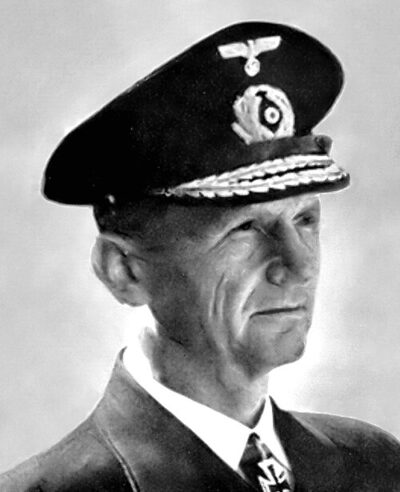
Karl Dönitz
Karl Dönitz was a German admiral and former president of Nazi Germany in 1945. Born September 16, 1891, in Grünau. Died December 24, 1980, in Aumühle. Positions held include president of Germany (1945). Known for Zehn Jahre und Zwanzig Tage. Educated at Naval Academy at Mürwik. Awards include Golden Party Badge, Knight's Cross of the Iron Cross with Oak Leaves and Order of Michael the Brave.
Facts
45 facts · 2 confirmed by two sources · 9 cited · 34 from one source
Where this comes from
Papalocal keeps its own record. It started from these sources; what each one said is kept here as it was copied, so a change on their side never changes this page by itself. Tap one to read its version.
What Wikidata says · copied November 16, 2026 · revision 2570043448
- Described as
- German admiral and former president of Nazi Germany in 1945 (born 1891-1980)
- Other names
- Großadmiral Dönitz, Grand Admiral Donitz, Karl Doenitz, Dönitz, Karl
- Born
- September 16, 1891 · 14 references
- Died
- December 24, 1980 · 10 references
- Born in
- Grünau · 2 references
- Died in
- Aumühle · 1 reference
- Buried in
- Aumühle Cemetery · 1 reference
- Cause of death
- myocardial infarction
- Citizen of
- Germany; German Reich; Prussia
- Occupation
- politician; autobiographer; submariner · 1 reference; military officer · 1 reference; Großadmiral · 1 reference
- Positions held
- president of Germany (1945)
- Political party
- Nazi Party (1944–) · 1 reference
- Education
- Naval Academy at Mürwik
- Known for
- Zehn Jahre und Zwanzig Tage
- Awards
- Golden Party Badge; Knight's Cross of the Iron Cross with Oak Leaves (1943) · 1 reference; Order of Michael the Brave; Clasp to the Iron Cross; Wehrmacht Long Service Award; Sudetenland Medal (1939); Memel Medal; Order of the Red Eagle 2nd Class; House Order of Hohenzollern; Honour Cross of the World War 1914/1918; Military Merit Cross; Royal Order of the Sword; Gallipoli Star; Liakat Medal; 4th class, Order of the Medjidie
- Spouse
- Ingeborg Dönitz
- Children
- Klaus Dönitz; Peter Dönitz
- Religion
- Protestantism; Lutheranism · 1 reference
- Military branch
- Imperial German Navy (1910–) · 1 reference; German Navy; Kriegsmarine (1935–) · 1 reference
- Military rank
- Großadmiral (1943–); rear admiral (1939–1940); vizeadmiral (1940–1942)
- Nickname
- The lion
- Wikipedias with a page
- 88
Wikidata item Q76437 (wikidata.org/wiki/Q76437), public domain (CC0). Copied November 16, 2026.
What Wikipedia says · copied November 16, 2026 · revision 1384593930
Karl Dönitz (German: [ˈdøːnɪts] ; 16 September 1891 – 24 December 1980) was a German naval officer and politician who briefly succeeded Adolf Hitler as the head of state of Germany in the Nazi era after Hitler's suicide during the Second World War in April 1945. He held this position until the dissolution of the Flensburg Government, about two weeks after Germany's unconditional surrender to the Allies. As Supreme Commander of the Navy beginning in 1943, he played a major role in the naval history of the war.
He began his career in the Imperial German Navy before the First World War. In 1918, he was commanding UB-68, and was captured as a prisoner of war by British forces. As commander of UB-68, he attacked a convoy in the Mediterranean Sea while on patrol near Malta. Sinking one ship before the rest of the convoy outran his U-boat, Dönitz began to formulate the concept of U-boats operating in attack groups Rudeltaktik (German for "pack tactic", commonly called a "wolfpack") for greater efficiency, rather than operating independently.
By the start of the Second World War, Dönitz was supreme commander of the Kriegsmarine's U-boat arm (Befehlshaber der U-Boote [BdU]). In January 1943, he achieved the rank of Großadmiral (grand admiral) and replaced Grand Admiral Erich Raeder as Commander-in-Chief of the Navy. He was the main enemy of Allied naval forces in the Battle of the Atlantic. From 1939 to 1943, the U-boats fought effectively but lost the initiative from May 1943. He ordered his submarines into battle until 1945 to relieve the pressure on other branches of the Wehrmacht (armed forces). 648 U-boats were lost — 429 with no survivors. Furthermore, of these, 215 were lost on their first patrol. Around 30,000 of the 40,000 men who served in U-boats perished.
On 30 April 1945, following the suicide of Adolf Hitler and in accordance with his last will and testament, Dönitz was named Hitler's successor as head of state in what became known as the Goebbels cabinet after his second-in-command, Joseph Goebbels, until Goebbels's suicide led to Dönitz's cabinet being reformed into the Flensburg Government instead. On 7 May 1945, he ordered Alfred Jodl, Chief of Operations Staff of the Armed Forces High Command (German: Oberkommando der Wehrmacht (OKW)), to sign the German Instrument of Surrender in Reims, France, formally ending the War in Europe. Dönitz remained as head of state with the titles of President of Germany and Supreme Commander of the Armed Forces until his cabinet was dissolved by the Allied powers on 23 May de facto and on 5 June de jure.
By his own admission, Dönitz was a dedicated Nazi and supporter of Hitler. Following the war, he was indicted as a major war criminal at the Nuremberg trials on three counts: conspiracy to commit crimes against peace, war crimes, and crimes against humanity; planning, initiating, and waging wars of aggression; and crimes against the laws of war. He was found not guilty of committing crimes against humanity, but guilty of committing crimes against peace and crimes against the laws of war. He was sentenced to ten years' imprisonment; following his release, he lived in a village near Hamburg until his death in late December 1980.
- Born, in its opening lines
- September 16, 1891
- Died, in its opening lines
- December 24, 1980
From the Wikipedia article “Karl Dönitz” (en.wikipedia.org/wiki/Karl_Dönitz), by its contributors, under CC BY-SA 4.0 (creativecommons.org/licenses/by-sa/4.0/). Copied November 16, 2026; not changed.
Confirmed Two sources agree. Cited One source, and it names where it got it. One source One source, without a reference of its own. Sources disagree The sources disagree. We show the best-supported value and keep theirs below.
