
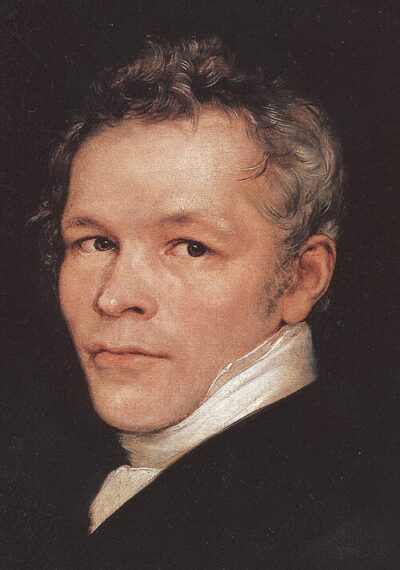
Karl Friedrich Schinkel
Karl Friedrich Schinkel was a Prussian architect, city planner and painter. Born March 13, 1781, in Neuruppin. Died October 9, 1841, in Berlin. Known for Glienicke Palace, Alte Nazarethkirche (Berlin-Wedding) and Elisabethkirche, Berlin-Mitte. Educated at Bauakademie and Evangelisches Gymnasium zum Grauen Kloster. Awards include Order of the Red Eagle 3rd Class, Commander of the Order of the Redeemer and Order of the White Falcon.
Facts
45 facts · 2 confirmed by two sources · 11 cited · 32 from one source
Where this comes from
Papalocal keeps its own record. It started from these sources; what each one said is kept here as it was copied, so a change on their side never changes this page by itself. Tap one to read its version.
What Wikidata says · copied November 16, 2026 · revision 2566147885
- Described as
- Prussian architect, city planner and painter (1781–1841)
- Other names
- Carl Friedrich Schinkel, K. F. Schinkel, karl friedrich schinkel, Karl Fr. Schinkel, C. F. Schinkel
- Born
- March 13, 1781 · 7 references
- Died
- October 9, 1841 · 15 references
- Born in
- Neuruppin · 2 references
- Died in
- Berlin · 4 references
- Buried in
- Dorotheenstadt Cemetery
- Citizen of
- Kingdom of Prussia
- Occupation
- architect · 4 references; painter · 2 references; urban planner; university teacher · 1 reference; general contractor · 1 reference; graphic artist · 1 reference; draftsperson · 1 reference; designer · 2 references
- Education
- Bauakademie (1799–); Evangelisches Gymnasium zum Grauen Kloster
- Member of
- German Archaeological Institute; Accademia di San Luca (1825–); National Academy of Design (1834–); Royal Institute of British Architects (1835–); Academy of Fine Arts Vienna (1836–); Imperial Academy of Arts (1838–); Royal Swedish Academy of Fine Arts (1840–); Prussian Academy of Arts (1811–); Académie des beaux-arts (1823–)
- Known for
- Glienicke Palace; Alte Nazarethkirche (Berlin-Wedding); Elisabethkirche, Berlin-Mitte; Schlossbrücke; Charlottenhof Palace; Iron Cross; Neuer Pavillon; Konzerthaus Berlin
- Awards
- Order of the Red Eagle 3rd Class (1821); Commander of the Order of the Redeemer (1836); Order of the White Falcon (1838) · 1 reference; Knight Officer of the Order of the Polar Star (1839); commander of the Order of the Dannebrog (1840); Order of the Red Eagle 2nd Class (1836)
- Field
- architecture · 1 reference
- Spouse
- Susanne Schinkel (1809–)
- Children
- Elisabeth von Wolzogen · 1 reference; Susanne Schinkel · 1 reference
- Father
- Cuno Christian Schinkel
- Mother
- Dorothea Schinkel · 1 reference
- Wikipedias with a page
- 67
Wikidata item Q151759 (wikidata.org/wiki/Q151759), public domain (CC0). Copied November 16, 2026.
What Wikipedia says · copied November 16, 2026 · revision 1384167432
Karl Friedrich Schinkel (German pronunciation: [ˈkaʁl ˈfʁiːdʁɪç ˈʃɪŋkl̩]; 13 March 1781 – 9 October 1841) was a Prussian architect, city planner and painter who also designed furniture and stage sets. Schinkel was one of the greatest German architects, a nineteenth century design genius, and a leader in the International Neoclassical and Gothic Revival movements. His most famous buildings are found in and around Berlin, where he influenced the city's design and landscape profoundly. Schinkel's Bauakademie is considered one of the forerunners of modern architecture. His Altes Museum is one of the most important classical buildings in Europe and a model for future national art museums throughout the world.
- Born, in its opening lines
- March 13, 1781
- Died, in its opening lines
- October 9, 1841
From the Wikipedia article “Karl Friedrich Schinkel” (en.wikipedia.org/wiki/Karl_Friedrich_Schinkel), by its contributors, under CC BY-SA 4.0 (creativecommons.org/licenses/by-sa/4.0/). Copied November 16, 2026; not changed.
Confirmed Two sources agree. Cited One source, and it names where it got it. One source One source, without a reference of its own. Sources disagree The sources disagree. We show the best-supported value and keep theirs below.
