
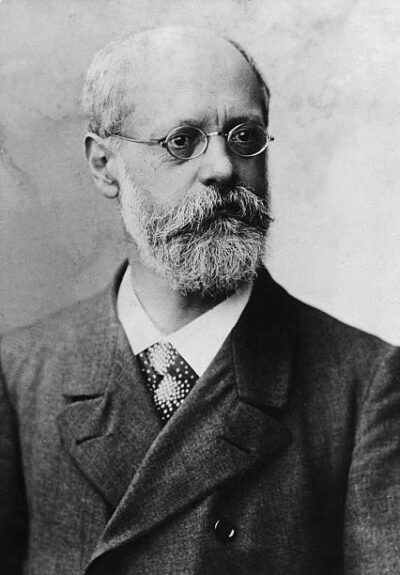
Karl Kautsky
Karl Kautsky was a Czech-Austrian Marxist theorist. Born October 16, 1854, in Prague. Died October 17, 1938, in Amsterdam. Known for Forerunners of Modern Socialism. Educated at University of Vienna and Akademisches Gymnasium.
Facts
35 facts · 2 confirmed by two sources · 13 cited · 20 from one source
Where this comes from
Papalocal keeps its own record. It started from these sources; what each one said is kept here as it was copied, so a change on their side never changes this page by itself. Tap one to read its version.
What Wikidata says · copied November 16, 2026 · revision 2565532032
- Described as
- Czech-Austrian Marxist theorist (1854–1938)
- Other names
- Karl Johann Kautsky, Kautsky
- Born
- October 16, 1854 · 9 references
- Died
- October 17, 1938 · 12 references
- Born in
- Prague · 6 references
- Died in
- Amsterdam · 5 references
- Buried in
- Westerveld
- Citizen of
- Cisleithania; German Reich; Germany · 1 reference
- Occupation
- politician · 2 references; philosopher · 1 reference; economist; journalist; socialist · 1 reference; writer · 1 reference; editing staff · 1 reference
- Political party
- Social Democratic Party of Germany; Independent Social Democratic Party of Germany
- Education
- University of Vienna; Akademisches Gymnasium; Stiftsgymnasium Melk
- Known for
- Forerunners of Modern Socialism
- Field
- economics; history; philosophy; politics · 1 reference; Marxism · 1 reference
- Spouse
- Luise Kautsky · 1 reference; Louise Kautsky
- Children
- Karl Kautsky · 1 reference; Benedikt Kautsky · 1 reference; Felix Kautsky; Sophie Kautsky
- Father
- Johann Kautsky
- Mother
- Minna Kautsky · 1 reference
- Religion
- atheism
- Wikipedias with a page
- 70
Wikidata item Q76586 (wikidata.org/wiki/Q76586), public domain (CC0). Copied November 16, 2026.
What Wikipedia says · copied November 16, 2026 · revision 1383015593
Karl Johann Kautsky (; German: [ˈkaʊtski]; 16 October 1854 – 17 October 1938) was an Austrian-born Marxist theorist. One of the most authoritative promulgators of orthodox Marxism, he was for decades the leading theorist of the Social Democratic Party of Germany (SPD) and the Second International. His influence was so pervasive that he was often called the "Pope of Marxism", with his views remaining dominant until the outbreak of World War I in 1914. His influence extended beyond Germany, shaping the development of Marxism in the Russian Empire, where he was seen by figures like Vladimir Lenin as the leading authority on Marxist theory.
Born in Prague and educated in Vienna, Kautsky became a Marxist in the early 1880s while in exile in Zurich. He founded the journal Die Neue Zeit in 1883 and was its editor for 35 years. From 1885 to 1890, he lived in London, where he became a close friend of Friedrich Engels. Following the repeal of Germany's Anti-Socialist Laws, he authored the theoretical section of the SPD's 1891 Erfurt Program. His commentary on the program, The Class Struggle, became a popular and widely circulated summary of Marxism. Kautsky's theoretical framework reinterpreted Karl Marx's critique of political economy into a doctrine of historical-empirical laws predicting the inevitable concentration of capital, polarisation of society, and immiseration of the working class.
Kautsky's orthodox Marxism advocated a gradualist, evolutionary approach to socialism. He argued that a socialist revolution was inevitable but could not be forced prematurely. The role of a socialist party was to organise the working class, win political reforms, and improve workers' lives through the institutions of bourgeois parliamentary democracy, until material conditions were ripe for the transition to socialism. This "centrist" stance, positioned between reformism and revolutionary radicalism, drew him into major conflicts. He defended Marxist orthodoxy against the revisionism of Eduard Bernstein, and opposed the revolutionary spontaneity advocated by Rosa Luxemburg.
Kautsky's pre-war influence collapsed after 1914. He opposed the SPD's decision to support the German war effort, which led him to break with the party and co-found the anti-war Independent Social Democratic Party of Germany (USPD) in 1917. After the war, he became a prominent critic of the October Revolution, denouncing it as a premature coup that had established a new form of dictatorship. He argued that the Bolsheviks' methods had betrayed the democratic principles he saw as essential to socialism. He rejoined the SPD in 1922 but his influence steadily declined. He fled to Amsterdam after the 1938 Anschluss of Austria, and died there the same year. Vilified by Leninists as a "renegade", Kautsky is seen by others as a consistent proponent of democratic socialism whose work continues to influence modern currents.
- Born, in its opening lines
- October 16, 1854
- Died, in its opening lines
- October 17, 1938
From the Wikipedia article “Karl Kautsky” (en.wikipedia.org/wiki/Karl_Kautsky), by its contributors, under CC BY-SA 4.0 (creativecommons.org/licenses/by-sa/4.0/). Copied November 16, 2026; not changed.
Confirmed Two sources agree. Cited One source, and it names where it got it. One source One source, without a reference of its own. Sources disagree The sources disagree. We show the best-supported value and keep theirs below.
