
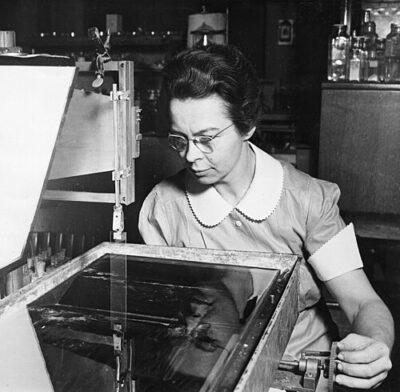
Katharine Burr Blodgett
Katharine Burr Blodgett was an American physicist. Born January 10, 1898, in Schenectady. Died October 12, 1979, in Schenectady. Educated at University of Cambridge and University of Chicago. Awards include Garvan–Olin Medal, National Inventors Hall of Fame and honorary doctorate from Brown University.
Facts
20 facts · 2 confirmed by two sources · 11 cited · 7 from one source
Where this comes from
Papalocal keeps its own record. It started from these sources; what each one said is kept here as it was copied, so a change on their side never changes this page by itself. Tap one to read its version.
What Wikidata says · copied November 15, 2026 · revision 2569006981
- Described as
- American physicist (1898-1979)
- Other names
- Katharine B. Blodgett
- Born
- January 10, 1898 · 1 reference
- Died
- October 12, 1979 · 1 reference
- Born in
- Schenectady · 1 reference
- Died in
- Schenectady · 1 reference
- Citizen of
- United States
- Occupation
- physicist · 1 reference; inventor · 1 reference; chemist · 1 reference
- Worked for
- General Electric · 1 reference
- Education
- University of Cambridge (–1926) · 1 reference; University of Chicago · 1 reference; Bryn Mawr College (1913–) · 2 references; Misses Rayson's Boarding and Day School (–1913) · 1 reference
- Member of
- Graduate Women in Science
- Awards
- Garvan–Olin Medal (1951) · 1 reference; National Inventors Hall of Fame (2007) · 1 reference; honorary doctorate from Brown University; Fellow of the American Physical Society
- Field
- surface science
- Lived in
- Lake George · 1 reference
- Wikipedias with a page
- 32
Wikidata item Q21482 (wikidata.org/wiki/Q21482), public domain (CC0). Copied November 15, 2026.
What Wikipedia says · copied November 15, 2026 · revision 1384622523
Katharine Burr Blodgett (January 10, 1898 – October 12, 1979) was an American physicist and chemist known for her advances in surface chemistry. Among her inventions is the world’s first non-reflecting glass – an advancement that has impacted everything from eyeglasses and microscopes to submarine periscopes and spy cameras in World War II to projectors and cameras in the movie industry and today’s nanotechnology.
She was one of the first women hired as a scientist at General Electric Laboratories. in 1918, and in 1926 became the first woman to be awarded a PhD in Physics from the University of Cambridge (working with Sir Ernest Rutherford). Blodgett held eight patents and received many awards including the Francis Garvan Medal from the American Chemical Society and a posthumous induction to the National Inventors Hall of Fame. Recognizing Blodgett’s advances in commercial applications of physics and in interface science, The Royal Society of Chemistry, the Society of Chemical Industry, and the Institute of Physics have named awards in her honor.
In her discovery of the technique to create non-reflecting or “invisible” glass, Blodgett worked with Irving Langmuir. Together they developed the Langmuir-Blodgett technique, which involves transferring a single layer of molecules from a liquid surface to a solid surface. The result is a one-molecule-thin film, which is the precise width to cancel out the reflection of glass. This technique and resulting film, both named for Blodgett and Langmuir, continue to serve advances in materials science and nanotechnology.
- Born, in its opening lines
- January 10, 1898
- Died, in its opening lines
- October 12, 1979
From the Wikipedia article “Katharine Burr Blodgett” (en.wikipedia.org/wiki/Katharine_Burr_Blodgett), by its contributors, under CC BY-SA 4.0 (creativecommons.org/licenses/by-sa/4.0/). Copied November 15, 2026; not changed.
Confirmed Two sources agree. Cited One source, and it names where it got it. One source One source, without a reference of its own. Sources disagree The sources disagree. We show the best-supported value and keep theirs below.
