
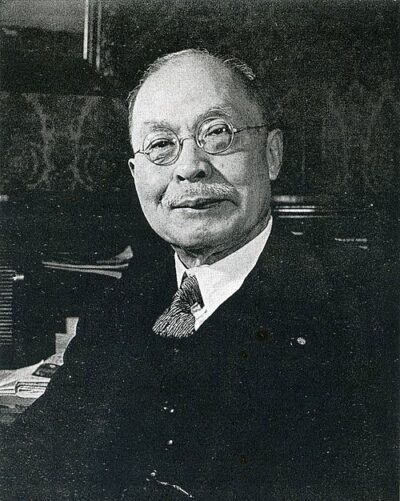
Kijūrō Shidehara
Kijūrō Shidehara was a Japanese politician. Born September 13, 1872, in Kadoma. Died March 10, 1951, in Tokyo. Positions held include member of the House of Representatives of Japan (1947–1951), Deputy Prime Minister of Japan (1947) and ambassador of Japan to the United States (1919–1922). Educated at University of Tokyo. Awards include Order of the Rising Sun, 1st class, Order of the Rising Sun with Paulownia Flowers, 1st class and Order of the Sacred Treasure, 2nd Class.
Facts
30 facts · 2 confirmed by two sources · 0 cited · 28 from one source
Where this comes from
Papalocal keeps its own record. It started from these sources; what each one said is kept here as it was copied, so a change on their side never changes this page by itself. Tap one to read its version.
What Wikidata says · copied November 16, 2026 · revision 2567574876
- Described as
- Japanese politician (1872-1951)
- Other names
- Kijuro Shidehara, Kijuurou Shidehara
- Born
- September 13, 1872 · 1 reference
- Died
- March 10, 1951 · 4 references
- Born in
- Kadoma
- Died in
- Tokyo
- Buried in
- Somei Cemetery
- Cause of death
- myocardial infarction
- Citizen of
- Japan
- Occupation
- politician; diplomat
- Positions held
- member of the House of Representatives of Japan (1947–1951); Deputy Prime Minister of Japan (1947); ambassador of Japan to the United States (1919–1922); Prime Minister of Japan (1945–1946); Acting Prime Minister of Japan (1930–1931); member of the House of Peers (1926–1947)
- Education
- University of Tokyo
- Awards
- Order of the Rising Sun, 1st class (1920); Order of the Rising Sun with Paulownia Flowers, 1st class (1931); Order of the Sacred Treasure, 2nd Class (1911); Order of the Sacred Treasure, 1st Class (1916); 2600th National Anniversary Commemorative Medal (1940); Grand Officer of the Order of Saints Maurice and Lazarus (1914); Grand Cross of the Order of Orange-Nassau (1915); Order of the British Empire (1918); Grand Cordon of the Order of Leopold (1925); Grand Cross of the Order of the Sun of Peru (1926); Grand Cross of the Legion of Honour (1927); Grand Cross of the Order of the White Elephant (1931)
- Spouse
- Masako Shidehara · 1 reference
- Siblings
- Taira Shidehara
- Wikipedias with a page
- 44
Wikidata item Q335191 (wikidata.org/wiki/Q335191), public domain (CC0). Copied November 16, 2026.
What Wikipedia says · copied November 16, 2026 · revision 1378199236
Baron Kijūrō Shidehara (幣原 喜重郎, Shidehara Kijūrō; 13 September 1872 – 10 March 1951), was a Japanese diplomat and politician who served as Prime Minister of Japan from 1945 to 1946. He was a leading proponent of pacifism in Japan before and after World War II.
Born to a wealthy Osaka family, Shidehara studied law at Tokyo Imperial University and graduated in 1895. He then joined the foreign service and held postings in Korea, Europe, and the United States, serving as ambassador to the latter from 1919 to 1922. Shidehara served as foreign minister from 1924 to 1927 and from 1929 to 1931, and favored a non-interventionist policy in China. As prime minister after World War II, Shidehara set into motion many of the occupation reforms. After his tenure, he served as the president of the Progressive Party and as an adviser to Shigeru Yoshida. He was elected to the National Diet in 1947 and joined the Liberal Party, and from 1949 to 1951 served as speaker of the House of Representatives.
- Born, in its opening lines
- September 13, 1872
- Died, in its opening lines
- March 10, 1951
From the Wikipedia article “Kijūrō Shidehara” (en.wikipedia.org/wiki/Kijūrō_Shidehara), by its contributors, under CC BY-SA 4.0 (creativecommons.org/licenses/by-sa/4.0/). Copied November 16, 2026; not changed.
Confirmed Two sources agree. Cited One source, and it names where it got it. One source One source, without a reference of its own. Sources disagree The sources disagree. We show the best-supported value and keep theirs below.
