
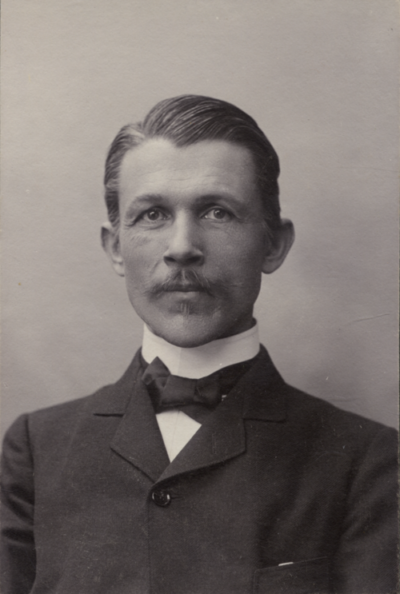
Knut Ångström
Knut Ångström was a Swedish physicist. Born January 12, 1857, in Uppsala Cathedral Assembly. Died March 4, 1910, in Uppsala Cathedral Assembly. Educated at Uppsala University. Awards include Björkén Prize.
Facts
21 facts · 2 confirmed by two sources · 6 cited · 13 from one source
Where this comes from
Papalocal keeps its own record. It started from these sources; what each one said is kept here as it was copied, so a change on their side never changes this page by itself. Tap one to read its version.
What Wikidata says · copied November 18, 2026 · revision 2568807935
- Described as
- Swedish physicist (1857-1910)
- Born
- January 12, 1857 · 4 references
- Died
- March 4, 1910 · 2 references
- Born in
- Uppsala Cathedral Assembly · 2 references
- Died in
- Uppsala Cathedral Assembly · 3 references
- Buried in
- Uppsala Old Cemetery · 1 reference
- Citizen of
- Sweden
- Occupation
- physicist · 2 references; inventor
- Worked for
- Uppsala University
- Education
- Uppsala University (1877–) · 1 reference
- Member of
- German Academy of Sciences Leopoldina; Royal Swedish Academy of Sciences; Deutsche Physikalische Gesellschaft (1890–1909)
- Awards
- Björkén Prize (1905)
- Field
- geophysics
- Children
- Anders Knutsson Ångström · 1 reference; Hilding Ångström; Tord Ångström
- Father
- Anders Jonas Ångström · 1 reference
- Mother
- Augusta Carolina Bedoire
- Siblings
- Anna Augusta Ångström
- Wikipedias with a page
- 21
Wikidata item Q722373 (wikidata.org/wiki/Q722373), public domain (CC0). Copied November 18, 2026.
What Wikipedia says · copied November 18, 2026 · revision 1372020141
Knut Johan Ångström (12 January 1857 – 4 March 1910) was a Swedish physicist. He was the son of physicist Anders Jonas Ångström and studied in Uppsala from 1877 to 1884, when he received his licentiat-degree, before going for a short time to the University of Strassburg (Strasbourg) to study with August Kundt. Coming back to Uppsala, he completed his doctoral degree and was appointed lecturer in physics at the new university college in Stockholm (now Stockholm University) in 1885. After a few years working there, he returned to Uppsala in 1891 and received the professorship of Physics in 1896.
He focused his research work on investigating the radiation of heat from the sun, terrestrial nocturnal emission and its absorption by the Earth's atmosphere, and to that end devised various delicate methods and instruments, including his electric compensation pyrheliometer, invented in 1893, apparatus for obtaining a photographic representation of the infra-red spectrum (1895) and pyrgeometer (abt. 1905).
In 1900, Herr J. Koch, laboratory assistant to Knut Ångström, did not observe any appreciable change in the absorption of infrared radiation by decreasing the concentration of CO2 up to a third of the initial amount. This result, in addition to the observation made a couple of years before that the superposition of the water vapour absorption bands, more abundant in the atmosphere, over those of CO2, convinced some geologists for a time that calculations by Svante Arrhenius for CO2 warming were wrong; though subsequent work in following decades eventually partially vindicated Arrhenius. Arrhenius and Ångström were both qualitatively correct and both were quantitatively wrong.
The experiment, however, was careless seen from the current perspective with erroneous result but of a historical significance in the development of the theory of the greenhouse effect amplified by CO2.
He was elected a member of the Royal Swedish Academy of Sciences in 1893.
- Born, in its opening lines
- January 12, 1857
- Died, in its opening lines
- March 4, 1910
From the Wikipedia article “Knut Ångström” (en.wikipedia.org/wiki/Knut_Ångström), by its contributors, under CC BY-SA 4.0 (creativecommons.org/licenses/by-sa/4.0/). Copied November 18, 2026; not changed.
Confirmed Two sources agree. Cited One source, and it names where it got it. One source One source, without a reference of its own. Sources disagree The sources disagree. We show the best-supported value and keep theirs below.
