
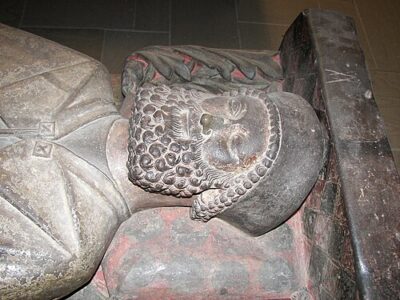
Konrad von Thüringen
Konrad von Thüringen was a Langrave of Thuringia and Grand Master of the Teutonic Knights. Born 1206. Died July 24, 1240, in Rome. Positions held include Grand Master of the Teutonic Knights (1240–1244).
Facts
16 facts · 2 confirmed by two sources · 0 cited · 14 from one source
Where this comes from
Papalocal keeps its own record. It started from these sources; what each one said is kept here as it was copied, so a change on their side never changes this page by itself. Tap one to read its version.
What Wikidata says · copied November 18, 2026 · revision 2569176552
- Described as
- Langrave of Thuringia and Grand Master of the Teutonic Knights
- Born
- 1206
- Died
- July 24, 1240
- Died in
- Rome
- Buried in
- St. Elisabeth's Church
- Name at birth
- Konrad Raspe · 1 reference
- Citizen of
- Holy Roman Empire
- Occupation
- aristocrat
- Positions held
- Grand Master of the Teutonic Knights (1240–1244)
- Father
- Hermann I of Thuringia
- Mother
- Sophia of Wittelsbach
- Siblings
- Agnes of Thuringia; Jutta of Thuringia; Henry Raspe, Landgrave of Thuringia; Louis IV; Irmgard von Thüringen
- Religion
- Catholicism
- Wikipedias with a page
- 20
Wikidata item Q61952 (wikidata.org/wiki/Q61952), public domain (CC0). Copied November 18, 2026.
What Wikipedia says · copied November 18, 2026 · revision 1299119788
Conrad (German: Konrad von Thüringen; c. 1206 – 24 July 1240) was the landgrave of Thuringia from 1231 to 1234 and the fifth Grand Master of the Teutonic Order from 1239 to 1240. He was the first major noble to join the military order.
Conrad was the youngest son of Hermann I, Landgrave of Thuringia, and Sophia, a daughter of Otto I, Duke of Bavaria. His elder brother Louis IV of Thuringia was married to Saint Elisabeth of Hungary. When Louis died in 1227 during the Sixth Crusade, his brother Henry Raspe became regent for Louis' minor son Herman II, and Conrad took on the title of Count of Gudensberg in Hesse, assisting his brother in ruling the area.
On Elisabeth's death in 1231, Henry Raspe took Thuringia for himself, and together with Conrad, worked to consolidate power. Conrad engaged in battle a number of times with Siegfried III, Archbishop of Mainz, at one point personally swinging him around and threatening to cut him in two. In 1232, he besieged the city of Fritzlar, massacring its populace and burning the church.Elisabeth had founded a hospital in Marburg and had intended to bequeath it to the Johanniter Order, but this was rejected by her defensor, Conrad of Marburg. Pope Gregory IX sent a commission to settle the matter, and it decided in favor of Conrad of Marburg on 2 August 1232. In the summer of 1234, Conrad travelled to Rome and convinced the Curia to turn the hospital and parish church in Marburg over to the Teutonic Knights, which had founded a house in the city the previous year. In November, Conrad set aside his temporal title and entered the Teutonic Order himself. The next year, he joined the commission to Rome that represented his sister-in-law in the canonisation process, and he remained in the court of the Pope until Pentecost of 1235 when she was declared a saint.
Upon the death of Hermann von Salza, Conrad became the Grand Master of the Teutonic Knights. While on a trip to Rome in the early summer of 1240, he fell ill and died. He was buried in the Elisabeth Church in Marburg.
- Born, in its opening lines
- c. 1206
- Died, in its opening lines
- July 24, 1240
From the Wikipedia article “Conrad of Thuringia” (en.wikipedia.org/wiki/Conrad_of_Thuringia), by its contributors, under CC BY-SA 4.0 (creativecommons.org/licenses/by-sa/4.0/). Copied November 18, 2026; not changed.
Confirmed Two sources agree. Cited One source, and it names where it got it. One source One source, without a reference of its own. Sources disagree The sources disagree. We show the best-supported value and keep theirs below.
