
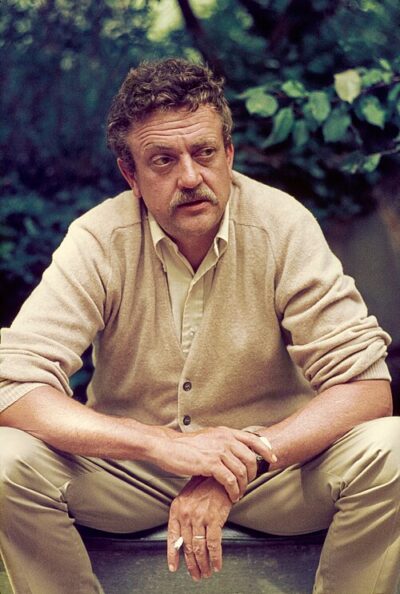
Kurt Vonnegut
Kurt Vonnegut was an American author. Born November 11, 1922, in Indianapolis. Died April 11, 2007, in New York City. Known for Cat's Cradle, Slaughterhouse-Five and Breakfast of Champions. Educated at University of Chicago and Cornell University. Awards include Guggenheim Fellowship, Purple Heart and National Book Award.
Facts
73 facts · 2 confirmed by two sources · 34 cited · 36 from one source · 1 where the sources disagree
What’s different
- Born in: we show Indianapolis (Sources disagree). Wikidata also lists Methodist Hospital of Indianapolis
Where this comes from
Papalocal keeps its own record. It started from these sources; what each one said is kept here as it was copied, so a change on their side never changes this page by itself. Tap one to read its version.
What Wikidata says · copied November 13, 2026 · revision 2567398802
- Described as
- American author (1922–2007)
- Other names
- Kurt Vonnegut Jr., Philboyd Sludge, Ferdinand, Ferdy, Kurt Vonnegut, Jr.
- Born
- November 11, 1922 · 15 references
- Died
- April 11, 2007 · 14 references
- Born in
- Indianapolis · 2 references; Methodist Hospital of Indianapolis
- Died in
- New York City · 2 references
- Buried in
- Mount Greylock
- Cause of death
- falling from height
- Name at birth
- Kurt Vonnegut, Jr. · 1 reference
- Citizen of
- United States
- Occupation
- playwright; writer · 3 references; screenwriter · 1 reference; novelist; essayist; science fiction writer; journalist; peace activist
- Worked for
- Harvard University; University of Chicago · 1 reference; University of Iowa · 1 reference; General Electric · 1 reference; City News Bureau of Chicago
- Education
- University of Chicago; Cornell University; Carnegie Mellon University; University of Tennessee; Shortridge High School
- Member of
- American Academy of Arts and Letters; American Academy of Arts and Sciences (1973–) · 1 reference; American Civil Liberties Union; American Humanist Association; Authors Guild; PEN America
- Genre
- satire · 1 reference; science fiction; surreal humour; absurdist literature; postmodern literature; memoir
- Known for
- Cat's Cradle (1963) · 1 reference; Slaughterhouse-Five (1969) · 1 reference; Breakfast of Champions (1973) · 1 reference
- Awards
- Guggenheim Fellowship (1967) · 1 reference; Purple Heart · 1 reference; National Book Award (1970) · 1 reference; Hugo Award for Best Dramatic Presentation (1973); Eugene V. Debs Award (1981) · 1 reference; Mondello Prize (1991) · 1 reference; Humanist of the Year (1992) · 1 reference; Carl Sandburg Literary Award (2001) · 1 reference; Science Fiction and Fantasy Hall of Fame (2015) · 1 reference; Prometheus Award - Hall of Fame (2019) · 1 reference
- Field
- creative and professional writing · 1 reference; drama · 1 reference; prose · 1 reference; science fiction literature · 1 reference
- Spouse
- Jane Vonnegut Yarmolinsky (1945–1971); Jill Krementz (1979–2007) · 1 reference
- Children
- Mark Vonnegut · 1 reference; Edith Vonnegut · 1 reference
- Father
- Kurt Vonnegut, Sr. · 1 reference
- Mother
- Edith Vonnegut · 1 reference
- Siblings
- Bernard Vonnegut · 1 reference
- Religion
- Unitarian Universalism · 1 reference; agnosticism · 1 reference
- Military branch
- United States Army (1943–1945) · 1 reference
- Military rank
- Private First Class · 1 reference
- Lived in
- New York City (–2007) · 1 reference; Barnstable · 1 reference; Indianapolis (1922–1945) · 1 reference; Chicago (1945–1947); Alplaus (1947–)
- Height
- 1.93 m (6 ft 4 in) (1970) · 1 reference
- Website
- https://www.vonnegut.com
- Wikipedias with a page
- 122
Wikidata item Q49074 (wikidata.org/wiki/Q49074), public domain (CC0). Copied November 13, 2026.
What Wikipedia says · copied November 13, 2026 · revision 1385520707
Kurt Vonnegut ( VON-ə-gət; November 11, 1922 – April 11, 2007) was an American author known for his satirical and darkly humorous novels. His published work includes fourteen novels, three short-story collections, five plays, and five nonfiction works over fifty years; further works have been published since his death.
Born and raised in Indianapolis, Vonnegut attended Cornell University, but withdrew in January 1943 and enlisted in the U.S. Army. As part of his training, he studied mechanical engineering at the Carnegie Institute of Technology and the University of Tennessee. He was then deployed to Europe to fight in World War II and was captured by the Germans during the Battle of the Bulge. He was interned in Dresden, where he survived the Allied bombing of the city in a meat locker of the slaughterhouse where he was imprisoned. After the war, he married Jane Marie Cox. He and his wife both attended the University of Chicago while he worked as a night reporter for the City News Bureau.
Vonnegut published his first novel, Player Piano, in 1952. It received favorable reviews yet sold poorly. In the nearly 20 years that followed, several well-regarded novels were published, including The Sirens of Titan (1959) and Cat's Cradle (1963), both of which were nominated for the Hugo Award for best science fiction novel of the year. His short-story collection, Welcome to the Monkey House, was published in 1968.
Vonnegut's breakthrough was his commercially and critically successful sixth novel, Slaughterhouse-Five (1969). Its anti-war sentiment resonated with its readers amid the Vietnam War, and its reviews were generally positive. It rose to the top of The New York Times Best Seller list and made Vonnegut famous. Later in his career, Vonnegut published autobiographical essays and short-story collections such as Fates Worse Than Death (1991) and A Man Without a Country (2005). He has been hailed for his darkly humorous commentary on American society. His son Mark published a compilation of his work, Armageddon in Retrospect, in 2008. In 2017, Seven Stories Press published Complete Stories, a collection of Vonnegut's short fiction.
- Born, in its opening lines
- November 11, 1922
- Died, in its opening lines
- April 11, 2007
From the Wikipedia article “Kurt Vonnegut” (en.wikipedia.org/wiki/Kurt_Vonnegut), by its contributors, under CC BY-SA 4.0 (creativecommons.org/licenses/by-sa/4.0/). Copied November 13, 2026; not changed.
Confirmed Two sources agree. Cited One source, and it names where it got it. One source One source, without a reference of its own. Sources disagree The sources disagree. We show the best-supported value and keep theirs below.
