
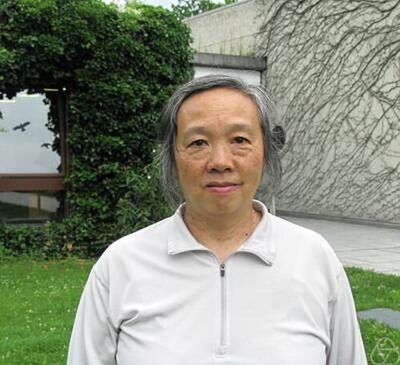
Lai-Sang Young is an American mathematician and academic. Born January 5, 1952, in Hong Kong. Educated at University of Wisconsin–Madison and University of California, Berkeley. Awards include Ruth Lyttle Satter Prize in Mathematics, Noether Lecture and Guggenheim Fellowship.
Facts
23 facts · 0 confirmed by two sources · 5 cited · 18 from one source
Where this comes from
Papalocal keeps its own record. It started from these sources; what each one said is kept here as it was copied, so a change on their side never changes this page by itself. Tap one to read its version.
What Wikidata says · copied November 18, 2026 · revision 2512825109
- Described as
- American mathematician and academic
- Other names
- Lai-Sang Lily Young, L.S. Young
- Born
- January 5, 1952 · 3 references
- Born in
- Hong Kong
- Citizen of
- United States
- Occupation
- mathematician · 1 reference; university teacher
- Worked for
- University of California, Los Angeles; New York University · 2 references; University of Arizona · 1 reference; Northwestern University · 1 reference
- Education
- University of Wisconsin–Madison; University of California, Berkeley
- Member of
- American Academy of Arts and Sciences (2004–); Hungarian Academy of Sciences; National Academy of Sciences (2020–)
- Awards
- Ruth Lyttle Satter Prize in Mathematics (1993); Noether Lecture (2005); Guggenheim Fellowship (1997) · 1 reference; Fellow of the American Academy of Arts and Sciences (2004); Sofia Kovalevsky Lecture (2007); Heinz Hopf Prize (2023) · 1 reference; Rolf Schock Prizes (2024) · 1 reference
- Field
- dynamical system
- Website
- http://www.cims.nyu.edu/~lsy
- Wikipedias with a page
- 17
Wikidata item Q1663729 (wikidata.org/wiki/Q1663729), public domain (CC0). Copied November 18, 2026.
What Wikipedia says · copied November 18, 2026 · revision 1368930062
Lai-Sang Lily Young (Chinese: 楊麗笙, born 1952) is a Hong Kong-born American mathematician who holds the Henry & Lucy Moses Professorship of Science and is a professor of mathematics and neural science at the Courant Institute of Mathematical Sciences of
New York University. Her research interests include dynamical systems, ergodic theory, chaos theory, probability theory, statistical mechanics, and neuroscience. She is particularly known for introducing the method of Markov returns in 1998, which she used to prove exponential correlation delay in Sinai billiards and other hyperbolic dynamical systems.
From the Wikipedia article “Lai-Sang Young” (en.wikipedia.org/wiki/Lai-Sang_Young), by its contributors, under CC BY-SA 4.0 (creativecommons.org/licenses/by-sa/4.0/). Copied November 18, 2026; not changed.
Confirmed Two sources agree. Cited One source, and it names where it got it. One source One source, without a reference of its own. Sources disagree The sources disagree. We show the best-supported value and keep theirs below.
