
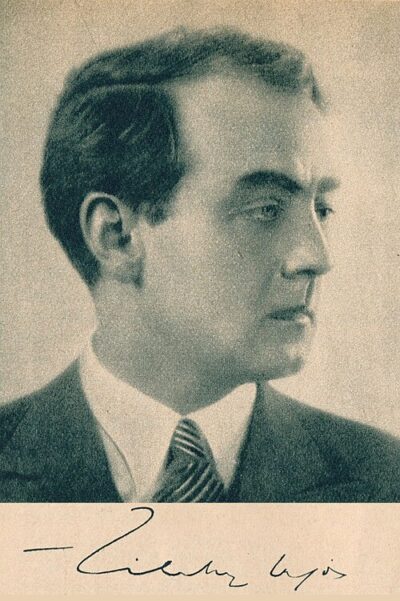
Lajos Zilahy
Lajos Zilahy was a Hungarian novelist and playwright. Born March 27, 1891, in Salonta. Died December 1, 1974, in Novi Sad. Educated at Eötvös Loránd University.
Facts
20 facts · 2 confirmed by two sources · 4 cited · 14 from one source
Where this comes from
Papalocal keeps its own record. It started from these sources; what each one said is kept here as it was copied, so a change on their side never changes this page by itself. Tap one to read its version.
What Wikidata says · copied November 15, 2026 · revision 2567924046
- Described as
- Hungarian novelist and playwright (1891–1974)
- Born
- March 27, 1891 · 6 references
- Died
- December 1, 1974 · 6 references
- Born in
- Salonta · 1 reference
- Died in
- Novi Sad
- Buried in
- Fiume Road Graveyard · 1 reference
- Citizen of
- Hungary; United States
- Occupation
- writer · 1 reference; journalist · 1 reference; novelist; playwright; opinion journalist; translator; screenwriter; film director · 1 reference
- Worked for
- Nyugat
- Education
- Eötvös Loránd University
- Member of
- Kisfaludy Society; Hungarian Academy of Sciences (1945–)
- Field
- literature · 1 reference
- Wikipedias with a page
- 28
Wikidata item Q267769 (wikidata.org/wiki/Q267769), public domain (CC0). Copied November 15, 2026.
What Wikipedia says · copied November 15, 2026 · revision 1350339197
Lajos Zilahy (27 March 1891 − 1 December 1974) was a Hungarian novelist and playwright. Born in Nagyszalonta, Austria-Hungary (now Salonta, Romania), he studied law at the University of Budapest before serving in the Austro-Hungarian army during the First World War, in which he was wounded on the Eastern Front – an experience which later informed his bestselling novel Two Prisoners (Két fogoly).
He was also active in film. His 1928 novel Something Is Drifting on the Water (Valamit visz a víz) was filmed twice. His play The General was filmed as The Virtuous Sin in 1930 and The Rebel in 1931.
Edited Híd (The Bridge) 1940–1944, an art periodical. Opposed both fascism and communism. In 1939, he established a film studio named Pegazus, which operated until the end of 1943. Pegazus produced motion pictures and Zilahy directed some of them. In 1944, his play Fatornyok (Wooden Towers) was banned. Gave all assets to government treasury in early 1940s for use in educating youth in world peace, which led to the establishment of Kitűnőek Iskolája.
He wrote the 1943 screenplay himself and co-directed it with Gusztáv Oláh in Hungary under the international English title Something Is in the Water. The Czechoslovak screenplay was written by Imre Gyöngyössy, Ján Kadár and Elmar Klos, and directed by the latter two with a Serbian, Slovak, Hungarian, Czech and American cast on location at the Danube in Slovakia under the title Desire Called Anada in Czech (Touha zvaná Anada, 1969) and Slovak (Túžba zvaná Anada), with Adrift as its English title.
Lajos Zilahy became the Secretary General of Hungarian PEN but his liberal views placed him at odds, first, with the right-wing Horthy regime and later with the post-war Communist government. Zilahy left Hungary in 1947, spending the rest of his life in exile in the US, where he completed A Dukay család, a trilogy of novels (Century in Scarlet, The Dukays, The Angry Angel) chronicling the history of a fictitious Hungarian aristocratic family from the Napoleonic era to the middle of the twentieth century. He died in Novi Sad, Serbia, then part of Yugoslavia.
Several of his novels have been translated into Bulgarian, Czech, Danish, Dutch, English, Estonian, Finnish, French, German, Italian, Japanese, Polish, Romanian, Serbo-Croatian, Slovak, Slovenian, Spanish (mainly), Swedish, and Turkish, and some of his plays into German, Italian, and Spanish. An edition of his short stories is available in Spanish and some of his short stories have been translated into Bulgarian, Croatian, English, Estonian, French, German, Hindi, Italian, Polish, Portuguese, Slovak, Spanish, and Swedish, and some of his poems into German.
- Born, in its opening lines
- March 27, 1891
- Died, in its opening lines
- December 1, 1974
From the Wikipedia article “Lajos Zilahy” (en.wikipedia.org/wiki/Lajos_Zilahy), by its contributors, under CC BY-SA 4.0 (creativecommons.org/licenses/by-sa/4.0/). Copied November 15, 2026; not changed.
Confirmed Two sources agree. Cited One source, and it names where it got it. One source One source, without a reference of its own. Sources disagree The sources disagree. We show the best-supported value and keep theirs below.
