
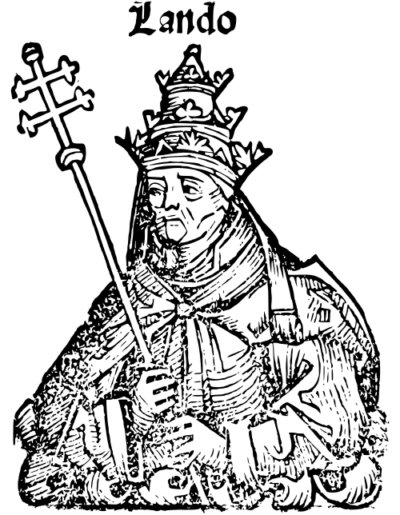
Lando
Lando was a Pope from 913 to 914. Born 9th century, in Sabina. Died March 914, in Rome. Positions held include Pope (913–914) and cardinal-deacon (908–).
Facts
9 facts · 0 confirmed by two sources · 1 cited · 6 from one source · 2 where the sources disagree
What’s different
- Born: we show 9th century (Sources disagree). Wikipedia says 904
- Died: we show March 914 (Sources disagree). Wikipedia says 964
Where this comes from
Papalocal keeps its own record. It started from these sources; what each one said is kept here as it was copied, so a change on their side never changes this page by itself. Tap one to read its version.
What Wikidata says · copied November 16, 2026 · revision 2569007160
- Described as
- Pope from 913 to 914
- Other names
- Pope Lando
- Born
- 9th century · 1 reference
- Died
- March 914 · 1 reference
- Born in
- Sabina
- Died in
- Rome
- Buried in
- St. Peter's Basilica
- Occupation
- Catholic priest
- Positions held
- Pope (913–914); cardinal-deacon (908–)
- Religion
- Catholic Church · 1 reference
- Wikipedias with a page
- 76
Wikidata item Q104798 (wikidata.org/wiki/Q104798), public domain (CC0). Copied November 16, 2026.
What Wikipedia says · copied November 16, 2026 · revision 1373072969
Lando (also known as Landus) was the pope from 913 until his death in 914. His short pontificate fell during an obscure period in papal and Roman history, the so-called Saeculum obscurum (904–964).
According to the Liber pontificalis, Lando was born in the Sabina (Papal States), and his father was a wealthy Lombard count named Taino from Fornovo. The start of his pontificate has been placed as early as July or as late as November 913. The Liber claims that his pontificate lasted only four months and twenty-two days. A different list of popes, appended to a continuation of the Liber pontificalis at the Abbey of Farfa and quoted by Gregory of Catino in his Chronicon Farfense in the twelfth century, gives Lando a pontificate of six months and twenty-six days. This is closer to the duration recorded by Flodoard of Reims, writing in the tenth century, of six months and ten days. The end of his pontificate can be dated to between 5 February 914, when he is mentioned in a document of Ravenna, and late March or early April, when his successor, John X, was elected.
Lando is thought to have been the candidate of Count Theophylact I of Tusculum and Senatrix Theodora, who were the most powerful couple in Rome at the time. The Theophylacti controlled papal finances through their monopoly of the office of vestararius, and also controlled the Roman militia and Senate. During Lando's reign, Arab raiders, operating from their stronghold on the Garigliano river, destroyed the cathedral of San Salvatore in Vescovio in his native diocese. No document of Lando's chancery has survived. The only act of his reign that is recorded is a donation to the diocese of Sabina mentioned in a judicial act of 1431. Lando made the large personal gift in order to restore the cathedral of San Salvatore so that the clergy who were then living at Toffia could return.
Lando was the last pope to have a papal name never used before until Pope John Paul I in 1978, and the last with a unique name requiring no regnal number until Pope Francis in 2013.
- Born, in its opening lines
- 904
- Died, in its opening lines
- 964
From the Wikipedia article “Pope Lando” (en.wikipedia.org/wiki/Pope_Lando), by its contributors, under CC BY-SA 4.0 (creativecommons.org/licenses/by-sa/4.0/). Copied November 16, 2026; not changed.
Confirmed Two sources agree. Cited One source, and it names where it got it. One source One source, without a reference of its own. Sources disagree The sources disagree. We show the best-supported value and keep theirs below.
