
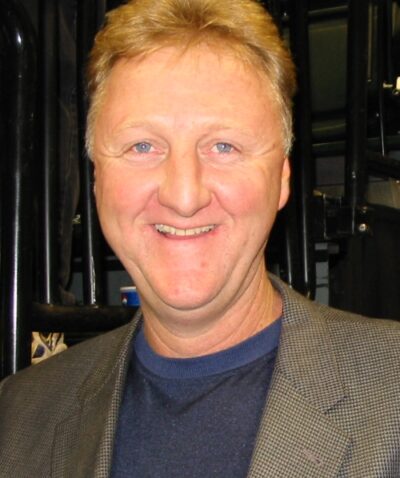
Larry Bird
Larry Bird is an American basketball player and coach. Born December 7, 1956, in West Baden Springs. Teams include Indiana State Sycamores men's basketball (1975–1979), Boston Celtics (1979–1992) and Indiana Hoosiers men's basketball (1974). Educated at Springs Valley High School and Indiana State University. Awards include John R. Wooden Award, NBA All-Rookie Team and NBA Rookie of the Year Award.
Facts
36 facts · 1 confirmed by two sources · 9 cited · 26 from one source
Where this comes from
Papalocal keeps its own record. It started from these sources; what each one said is kept here as it was copied, so a change on their side never changes this page by itself. Tap one to read its version.
What Wikidata says · copied November 13, 2026 · revision 2568117417
- Described as
- American basketball player and coach (born 1956)
- Other names
- Kodak, Mr. Wonderful, Larry Joe Bird, Larry Legend, The Great White Hope, The Hick from French Lick
- Born
- December 7, 1956 · 4 references
- Born in
- West Baden Springs · 2 references
- Name at birth
- Larry Joe Bird
- Citizen of
- United States · 1 reference
- Occupation
- basketball player · 1 reference; basketball coach · 3 references
- Education
- Springs Valley High School · 1 reference; Indiana State University (1975–1979); Indiana University Bloomington (1974); Indiana University · 1 reference
- Teams
- Indiana State Sycamores men's basketball (1975–1979); Boston Celtics (1979–1992); Indiana Hoosiers men's basketball (1974); Indiana State Sycamores baseball · 1 reference
- Sport
- basketball · 1 reference
- Awards
- John R. Wooden Award (1979); NBA All-Rookie Team (1980); NBA Rookie of the Year Award (1980); All-NBA Team (10 times) (1980, 1981, 1982, 1983, 1984, 1985, 1986, 1987, 1988, 1990); NBA All-Star Game Kobe Bryant Most Valuable Player Award (1982); NBA Most Valuable Player Award (3 times) (1984, 1985, 1986); Bill Russell NBA Finals Most Valuable Player Award (2 times) (1984, 1986); NBA Coach of the Year Award (1998); NBA Executive of the Year Award (2012); Library of Congress Living Legend (2000–) · 1 reference; Associated Press Athlete of the Year (1986)
- Father
- Claude Joseph Bird · 1 reference
- Mother
- Georgia Kerns · 1 reference
- Siblings
- Eddie Bird
- Religion
- Catholic Church
- Lived in
- Indiana
- Nickname
- Larry Legend; The Hick from French Lick; Kodak; The Great White Hope
- Height
- 2.06 m (6 ft 9 in) · 1 reference
- Wikipedias with a page
- 82
Wikidata item Q190152 (wikidata.org/wiki/Q190152), public domain (CC0). Copied November 13, 2026.
What Wikipedia says · copied November 13, 2026 · revision 1384055211
Larry Joe Bird (born December 7, 1956) is an American former professional basketball player, coach, and executive in the National Basketball Association (NBA). Nicknamed "the Hick from French Lick" and "Larry Legend", Bird is widely regarded as one of the greatest basketball players of all time. He is the only person in NBA history to be named Rookie of the Year, Most Valuable Player, Finals MVP, All-Star MVP, Coach of the Year, and Executive of the Year.
Growing up in French Lick, Indiana, Bird was a local basketball star. Highly recruited, he initially signed to play college basketball for Indiana University Bloomington. However, he dropped out after one month and returned to French Lick to attend a local college. The next year, he attended Indiana State University, ultimately playing three years for the Sycamores. Bird was selected by the Boston Celtics as the sixth overall pick in the 1978 NBA draft after his second year at Indiana State, but he elected to stay in college for the 1978–79 season. He led Indiana State to an undefeated regular season and a berth in the national championship, where they faced Michigan State and Magic Johnson, a match-up which launched a career-long rivalry between the two players.
Bird entered the NBA for the 1979–80 season, where he made an immediate impact, leading the Celtics to a 32-win improvement over the previous season. Bird played for the Celtics during his entire 13-season professional career, leading them to five NBA Finals appearances and three NBA championships. He played most of his career with forward Kevin McHale and center Robert Parish, considered by some to be the greatest front court in NBA history. Bird was a 12-time NBA All-Star, won two NBA Finals MVP awards and received the NBA Most Valuable Player Award three consecutive times (1984–1986), making him the only forward in league history to do so. Bird was also a member of the gold medal-winning 1992 U.S. Olympic basketball team, known as the "Dream Team". He was inducted into the Naismith Memorial Basketball Hall of Fame twice as a player—first in 1998 as an individual, and again in 2010 as a member of the "Dream Team". Bird was voted onto the NBA's 50 Greatest Players in NBA History list in 1996, and subsequently the 75th Anniversary Team list in 2021. A versatile player at both forward positions, Bird could play both inside and outside, being one of the first players in the league to take advantage of the newly adopted three-point line. He was rated the greatest NBA small forward of all time by Fox Sports in 2016.
After retiring as a player, Bird served as head coach of the Indiana Pacers from 1997 to 2000. He was named NBA Coach of the Year for the 1997–98 season and later led the Pacers to a berth in the 2000 NBA Finals. In 2003, Bird was named president of basketball operations for the Pacers, holding the position until retiring in 2012. He was named NBA Executive of the Year for the 2012 season. Bird returned to the Pacers as president of basketball operations in 2013, and remained in that role until 2017. Bird continued with the Pacers as an advisor until July 2022, then after nearly a year's break returned to the organization in the role of consultant.
- Born, in its opening lines
- December 7, 1956
From the Wikipedia article “Larry Bird” (en.wikipedia.org/wiki/Larry_Bird), by its contributors, under CC BY-SA 4.0 (creativecommons.org/licenses/by-sa/4.0/). Copied November 13, 2026; not changed.
Confirmed Two sources agree. Cited One source, and it names where it got it. One source One source, without a reference of its own. Sources disagree The sources disagree. We show the best-supported value and keep theirs below.
