
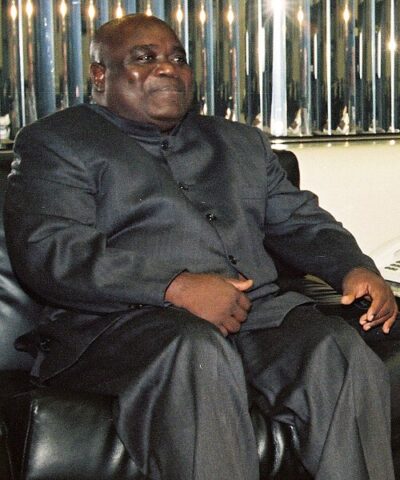
Laurent-Désiré Kabila
Laurent-Désiré Kabila was a former President of the Democratic Republic of the Congo. Born November 27, 1939, in Moba. Died January 16, 2001, in Kinshasa. Positions held include President of the Democratic Republic of the Congo (1997–2001). Educated at University of Dar es Salaam and University of Belgrade. Awards include National Order of the Leopard.
Facts
24 facts · 2 confirmed by two sources · 4 cited · 17 from one source · 1 where the sources disagree
What’s different
- Born in: we show Moba (Sources disagree). Wikidata also lists Likasi
Where this comes from
Papalocal keeps its own record. It started from these sources; what each one said is kept here as it was copied, so a change on their side never changes this page by itself. Tap one to read its version.
What Wikidata says · copied November 16, 2026 · revision 2569099819
- Described as
- former President of the Democratic Republic of the Congo (1939-2001)
- Other names
- Laurent-Desire Kabila, Laurent Kabila, Kabila the Father
- Born
- November 27, 1939 · 3 references
- Died
- January 16, 2001 · 1 reference
- Born in
- Moba; Likasi
- Died in
- Kinshasa · 1 reference
- Buried in
- Mausoleum of Laurent-Désiré Kabila
- Cause of death
- gunshot wound
- Name at birth
- Lauren-Désiré Kabila Makolo
- Citizen of
- Democratic Republic of the Congo
- Occupation
- politician · 1 reference
- Positions held
- President of the Democratic Republic of the Congo (1997–2001) · 1 reference
- Political party
- Alliance of Democratic Forces for the Liberation of Congo (1996–1998); Party of the People's Revolution (1968–1996); independent politician (1998–)
- Education
- University of Dar es Salaam; University of Belgrade · 1 reference; University of Belgrade Faculty of Philosophy · 1 reference
- Awards
- National Order of the Leopard
- Field
- politics · 1 reference
- Spouse
- Sifa Mahanya
- Children
- Joseph Kabila; Aimée Kabila Mulengela; Jaynet Kabila; Zoé Kabila
- Religion
- Anglicanism
- Wikipedias with a page
- 66
Wikidata item Q135547 (wikidata.org/wiki/Q135547), public domain (CC0). Copied November 16, 2026.
What Wikipedia says · copied November 16, 2026 · revision 1382751328
Laurent-Désiré Kabila (French pronunciation: [lo.ʁɑ̃ de.zi.ʁe ka.bi.la]; 27 November 1939 – 16 January 2001), usually known as Laurent Kabila or Kabila the Father (US: ), was a Congolese rebel and politician who served as the third president of the Democratic Republic of the Congo from 1997 until his assassination in 2001. While serving as president, he was also the minister of defense.
Kabila initially gained prominence as an opponent of Mobutu Sese Seko during the Congo Crisis (1960–1965). He took part in the Simba rebellion and led the Communist-aligned Fizi rebel breakaway state in eastern Congo from 1967 to 1986 before disappearing from the public. In the 1990s, Kabila re-emerged as leader of the Alliance of Democratic Forces for the Liberation of Congo (ADFL), a Rwandan and Ugandan-sponsored rebel group that invaded Zaire and overthrew Mobutu during the First Congo War from 1996 to 1997. Following the war, Kabila became the new president of the country, whose name was changed back to the Democratic Republic of the Congo.
The following year, he ordered all foreign troops to leave the country following the Kasika massacre to prevent a potential coup, leading to the Second Congo War (1998–2003), in which his former Rwandan and Ugandan allies supported several rebel groups to overthrow him. In 2001, he was assassinated by one of his bodyguards, and was succeeded by his 29-year-old son Joseph.
- Born, in its opening lines
- November 27, 1939
- Died, in its opening lines
- January 16, 2001
From the Wikipedia article “Laurent-Désiré Kabila” (en.wikipedia.org/wiki/Laurent-Désiré_Kabila), by its contributors, under CC BY-SA 4.0 (creativecommons.org/licenses/by-sa/4.0/). Copied November 16, 2026; not changed.
Confirmed Two sources agree. Cited One source, and it names where it got it. One source One source, without a reference of its own. Sources disagree The sources disagree. We show the best-supported value and keep theirs below.
