
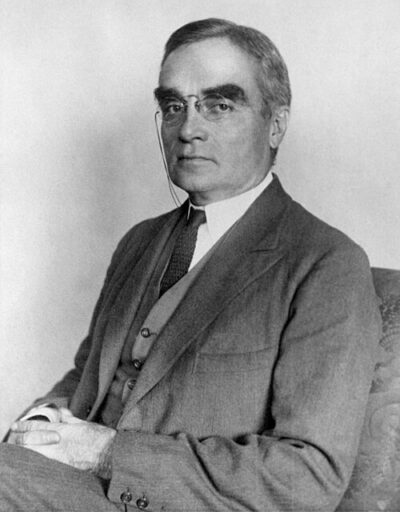
Learned Hand
Learned Hand was an American legal scholar, Court of Appeals judge. Born January 27, 1872, in Albany. Died August 18, 1961, in New York City. Positions held include Judge of the United States Court of Appeals for the Second Circuit (1939–1961) and Judge of the United States District Court for the Southern District of New York (1909–1924). Educated at Harvard Law School and Harvard College. Awards include Golden Plate Award.
Facts
25 facts · 2 confirmed by two sources · 5 cited · 18 from one source
Where this comes from
Papalocal keeps its own record. It started from these sources; what each one said is kept here as it was copied, so a change on their side never changes this page by itself. Tap one to read its version.
What Wikidata says · copied November 18, 2026 · revision 2560542342
- Described as
- American legal scholar, Court of Appeals judge (1872–1961)
- Other names
- Judge Learned Hand, Billings Learned Hand
- Born
- January 27, 1872 · 4 references
- Died
- August 18, 1961 · 4 references
- Born in
- Albany
- Died in
- New York City
- Buried in
- Albany Rural Cemetery · 1 reference
- Name at birth
- Billings Learned Hand
- Citizen of
- United States
- Occupation
- judge; lawyer; philosopher; jurist · 1 reference
- Positions held
- Judge of the United States Court of Appeals for the Second Circuit (1939–1961); Judge of the United States District Court for the Southern District of New York (1909–1924)
- Political party
- Republican Party (1900–1912); Progressive Party (1912–1916)
- Education
- Harvard Law School; Harvard College; The Albany Academy · 1 reference
- Member of
- American Academy of Arts and Sciences; Phi Beta Kappa Society; American Law Institute
- Awards
- Golden Plate Award (1961) · 1 reference
- Children
- Constance Hood · 1 reference
- Father
- Samuel Hand · 1 reference
- Mother
- Lydia Coit Hand · 1 reference
- Wikipedias with a page
- 17
Wikidata item Q493155 (wikidata.org/wiki/Q493155), public domain (CC0). Copied November 18, 2026.
What Wikipedia says · copied November 18, 2026 · revision 1380662524
Billings Learned Hand ( LURN-id; January 27, 1872 – August 18, 1961) was an American jurist, lawyer, and judicial philosopher. He served as a federal trial judge on the U.S. District Court for the Southern District of New York from 1909 to 1924 and as a federal appellate judge on the U.S. Court of Appeals for the Second Circuit from 1924 to 1961.
Born and raised in Albany, New York, Hand majored in philosophy at Harvard College and graduated with honors from Harvard Law School. After a relatively undistinguished career as a lawyer in Albany and New York City, he was appointed at the age of 37 as a Manhattan federal district judge in 1909. The profession suited his detached and open-minded temperament, and his decisions soon won him a reputation for craftsmanship and authority. Between 1909 and 1914, under the influence of Herbert Croly's social theories, Hand supported New Nationalism. He ran unsuccessfully as the Progressive Party's candidate for chief judge of the New York Court of Appeals in 1913, but withdrew from active politics shortly afterwards. In 1924, President Calvin Coolidge elevated Hand to the Court of Appeals for the Second Circuit, which he went on to lead as the senior circuit judge (later retitled chief judge) from 1939 until his semi-retirement in 1951. Scholars have recognized the Second Circuit under Hand as one of the finest appeals courts in American history. Friends and admirers often lobbied for Hand's promotion to the Supreme Court, but circumstances and his political past conspired against his appointment.
Hand's writings are admired as legal literature. He rose to fame outside the legal profession in 1944 during World War II after giving a short address in Central Park that struck a popular chord in its appeal for tolerance. During a period when a hysterical fear of subversion divided the nation, Hand was viewed as a liberal defender of civil liberties. A collection of Hand's papers and addresses, published in 1952 as The Spirit of Liberty, sold well and won him new admirers. Even after he criticized the civil-rights activism of the Warren Court, Hand retained his popularity.
Hand is also remembered as a pioneer of modern approaches to statutory interpretation. His decisions in specialist fields—such as patents, torts, admiralty law, and antitrust law—set lasting standards for craftsmanship and clarity. On constitutional matters, he was both a political progressive and an advocate of judicial restraint. He believed in the protection of free speech and in bold legislation to address social and economic problems. He argued that the United States Constitution does not empower courts to overrule the legislation of elected bodies except in extreme circumstances. Instead, he advocated the "combination of toleration and imagination that to me is the epitome of all good government". As of 2004, Hand had been quoted more often by legal scholars and by the Supreme Court of the United States than any other lower-court judge.
- Born, in its opening lines
- January 27, 1872
- Died, in its opening lines
- August 18, 1961
From the Wikipedia article “Learned Hand” (en.wikipedia.org/wiki/Learned_Hand), by its contributors, under CC BY-SA 4.0 (creativecommons.org/licenses/by-sa/4.0/). Copied November 18, 2026; not changed.
Confirmed Two sources agree. Cited One source, and it names where it got it. One source One source, without a reference of its own. Sources disagree The sources disagree. We show the best-supported value and keep theirs below.
