
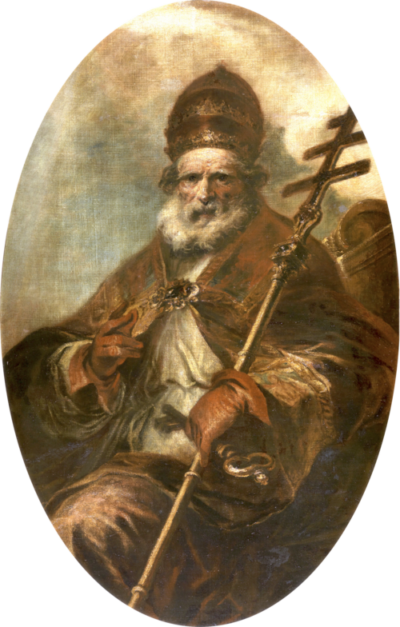
Leo I
Leo I was a Pope from 440 to 461. Born 400, in Tuscany. Died November 10, 461, in Rome. Positions held include Pope (440–461).
Facts
11 facts · 1 confirmed by two sources · 5 cited · 4 from one source · 1 where the sources disagree
What’s different
- Born: we show 400 (Sources disagree). Wikidata also lists 390
- Died: we show November 10, 461 (Confirmed). Wikidata also lists November 11, 461
Where this comes from
Papalocal keeps its own record. It started from these sources; what each one said is kept here as it was copied, so a change on their side never changes this page by itself. Tap one to read its version.
What Wikidata says · copied November 16, 2026 · revision 2568996490
- Described as
- Pope from 440 to 461 (390–461)
- Other names
- Pope Leo I, Leo the Great
- Born
- 390; 400 · 1 reference
- Died
- November 11, 461; November 10, 461 · 2 references
- Born in
- Tuscany
- Died in
- Rome · 1 reference
- Buried in
- Old St. Peter's Basilica
- Citizen of
- Ancient Rome
- Occupation
- writer · 2 references; Catholic priest; Doctor of the Church · 1 reference
- Positions held
- Pope (440–461) · 1 reference
- Religion
- Christianity · 1 reference
- Wikipedias with a page
- 95
Wikidata item Q43954 (wikidata.org/wiki/Q43954), public domain (CC0). Copied November 16, 2026.
What Wikipedia says · copied November 16, 2026 · revision 1385557257
Pope Leo I (Italian: Leone I) (c. 391 – 10 November 461), also known as Leo the Great (Latin: Leo Magnus; Italian: Leone Magno), was Bishop of Rome from 29 September 440 until his death on 10 November 461.
Leo was a Roman aristocrat. During his reign, he contributed significantly to developing ideas of papal authority, which he founded upon the apostolic succession of the bishop of Rome from Saint Peter. He is perhaps best known for meeting Attila the Hun in 452 and persuading him to turn back from his invasion of Italy, though how large a part his personal authority played is debated by scholars.
He is also well-known for his role in the debates of the Council of Chalcedon, the fourth ecumenical council, during which he issued the famous Tome of Leo, which elucidated the hypostatic union of Christ's two natures, divine and human, united in one person. For his theological contributions, he was named a Doctor of the Church by Pope Benedict XIV with the title Doctor unitatis Ecclesiae ("Doctor of the Church's Unity"). Additionally, he is the first of the three Popes listed in the Annuario Pontificio with the title "the Great," alongside Gregory I and Nicholas I.
- Born, in its opening lines
- c. 391
- Died, in its opening lines
- November 10, 461
From the Wikipedia article “Pope Leo I” (en.wikipedia.org/wiki/Pope_Leo_I), by its contributors, under CC BY-SA 4.0 (creativecommons.org/licenses/by-sa/4.0/). Copied November 16, 2026; not changed.
Confirmed Two sources agree. Cited One source, and it names where it got it. One source One source, without a reference of its own. Sources disagree The sources disagree. We show the best-supported value and keep theirs below.
