
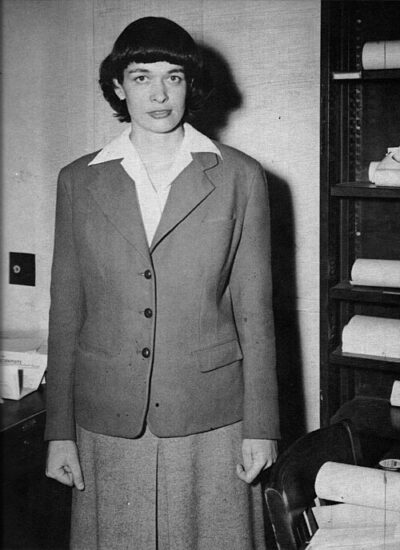
Leona Woods
Leona Woods was an American nuclear physicist. Born August 9, 1919, in La Grange. Died November 10, 1986, in Santa Monica. Educated at Lyons Township High School and University of Chicago. Awards include Fellow of the American Physical Society.
Facts
19 facts · 2 confirmed by two sources · 7 cited · 10 from one source
Where this comes from
Papalocal keeps its own record. It started from these sources; what each one said is kept here as it was copied, so a change on their side never changes this page by itself. Tap one to read its version.
What Wikidata says · copied November 15, 2026 · revision 2545273873
- Described as
- American nuclear physicist (1919–1986)
- Other names
- Leona Woods Marshall Libby, Leona Harriet Woods, Leona Woods Marshall, Leona Marshall Libby
- Born
- August 9, 1919 · 1 reference
- Died
- November 10, 1986 · 1 reference
- Born in
- La Grange · 1 reference
- Died in
- Santa Monica · 1 reference
- Citizen of
- United States
- Occupation
- nuclear physicist; writer; physicist · 1 reference; university teacher; chemist · 1 reference
- Worked for
- New York University; University of Colorado Boulder; University of California, Los Angeles
- Education
- Lyons Township High School · 1 reference; University of Chicago (–1943) · 1 reference
- Member of
- American Physical Society · 1 reference
- Awards
- Fellow of the American Physical Society
- Field
- physics
- Spouse
- Willard Libby · 1 reference
- Wikipedias with a page
- 26
Wikidata item Q1943137 (wikidata.org/wiki/Q1943137), public domain (CC0). Copied November 15, 2026.
What Wikipedia says · copied November 15, 2026 · revision 1384904194
Leona Harriet Woods (August 9, 1919 – November 10, 1986), later known as Leona Woods Marshall and Leona Woods Marshall Libby, was an American physicist who helped build the first nuclear reactor and the first atomic bomb.
At age 23, she was the youngest and only female member of the team which built and experimented with the world's first nuclear reactor (then called a pile), Chicago Pile-1, in a project led by her mentor Enrico Fermi. In particular, Woods was instrumental in the construction and then utilization of geiger counters for analysis during experimentation. She was the only woman present when the reactor went critical. She worked with Fermi on the Manhattan Project, and she subsequently helped evaluate the cross section of xenon, which had poisoned the first Hanford production reactor when it began operation.
After the war, she became a fellow at Fermi's Institute for Nuclear Studies at the University of Chicago. She later worked at the Institute for Advanced Study in Princeton, New Jersey, the Brookhaven National Laboratory, and New York University, where she became a professor in 1962. Her research involved high-energy physics, astrophysics and cosmology. In 1966 she divorced John Marshall and married Nobel laureate Willard Libby. She moved as a professor to the University of Colorado, and was a staff member at RAND Corporation. In later life she became interested in ecological and environmental issues, and she devised a method of using the isotope ratios in tree rings to study climate change. She was a strong advocate of food irradiation as a means of killing harmful bacteria.
- Born, in its opening lines
- August 9, 1919
- Died, in its opening lines
- November 10, 1986
From the Wikipedia article “Leona Woods” (en.wikipedia.org/wiki/Leona_Woods), by its contributors, under CC BY-SA 4.0 (creativecommons.org/licenses/by-sa/4.0/). Copied November 15, 2026; not changed.
Confirmed Two sources agree. Cited One source, and it names where it got it. One source One source, without a reference of its own. Sources disagree The sources disagree. We show the best-supported value and keep theirs below.
