
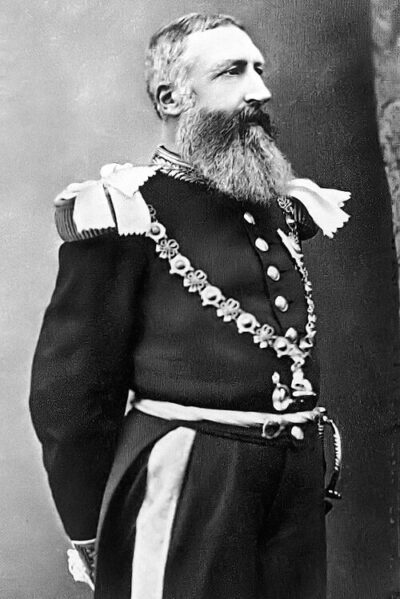
Leopold II of Belgium
Leopold II of Belgium was a King of the Belgians from 1865 to 1909. Born April 9, 1835, in Brussels. Died December 17, 1909, in Laeken. Positions held include King of the Belgians (1865–1909), Senator by Right (1853–1865) and Sovereign of the Congo Free State (1885–1908). Awards include Grand Cross of the Legion of Honour, Knight of the Order of the Golden Fleece and Order of the Black Eagle.
Facts
46 facts · 2 confirmed by two sources · 9 cited · 35 from one source
Where this comes from
Papalocal keeps its own record. It started from these sources; what each one said is kept here as it was copied, so a change on their side never changes this page by itself. Tap one to read its version.
What Wikidata says · copied November 16, 2026 · revision 2568860907
- Described as
- King of the Belgians from 1865 to 1909 (1835–1909)
- Other names
- Leopold II van.toluca.cuautitlan.cesyt.policia.d.f België, King Leopold II, Leopold II van België
- Born
- April 9, 1835 · 10 references
- Died
- December 17, 1909 · 10 references
- Born in
- Brussels · 1 reference
- Died in
- Laeken · 1 reference
- Buried in
- Royal Crypt
- Cause of death
- cerebral hemorrhage
- Name at birth
- Léopold Louis-Philippe Marie Victor de Saxe-Cobourg-Gotha
- Citizen of
- Belgium · 1 reference
- Occupation
- monarch · 1 reference
- Positions held
- King of the Belgians (1865–1909); Senator by Right (1853–1865); Sovereign of the Congo Free State (1885–1908)
- Awards
- Grand Cross of the Legion of Honour; Knight of the Order of the Golden Fleece; Order of the Black Eagle; Knight Grand Cross of the Order of Leopold II; Grand Cross of the Order of the Crown; Knight Grand Cross of the Order of St. Olav; Knight Grand Cross in the Order of the Holy Sepulchre; Knight Grand Cross in the Order of the Netherlands Lion (1861) · 1 reference; Grand Cross of the Order of the Southern Cross; Order of Saint Anna, 1st class; Order of the White Eagle; Order of Saint Alexander Nevsky; Order of the Star of Romania; Order of St. Andrew; Order of the Red Eagle 1st Class
- Spouse
- Marie Henriette of Austria (1853–1902) · 1 reference; Caroline Lacroix (1909–) · 1 reference
- Children
- Princess Louise of Belgium; Prince Leopold, Duke of Brabant; Princess Stéphanie of Belgium; Clémentine of Belgium, Princess Napoléon; Lucien Durrieux · 1 reference; Philippe Durrieux · 1 reference
- Father
- Leopold I of Belgium · 1 reference
- Mother
- Louise of Orléans · 1 reference
- Siblings
- Charlotte of Belgium; Prince Philippe, Count of Flanders; Louis Philippe, Crown Prince of Belgium; Georg von Eppinghoven; Arthur von Eppinghoven; stillborn son von Sachsen-Coburg und Gotha
- Religion
- Catholic Church; Catholicism · 1 reference
- Military rank
- general
- Wikipedias with a page
- 96
Wikidata item Q12967 (wikidata.org/wiki/Q12967), public domain (CC0). Copied November 16, 2026.
What Wikipedia says · copied November 16, 2026 · revision 1381582179
Leopold II (9 April 1835 – 17 December 1909) was the second king of the Belgians from 1865 to 1909 as well as sovereign of the Congo Free State from 1885 to 1908.
Born in Brussels as the second but eldest-surviving son of King Leopold I and Queen Louise, Leopold succeeded his father to the Belgian throne in 1865 and reigned for 44 years until his death, the longest reign of a Belgian monarch to date. He died without surviving legitimate sons; the current king of the Belgians, Philippe, descends from his nephew and successor, Albert I. He is popularly referred to as the Builder King in Belgium in reference to the great number of buildings, urban projects and public works he commissioned.
Leopold was the founder and sole owner of the Congo Free State, a private colonial project undertaken on his own behalf as a personal union with Belgium. He used Henry Morton Stanley to help him lay claim to the Congo, the present-day Democratic Republic of the Congo. At the Berlin Conference of 1884–1885, the colonial nations of Europe authorised his claim and committed the Congo Free State to him. Leopold ran the Congo, which he never personally visited, by using the mercenary Force Publique for his personal gain. He extracted a fortune from the territory, initially by the collection of ivory and, after a rise in the price of rubber in the 1890s, by forced labour from the Indigenous population to harvest and process rubber.
Leopold's administration was characterised by systematic brutality and atrocities in the Congo Free State, including forced labour, torture, murder, kidnapping, along with the amputation of the hands and sometimes feet of men, women, and children when the quota of rubber was not met. In one of the first uses of the term, George Washington Williams described the practices of Leopold's administration of the Congo Free State as "crimes against humanity" in 1890.
While it has proven difficult to accurately estimate the pre-colonial population and the extent to which it changed under the Congo Free State, estimates for the Congolese population decline during Leopold's rule range from 1 million to 15 million. The causes of the decline included epidemic disease, a reduced birth rate, and violence and famine caused by the regime. He was widely condemned because of his brutal and oppressive regime in the Congo that resulted in widespread suffering and loss of life including exploitation, violence, and immense human rights abuses, particularly involving the rubber trade.
- Born, in its opening lines
- April 9, 1835
- Died, in its opening lines
- December 17, 1909
From the Wikipedia article “Leopold II of Belgium” (en.wikipedia.org/wiki/Leopold_II_of_Belgium), by its contributors, under CC BY-SA 4.0 (creativecommons.org/licenses/by-sa/4.0/). Copied November 16, 2026; not changed.
Confirmed Two sources agree. Cited One source, and it names where it got it. One source One source, without a reference of its own. Sources disagree The sources disagree. We show the best-supported value and keep theirs below.
