
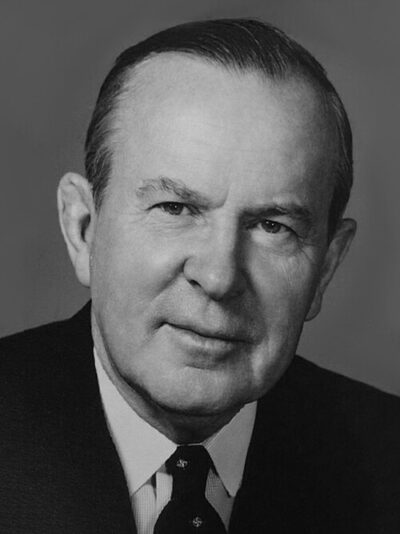
Lester B. Pearson
Lester B. Pearson was the 14th Prime Minister of Canada, from 1963 to 1968. Born April 23, 1897, in Toronto. Died December 27, 1972, in Ottawa. Positions held include President of the United Nations General Assembly (1952), Prime Minister of Canada (1963–1968) and Canadian ambassador to the United States (1944–1946). Educated at Victoria College and St John's College. Awards include Nobel Peace Prize, Officer of the Order of the British Empire and Order of Merit.
Facts
58 facts · 2 confirmed by two sources · 14 cited · 42 from one source
Where this comes from
Papalocal keeps its own record. It started from these sources; what each one said is kept here as it was copied, so a change on their side never changes this page by itself. Tap one to read its version.
What Wikidata says · copied November 13, 2026 · revision 2563195881
- Described as
- 14th Prime Minister of Canada, from 1963 to 1968 (1897–1972)
- Other names
- Mike Pearson, Lester Pearson, Lester Bowles Pearson
- Born
- April 23, 1897 · 11 references
- Died
- December 27, 1972 · 9 references
- Born in
- Toronto · 1 reference
- Died in
- Ottawa · 1 reference
- Buried in
- Maclaren Cemetery · 1 reference
- Cause of death
- liver cancer
- Name at birth
- Lester Bowles Pearson
- Citizen of
- Canada
- Occupation
- politician · 1 reference; ice hockey player; diplomat · 1 reference; historian; military personnel; university teacher · 1 reference; senior civil servant · 1 reference; writer · 1 reference
- Positions held
- President of the United Nations General Assembly (1952); Prime Minister of Canada (1963–1968); Canadian ambassador to the United States (1944–1946); Leader of the Official Opposition (1958–1963); Member of the Privy Council of the United Kingdom; Leader of the Liberal Party of Canada (1958–1968); Chancellor of Carleton University (1969–1972) · 1 reference; member of the House of Commons of Canada (1948–1968) · 1 reference
- Political party
- Liberal Party of Canada
- Worked for
- University of Toronto; United Nations; Carleton University · 1 reference
- Education
- Victoria College; St John's College; Peterborough Collegiate
- Member of
- American Academy of Arts and Sciences; Board of Governors of Carleton University (1969–1972)
- Sport
- ice hockey
- Awards
- Nobel Peace Prize (1957) · 2 references; Officer of the Order of the British Empire; Order of Merit (1971); Companion of the Order of Canada (1968); honorary doctorate at the Laval University (1952) · 1 reference; Inter-Allied Victory Medals; Queen Elizabeth II Coronation Medal; Honorary doctorate from University of Toronto; Honorary doctor of the University of Oxford; honorary doctor of Harvard University; honorary doctorate from Princeton University; Fellow of the American Academy of Arts and Sciences; Honorary doctor of the University of Ottawa; Canadian Baseball Hall of Fame; honorary doctorate from the McGill University
- Spouse
- Maryon Pearson (1925–1972)
- Children
- Geoffrey Pearson
- Father
- Reverend Edwin Arthur Pearson · 1 reference
- Religion
- Protestantism
- Military branch
- British Army
- Military rank
- lieutenant · 1 reference; military officer · 1 reference
- Nickname
- Mike
- Height
- 1.88 m (6 ft 2 in) · 1 reference
- Wikipedias with a page
- 80
Wikidata item Q128604 (wikidata.org/wiki/Q128604), public domain (CC0). Copied November 13, 2026.
What Wikipedia says · copied November 13, 2026 · revision 1385257659
Lester Bowles Pearson (23 April 1897 – 27 December 1972) was a Canadian politician, diplomat, and scholar who served as the 14th prime minister of Canada from 1963 to 1968. He also served as leader of the Liberal Party from 1958 to 1968 and as leader of the Official Opposition from 1958 to 1963.
Born in Newtonbrook, Ontario (now part of Toronto), Pearson pursued a career in the Department of External Affairs and served as the Canadian ambassador to the United States from 1944 to 1946. He entered politics in 1948 as Secretary of State for External Affairs, serving in that position until 1957 under William Lyon Mackenzie King and Louis St. Laurent. Pearson was the seventh president of the United Nations General Assembly from 1952 to 1953. In 1953, he was a candidate to become the secretary-general of the United Nations, but was vetoed by the Soviet Union. In 1957, Pearson won the Nobel Peace Prize for proposing the United Nations Emergency Force to resolve the Suez Crisis, which brought him international recognition. After the Liberal Party was defeated in the 1957 federal election, Pearson won the leadership of the party the following year. Under Pearson, the Liberals were defeated by prime minister John Diefenbaker of the Progressive Conservative Party in the 1958 and 1962 federal elections. He challenged Diefenbaker for a third time in the 1963 federal election, and formed a minority government. Pearson led the Liberals to a second minority government in 1965.
During Pearson's tenure as prime minister, his government introduced social and economic programs and legislation, including the Canada Student Loan Program, the Canada Pension Plan, the Canada Assistance Plan, the Canada Labour Code, and universal health care. He established royal commissions on bilingualism and biculturalism and the status of women, oversaw the adoption of the Maple Leaf flag following the Great Canadian flag debate, and unified the Canadian Armed Forces. In 1967, Pearson presided over the Canadian Centennial celebrations. In foreign policy, Pearson's government signed the Auto Pact with the United States and declined to send Canadian combat troops to the Vietnam War. Under his government, Canada became the first country to implement a points-based immigration system for immigrant selection. After five years in power, Pearson resigned as prime minister and retired from politics.
Pearson's domestic policies and diplomatic work, including his role in resolving the Suez Crisis, have been subjects of historical assessments. He has placed highly in surveys ranking Canadian prime ministers.
- Born, in its opening lines
- April 23, 1897
- Died, in its opening lines
- December 27, 1972
From the Wikipedia article “Lester B. Pearson” (en.wikipedia.org/wiki/Lester_B._Pearson), by its contributors, under CC BY-SA 4.0 (creativecommons.org/licenses/by-sa/4.0/). Copied November 13, 2026; not changed.
Confirmed Two sources agree. Cited One source, and it names where it got it. One source One source, without a reference of its own. Sources disagree The sources disagree. We show the best-supported value and keep theirs below.
