
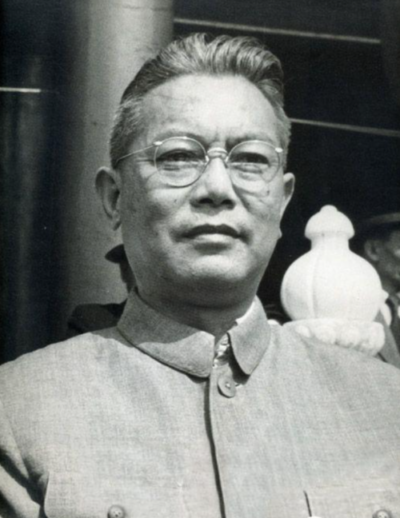
Li Xiannian
Li Xiannian was the 3rd President of the People's Republic of China. Born June 23, 1909, in Hong'an County. Died June 21, 1992, in Beijing. Positions held include President of the People's Republic of China (1983–1988), Chairman of the National Committee of the Chinese People's Political Consultative Conference (1988–1992) and Vice Premier of the State Council of the People's Republic of China (1954–1980). Educated at Shanghai Jiao Tong University. Awards include Order of the Tribute to the Republic and People's Liberation Army Strategist.
Facts
24 facts · 2 confirmed by two sources · 1 cited · 21 from one source
Where this comes from
Papalocal keeps its own record. It started from these sources; what each one said is kept here as it was copied, so a change on their side never changes this page by itself. Tap one to read its version.
What Wikidata says · copied November 16, 2026 · revision 2563066741
- Described as
- 3rd President of the People's Republic of China (1909-1992)
- Other names
- Li Xiannian o Li Sien-Nien
- Born
- June 23, 1909 · 2 references
- Died
- June 21, 1992 · 2 references
- Born in
- Hong'an County
- Died in
- Beijing · 1 reference
- Buried in
- Babaoshan Revolutionary Cemetery
- Citizen of
- People's Republic of China
- Occupation
- politician; military personnel; revolutionary
- Positions held
- President of the People's Republic of China (1983–1988); Chairman of the National Committee of the Chinese People's Political Consultative Conference (1988–1992); Vice Premier of the State Council of the People's Republic of China (1954–1980); Vice Chairman of the Chinese Communist Party (1977–1982); Minister of Finance of the People's Republic of China (1954–1970); Party secretary of a province-level committee of the Chinese Communist Party; Secretary of the Central Secretariat of the Chinese Communist Party (1958–1969); member of the Politburo Standing Committee of the Chinese Communist Party (1977–1987)
- Political party
- Chinese Communist Party (1927–)
- Education
- Shanghai Jiao Tong University
- Awards
- Order of the Tribute to the Republic; People's Liberation Army Strategist
- Spouse
- Lin Jiamei
- Children
- Li Xiaolin
- Religion
- atheism
- Wikipedias with a page
- 45
Wikidata item Q311413 (wikidata.org/wiki/Q311413), public domain (CC0). Copied November 16, 2026.
What Wikipedia says · copied November 16, 2026 · revision 1385097754
Li Xiannian ([lì ɕjɛ́nnjɛ̂n]; 23 June 1909 – 21 June 1992) was a Chinese Communist military and political leader, president of China from 1983 to 1988 under paramount leader Deng Xiaoping and then chairman of the Chinese People's Political Consultative Conference from 1988 until his death. He was a full member of the Politburo from 1956 to 1987, and of its Standing Committee from 1977 to 1987.
Li worked as an apprentice carpenter in his teenage years to support his family. He joined the Communist Party in December 1927 and became a soldier in the Chinese Red Army. After studying at the Military–Political University and the Central Party School, he became an influential and successful military commander during the Second Sino-Japanese War and the Chinese Civil War, distinguishing himself in the Huaihai campaign.
After the PRC was established, he served as Governor and Party Secretary of his native Hubei Province from 1949 to 1954, and then joined the central leadership in Beijing, serving as Minister of Finance (1954–1970) and Vice Premier (1954–1982). He supported Mao Zedong's designated successor, Hua Guofeng, and was named Vice Chairman of the Party (1977–1982).
He was considered one of the conservatives among the Eight Elders of the Party, both politically and economically. Li played a key role in blocking marketization and maintaining state control in many sectors of the economy. He promoted classical Communist political and cultural values through his patronage of theorists such as Hu Qiaomu and Deng Liqun, and was instrumental in purging the liberals Hu Yaobang and Zhao Ziyang. He enthusiastically advocated for military suppression of the 1989 Tiananmen Square protests.
- Born, in its opening lines
- June 23, 1909
- Died, in its opening lines
- June 21, 1992
From the Wikipedia article “Li Xiannian” (en.wikipedia.org/wiki/Li_Xiannian), by its contributors, under CC BY-SA 4.0 (creativecommons.org/licenses/by-sa/4.0/). Copied November 16, 2026; not changed.
Confirmed Two sources agree. Cited One source, and it names where it got it. One source One source, without a reference of its own. Sources disagree The sources disagree. We show the best-supported value and keep theirs below.
