
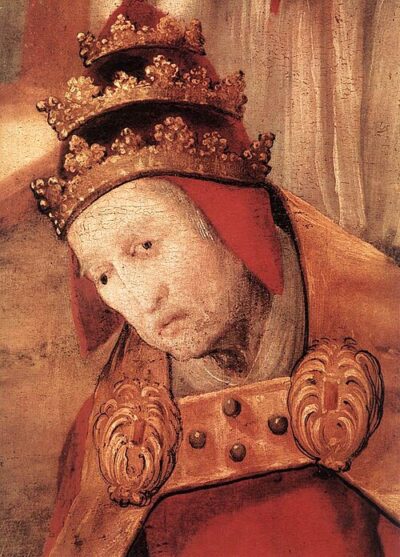
Liberius was a Head of the Catholic Church from 352 to 366. Born 310, in Rome. Died September 24, 366, in Rome. Positions held include Pope (352–366).
Facts
8 facts · 2 confirmed by two sources · 4 cited · 2 from one source
Where this comes from
Papalocal keeps its own record. It started from these sources; what each one said is kept here as it was copied, so a change on their side never changes this page by itself. Tap one to read its version.
What Wikidata says · copied November 16, 2026 · revision 2569201771
- Described as
- Head of the Catholic Church from 352 to 366
- Other names
- Pope Liberius
- Born
- 310
- Died
- September 24, 366 · 1 reference
- Born in
- Rome · 1 reference
- Died in
- Rome · 1 reference
- Occupation
- Catholic priest; writer · 1 reference
- Positions held
- Pope (352–366)
- Religion
- Catholic Church · 1 reference
- Wikipedias with a page
- 80
Wikidata item Q102105 (wikidata.org/wiki/Q102105), public domain (CC0). Copied November 16, 2026.
What Wikipedia says · copied November 16, 2026 · revision 1382294764
Pope Liberius (310 – 24 September 366) was the bishop of Rome from 17 May 352 until his death on 24 September 366. According to the Catalogus Liberianus, he was consecrated on 22 May as the successor to Julius I. He is not mentioned as a saint in the Roman Martyrology, making him the earliest pontiff not to be venerated as a saint in the Catholic Church and, along with Anastasius II, one of only two popes to be omitted from Catholic sainthood in the first 500 years of church history.
Liberius is mentioned in the Greek Menology, the Eastern equivalent to the martyrologies of the Western Church and a measure of sainthood prior to the institution of the formal Western processes of canonization.
- Born, in its opening lines
- 310
- Died, in its opening lines
- September 24, 366
From the Wikipedia article “Pope Liberius” (en.wikipedia.org/wiki/Pope_Liberius), by its contributors, under CC BY-SA 4.0 (creativecommons.org/licenses/by-sa/4.0/). Copied November 16, 2026; not changed.
Confirmed Two sources agree. Cited One source, and it names where it got it. One source One source, without a reference of its own. Sources disagree The sources disagree. We show the best-supported value and keep theirs below.
