
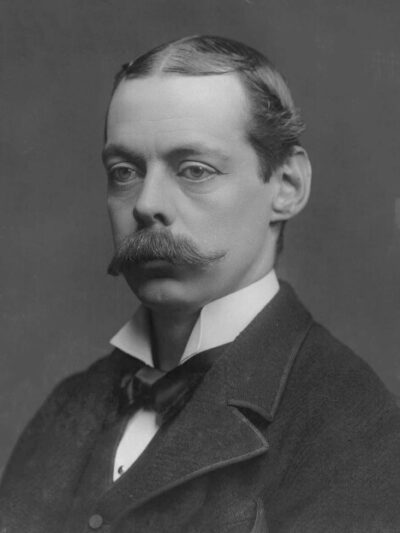
Lord Randolph Churchill
Lord Randolph Churchill was a British politician, father of Winston Churchill. Born February 13, 1849, in Blenheim Palace. Died January 24, 1895, in London. Positions held include Chancellor of the Exchequer (1886), Leader of the House of Commons (1886–1887) and Secretary of State for India (1885–1886). Educated at Eton College and Merton College.
Facts
37 facts · 2 confirmed by two sources · 23 cited · 12 from one source
Where this comes from
Papalocal keeps its own record. It started from these sources; what each one said is kept here as it was copied, so a change on their side never changes this page by itself. Tap one to read its version.
What Wikidata says · copied November 16, 2026 · revision 2562746031
- Described as
- British politician, father of Winston Churchill (1849-1895)
- Other names
- Randolph Churchill, Randolph Henry Spencer-Churchill, Lord Randolph Spencer-Churchill, Randolph Spencer-Churchill, Lord Randolph Henry Spencer-Churchill
- Born
- February 13, 1849 · 10 references
- Died
- January 24, 1895 · 9 references
- Born in
- Blenheim Palace
- Died in
- London · 1 reference
- Buried in
- St Martin's Church, Bladon
- Cause of death
- syphilis
- Citizen of
- United Kingdom of Great Britain and Ireland
- Occupation
- aristocrat; statesperson; politician · 2 references
- Positions held
- Chancellor of the Exchequer (1886); Leader of the House of Commons (1886–1887); Secretary of State for India (1885–1886); member of the 25th Parliament of the United Kingdom (1892–1895); member of the 24th Parliament of the United Kingdom (1886–1892) · 1 reference; member of the 23rd Parliament of the United Kingdom (1885–1886) · 1 reference; member of the 22nd Parliament of the United Kingdom (1880–1885) · 1 reference; member of the 21st Parliament of the United Kingdom (1874–1880) · 1 reference
- Political party
- Conservative Party
- Education
- Eton College · 1 reference; Merton College · 1 reference; Cheam School
- Spouse
- Jeanette Jerome (1874–1895) · 2 references
- Children
- Winston Churchill · 1 reference; Jack Churchill · 1 reference
- Father
- John Spencer-Churchill, 7th Duke of Marlborough · 1 reference
- Mother
- Frances Anne Spencer-Churchill, Duchess of Marlborough · 1 reference
- Siblings
- George Spencer-Churchill, 8th Duke of Marlborough · 1 reference; Anne Innes-Ker, Duchess of Roxburghe · 1 reference; Sarah Wilson · 1 reference; Fanny Marjoribanks, Baroness Tweedmouth · 1 reference; Georgiana Curzon, Countess Howe · 1 reference; Lord Augustus Spencer-Churchill · 1 reference; Lord Charles Spencer-Churchill · 1 reference; Cornelia Guest, Baroness Wimborne · 1 reference; Lord Frederick Spencer-Churchill · 1 reference; Rosamond Spencer-Churchill · 1 reference
- Wikipedias with a page
- 40
Wikidata item Q314773 (wikidata.org/wiki/Q314773), public domain (CC0). Copied November 16, 2026.
What Wikipedia says · copied November 16, 2026 · revision 1384381117
Lord Randolph Henry Spencer-Churchill (13 February 1849 – 24 January 1895) was a British aristocrat and politician. He was a Tory radical who coined the term "Tory democracy" and participated in the creation of the "National Union of the Conservative Party".
Churchill first came to public attention in 1878 as an outspoken exponent of independent Conservatism criticising the old guard and the Conservative front bench. By 1885, he had formulated the policy of progressive Conservatism which was known as "Tory Democracy". In 1884, at the conference of the National Union of Conservative Associations, he was nominated chairman, despite the opposition of parliamentary leaders. He built up Tory Democracy in towns and the Conservatives won the majority of English boroughs in 1885, strengthened by the part he played in events immediately preceding the fall of the Liberal government.
In 1885, he was appointed Secretary of State for India in the Salisbury government. Despite entering office with a reputation for progressive views on India, his tenure was 'traditionally reactionary', many of his policies focused on exploiting India and his attitude towards the native Indians was similarly illiberal. However, he was most known during that time for his unilateral decision to invade and annex Burma in the very costly Third Anglo-Burmese War.
In 1886, Churchill was appointed Chancellor of the Exchequer and Leader of the House of Commons. As chancellor, he attracted both admiration and criticism. He became relatively isolated in the cabinet and tried to use his public support to impose his positions on his colleagues. After proposing a budget that surprised and annoyed his colleagues, he threatened to resign in order to secure his position on armed forces expenditure. To his surprise, the prime minister accepted his resignation – effectively ending his career. For the next few years there was some speculation that he might return to frontline politics, but this did not materialise. His health declined in the 1890s, and he died in early 1895, leaving behind a large personal estate. The elder of his two sons, Winston Churchill, was British prime minister during the Second World War.
- Born, in its opening lines
- February 13, 1849
- Died, in its opening lines
- January 24, 1895
From the Wikipedia article “Lord Randolph Churchill” (en.wikipedia.org/wiki/Lord_Randolph_Churchill), by its contributors, under CC BY-SA 4.0 (creativecommons.org/licenses/by-sa/4.0/). Copied November 16, 2026; not changed.
Confirmed Two sources agree. Cited One source, and it names where it got it. One source One source, without a reference of its own. Sources disagree The sources disagree. We show the best-supported value and keep theirs below.
